Learn about thermal grouting, an engineering technique that enhances structural stability by improving foundation quality and thermal properties.
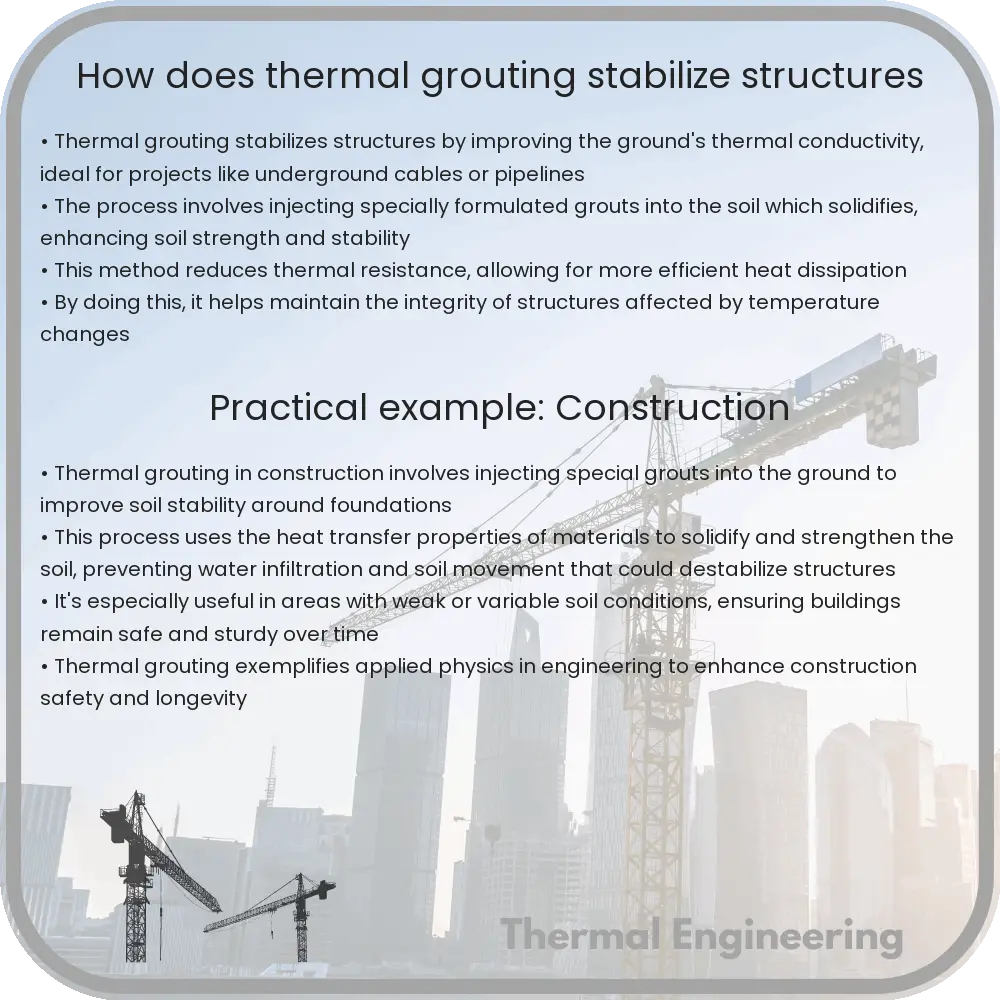
Understanding the Role of Thermal Grouting in Stabilizing Structures
Thermal grouting is a sophisticated engineering technique used to enhance the stability and durability of structures by improving their foundation. But what exactly is thermal grouting, and how does it help in stabilizing structures? This article demystifies the concept and explains its significance in modern engineering.
What Is Thermal Grouting?
Thermal grouting is a method that involves injecting specially designed grouts into the ground, around or under a structure, to strengthen its foundation or to modify the thermal properties of the substrate. This injected material can be a form of cementitious or chemical mixture depending on the ground condition and the intended outcome. The primary purpose of thermal grouting is to address issues related to ground stability, soil permeability, and thermal conductivity.
Key Applications of Thermal Grouting
- Stabilization: Thermal grouting helps in stabilizing loose or weak soils, which are incapable of supporting structures adequately. By filling voids and consolidating the soil, grouting increases the ground’s load-bearing capacity.
- Sealing: It also acts as a sealant to prevent water ingress, which can lead to soil erosion or freeze-thaw damage in colder climates.
- Thermal Enhancement: In projects requiring temperature control, such as underground cables or pipelines, thermal grouting improves the soil’s ability to conduct heat, thereby maintaining optimal temperature ranges.
How Does Thermal Grouting Work?
The process of thermal grouting involves several steps. First, assessment of the site and soil properties is conducted to determine the appropriate grout formulation and injection strategy. Following this, grout is pumped into pre-drilled holes at determined depths and spreads through the soil or rock layers. As the grout cures, it forms a solid mass, altering the physical and thermal characteristics of the foundation material.
- Site Assessment: Evaluating the geotechnical properties of the site to tailor the grouting composition and procedure.
- Grout Preparation: Mixing grout in accordance to the specific requirements of the project for optimum performance.
- Injection: Carefully pumping the grout into the ground through drilled holes at strategic locations and depths.
- Curing: Allowing time for the grout to harden, thereby integrating with the surrounding material to form an improved, unified ground structure.
Benefits of Thermal Grouting
Implementing thermal grouting offers numerous benefits:
- Increased Stability: By reinforcing soil particles and filling voids, thermal grouting significantly enhances the stability of the structure.
- Longevity: It helps in prolonging the life of a structure by mitigating issues like water damage and soil shifting, common causes of structural failures.
- Cost-effectiveness: Compared to more extensive foundation repairs or replacements, grouting is often a more economical choice.
- Environment-friendly: Modern grout materials are designed to be less invasive and more environmentally friendly compared to traditional methods.
Conclusion
Thermal grouting is an essential technique in the field of engineering, particularly when it comes to improving the stability and durability of structures. Utilizing specialized grout to reinforce soil or modify its properties ensures buildings, roads, and other infrastructures remain safe and functional over their expected lifespans. By understanding and applying these principles, engineers can effectively tackle challenges associated with unstable or inadequate ground conditions.