Exploring the role and components of Thermal Barrier Coatings (TBCs) in high-temperature industrial applications.
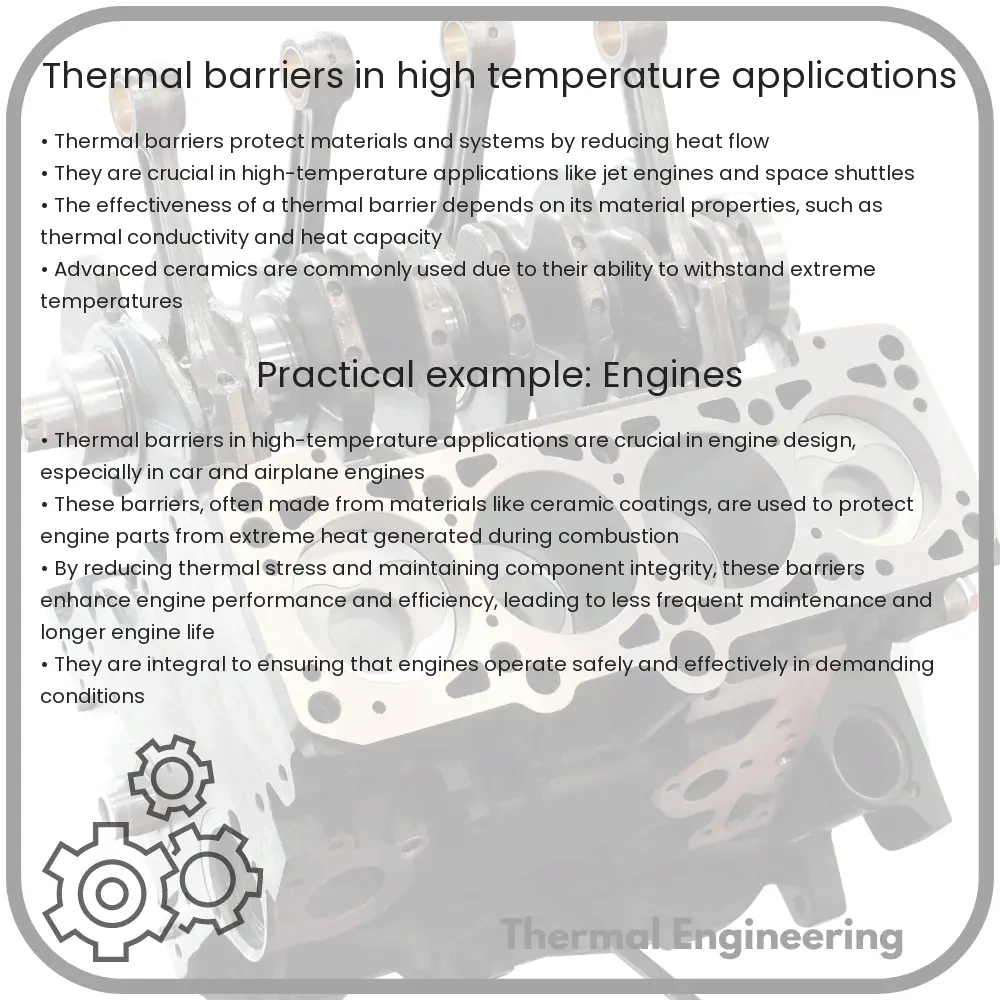
Understanding Thermal Barriers in High-Temperature Applications
In various engineering and industrial processes, controlling and managing heat is crucial. This is particularly important in high-temperature applications such as jet engines, power plants, or spacecraft re-entry systems. Thermal barrier coatings (TBCs) play a fundamental role in protecting underlying components from temperatures that could lead to failure due to melting, oxidation, or other forms of degradation.
What are Thermal Barrier Coatings?
Thermal barrier coatings are advanced materials applied to metallic surfaces operating in high-temperature environments. These coatings are designed to insulate and protect the underlying base materials from extreme heat exposures while maintaining structural integrity and functionality.
The primary material used in TBCs is typically a ceramic, owing to ceramics’ low thermal conductivity, high melting point, and stability under thermal cycling conditions. The most commonly used ceramic material is yttria-stabilized zirconia (YSZ). YSZ is preferred for its stability at high temperatures and its thermal expansion characteristics, which are somewhat similar to those of the metals commonly used in high-temperature applications.
Components of a Thermal Barrier Coating System
- Bond Coat: This is a metallic layer applied directly to the substrate. The bond coat helps to protect the base material from oxidation and corrosion, and improves the adhesion of the ceramic topcoat.
- Ceramic Topcoat: This is the outermost layer and is typically made of YSZ. The topcoat is the primary insulation layer that diffuses and reflects heat, thereby protecting the integrity of the structure beneath.
- Thermally Grown Oxide (TGO): This oxide layer forms at the interface between the bond coat and the ceramic layer during operation. It is primarily an alumina layer that grows as a result of the oxidation of the bond coat.
Application Methods
The application of TBCs involves high-technology processes that ensure the coat delivers its purpose effectively. The most common methods are:
- Electron Beam Physical Vapor Deposition (EB-PVD): This method is primarily used for producing TBCs that have a columnar grain structure. It provides excellent strain tolerance against thermal expansion and contraction.
- Air Plasma Spraying (APS): APS is a more cost-effective process compared to EB-PVD and is commonly used for applying the ceramic topcoat. It creates coatings with a non-directional grain structure which is beneficial for some applications.
Importance of Thermal Barrier Coatings
TBCs significantly enhance the efficiency and longevity of high-temperature systems. By allowing components to operate at higher temperatures without sustaining heat damage, these coatings enable improvements in efficiency, particularly in power generation and aerospace engines. Increased thermal efficiency directly correlates with reduced greenhouse gas emissions, aligning with global efforts towards more sustainable energy practices.
Moreover, the extension of component life due to reduced degradation from heat exposure decreases maintenance frequency and cost, which is vitally important in industries where high downtime costs are incurred, such as in aviation and energy production.
Challenges and Future Directions
Despite their advantages, TBCs face challenges such as thermal shock, sintering, and degradation due to CMAS (Calcium-Magnesium-Alumino-Silicate) infiltration. Emerging research in the development of new materials like gadolinium zirconate and innovations in application techniques aim to overcome these challenges, increasing the resilience and effectiveness of TBCs.
The continuous evolution of TBC technology promises not only to enhance the operational capabilities of high-temperature industrial applications but also to drive forward the efficiency and longevity of critical components across various sectors.