Learn about entropy generation minimization in engineering systems to enhance energy efficiency and system performance.
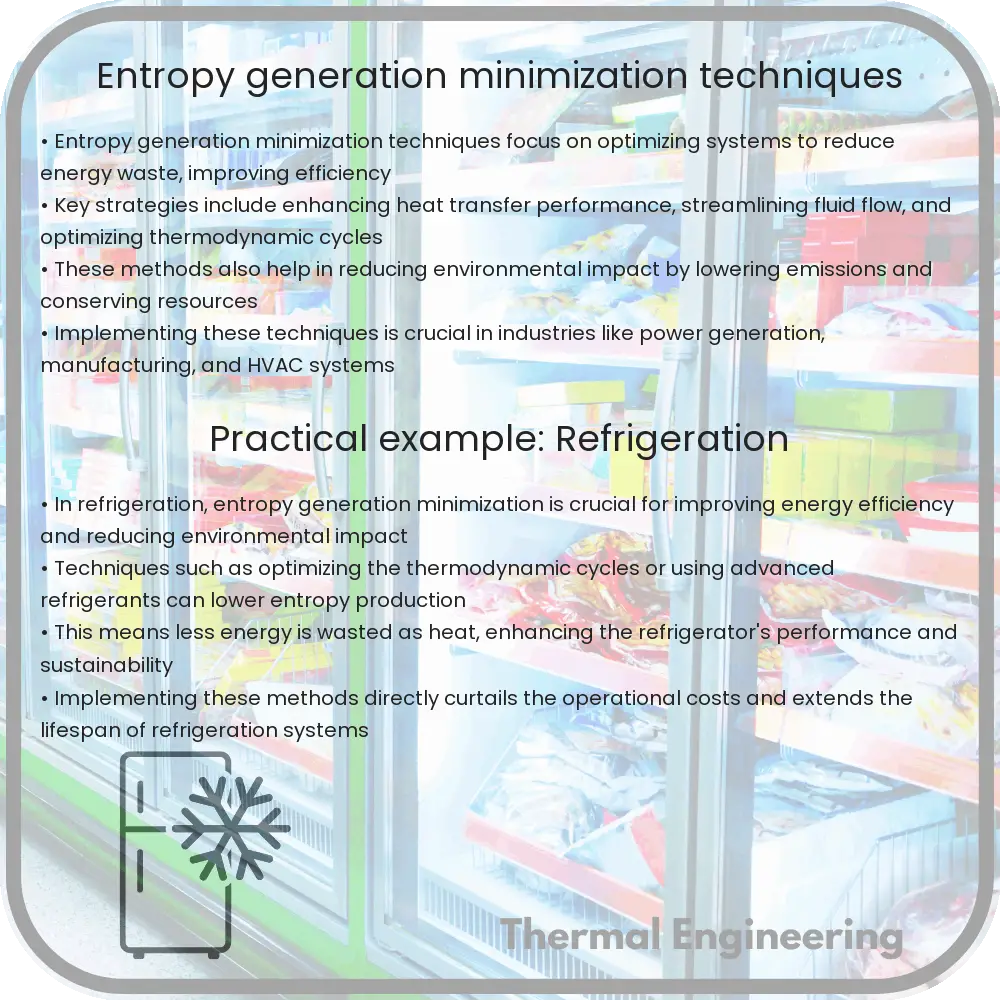
Understanding Entropy Generation Minimization Techniques
Entropy generation in engineering systems is a key concept that stems from the second law of thermodynamics. This law implies that during any process, the entropy (or disorder) of a system and its surroundings tends to increase. In engineering terms, minimizing entropy generation is crucial for enhancing the efficiency of energy systems. This article explores several techniques used to minimize entropy generation, thereby improving system performance and reducing energy waste.
Basic Concepts of Entropy
Entropy is a measure of the randomness or disorder in a system. The second law of thermodynamics states that the total entropy of an isolated system can never decrease over time. In practical applications, entropy generation refers to the loss of useful energy during a process, which results in less efficiency and more wastage of resources. Therefore, minimizing entropy generation is synonymous with optimizing energy use and enhancing system efficiency.
Techniques for Minimizing Entropy Generation
- Better Design and Optimization: One of the primary methods to reduce entropy generation is through the careful design and optimization of components and processes. This includes optimizing shapes and sizes of components, streamlining flow paths, and improving thermal insulation, all of which reduce irreversible losses.
- Utilization of Advanced Materials: The selection of materials with superior thermal properties can significantly cut down entropy production. Materials that can withstand higher temperatures and have lower rates of thermal conductivity help in preserving the energy levels in a system.
- Waste Heat Recovery: Implementing processes that capture and reuse waste heat can effectively decrease entropy generation. Techniques like regenerative heat exchangers or using waste heat for cogeneration can leverage energy that would otherwise be lost to the surroundings.
- Increasing Process Integration: Process integration involves redesigning adjacent or connected processes so that they operate more synergistically. For instance, using the output or waste from one process as the input for another reduces the total entropy generation across the system.
- Control Systems: Sophisticated control systems can significantly influence entropy generation. By precisely controlling the operational conditions such as temperature, pressure, and flow rates, systems can be maintained close to their optimum performance states, minimizing entropy production.
Mathematical Representation of Entropy Generation
The generation of entropy \( S_{gen} \) in a process can be quantified using the following general relationship:
\[ S_{gen} = \frac{Q}{T} \]
where \( Q \) is the heat transfer involved in the process and \( T \) is the absolute temperature at which the heat transfer occurs. This mathematical framework helps in quantifying the inefficiencies and identifying areas for improvement in any engineering system.
Case Studies and Real-world Applications
In real-world applications, minimizing entropy generation has led to significant advancements in power generation, automotive engines, refrigeration systems, and air conditioning units. By applying the above techniques, engineers have successfully designed systems that operate closer to thermodynamic ideal conditions, reducing energy costs and environmental impacts.
For example, modern gas turbines now incorporate advanced aerodynamic designs and cooling technologies to minimize entropy generation, thus improving their efficiency and operational lifespan. Similarly, in the automotive industry, improving engine design and employing waste heat recovery systems have resulted in more fuel-efficient vehicles with lower emissions.
Conclusion
Minimizing entropy generation is a vital consideration in the design and operation of any energy system. By understanding and implementing techniques to reduce entropy production, engineers can significantly enhance the efficiency, sustainability, and cost-effectiveness of these systems. This not only fulfills engineering goals but also contributes towards a greener and more sustainable environment. As technology progresses, entropy minimization will continue to play a crucial role in the development of innovative and efficient engineering solutions.