Learn how fluid coupling enhances smooth power transmission and cooling in automotive and industrial applications.
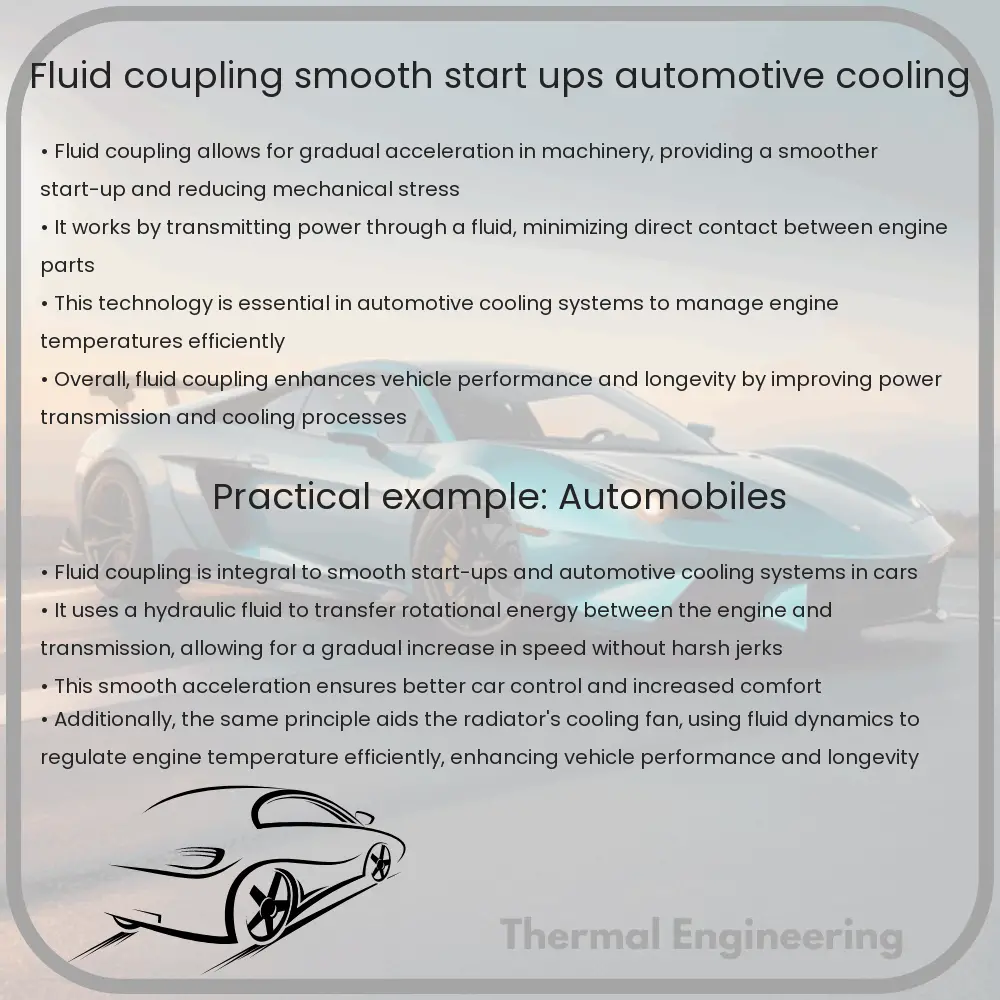
Understanding Fluid Coupling: Smooth Start-ups and Automotive Cooling
Fluid coupling is a fascinating component widely used in automotive and industrial applications to enable smooth transmission of rotational power. Essentially, it is a hydrodynamic device that uses a liquid medium to transmit torque between the shafts, providing a smooth, gradual acceleration and improving operational efficiency. Let’s break down how fluid couplings work and their role in various systems, particularly focusing on their use in smooth start-ups and automotive cooling systems.
How Fluid Coupling Works
A fluid coupling consists of three primary parts: the housing (also known as the shell), which is filled with fluid; an input shaft connected to an impeller (or pump); and an output shaft connected to a turbine. The impeller and the turbine sit facing each other with a slight gap and are enclosed inside the shell. The operation begins when the input shaft driven by an engine or motor causes the impeller to spin. As the impeller spins, it impels the fluid outward to the turbine blades, thereby transferring the torque to the output shaft.
The beauty of a fluid coupling is that it provides a variable torque depending on the speed. At low speeds, the fluid doesn’t transfer much torque, allowing for gentle and controlled acceleration. As the engine’s speed increases, the fluid is thrown outward with greater force, and more torque is transmitted to the output shaft, gradually ramping up to full speed and power.
Advantages of Using Fluid Couplings
- Smooth Start-ups: Fluid couplings allow for a soft start capability, reducing the stress on mechanical components. This is crucial in heavy machinery and automotive applications where sudden starts could lead to premature wear or failure of components.
- Load Balancing: They help distribute drive energy effectively when there are fluctuations in load, thereby safeguarding the engine and transmission system against shock loads and vibrations.
- Overload Protection: In a situation where a machine encounters a blockage, a fluid coupling will slip incrementally, which can limit the torque and prevent mechanical overload.
- Energy Efficiency: By matching the load requirements and the engine output efficiently, fluid couplings can contribute to better fuel efficiency and decreased operational costs.
Fluid Coupling in Automotive Cooling
In automotive applications, fluid couplings are particularly useful in managing engine heat. They are commonly used in cooling fans in vehicles. The coupling controls the fan speed, making it operational when the engine’s heat reaches a certain threshold. This operation is crucial because it ensures that the fan doesn’t run continuously but only when necessary, thus optimizing energy use and ensuring efficient cooling.
Conclusion
Fluid couplings play an integral role in enhancing the functionality and longevity of automotive and industrial machinery. By enabling smooth start-ups and efficient power transmission, while also contributing to vehicle cooling systems, they exemplify how a simple principle of fluid dynamics can be harnessed to solve complex engineering challenges. The application of fluid couplings across different sectors underlines their versatility and importance in the smooth operation of machinery.
For automobile owners, engineers, and machinery operators, understanding how fluid couplings work can provide insights into better vehicle maintenance practices and machinery management, ultimately leading to improved performance and reduced operational costs.