Learn about industrial ovens, their temperature control mechanisms, and design features essential for manufacturing efficiency and product quality.
Understanding Industrial Ovens: Temperature Control and Design Elements
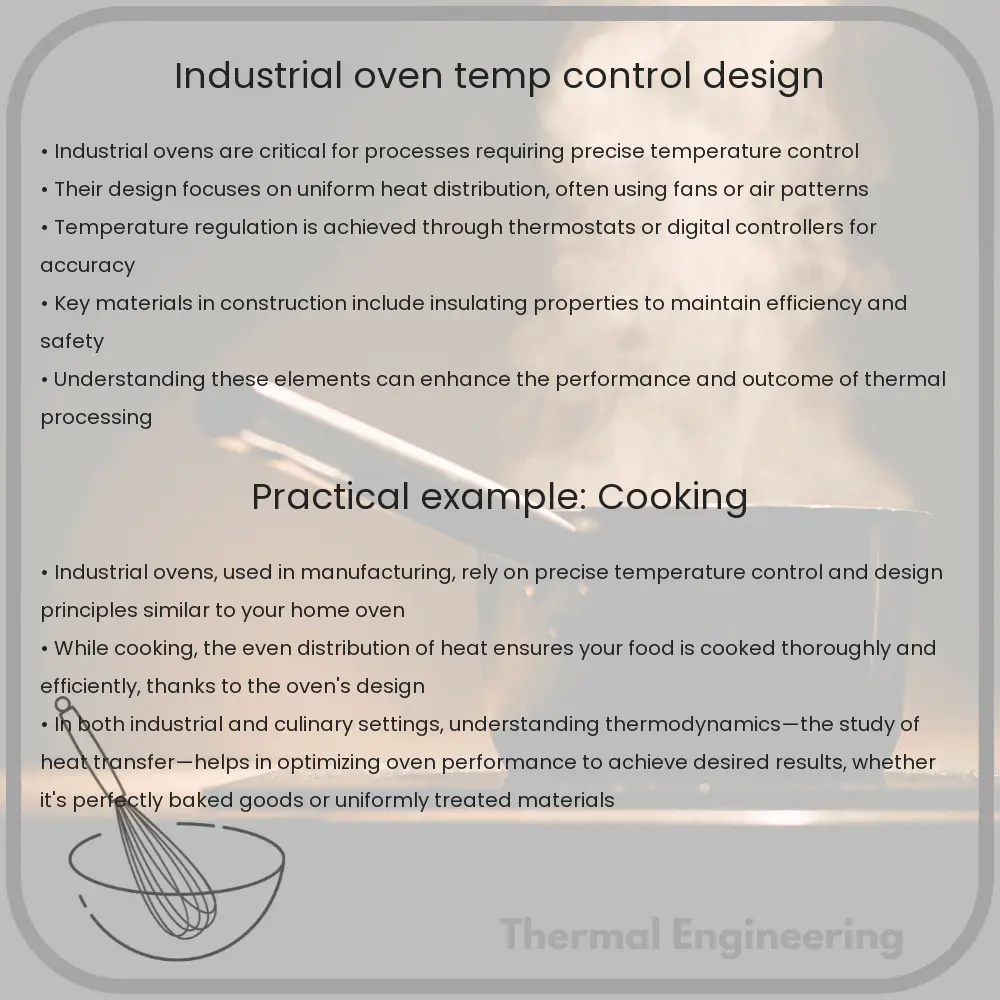
Industrial ovens are critical components in various manufacturing processes, where precise temperature control and efficient design play key roles in product quality and process efficiency. These ovens are used for a range of applications including drying, curing, baking, and heat treatment of materials and components. Understanding the fundamentals of their temperature control mechanisms and design features is essential for optimizing their operation and output.
Key Components of Temperature Control Systems
Temperature control in industrial ovens is essential for maintaining the integrity and quality of processed materials. It involves several key components:
- Thermostats: These are the primary devices used to set the desired temperature within the oven. They detect the internal temperature and turn the heat on or off to maintain the set point.
- Thermocouples: These sensors measure temperature at various points inside the oven to provide feedback for temperature adjustments, enhancing accuracy across the oven’s space.
- Controllers: Modern industrial ovens use PID (Proportional, Integral, Derivative) controllers that adjust the heating rate by calculating the difference between the desired and actual temperatures. The formula used is: ΔT = Tset – Tactual, where ΔT is the temperature difference, Tset is the set temperature, and Tactual is the current inside temperature.
These components work together to stabilize oven temperature and ensure uniform heating, which is crucial for process consistency and product quality.
Design Considerations for Industrial Ovens
The design of an industrial oven affects its performance, efficiency, and suitability for specific processes. Several design elements must be considered:
- Insulation: Proper insulation reduces heat loss, improves efficiency, and helps to maintain a uniform temperature inside the oven. Materials such as mineral wool or ceramic fiber are commonly used.
- Airflow: Efficient airflow design, including options for vertical or horizontal airflow, ensures uniform distribution of heat within the oven cavity. This is crucial for achieving even processing of materials.
- Size and Loading: The size of the oven should match the volume of goods to be processed. Additionally, the loading configuration (batch or continuous) impacts productivity and process flow.
- Material Handling: Integration with conveyance systems for loading and unloading can enhance process automation and reduce cycle times.
- Safety Features: Design features like emergency stops, over-temperature alarms, and fire suppression systems are critical for ensuring operational safety.
Applications of Industrial Ovens
Industrial ovens cater to a variety of industries and applications, reflecting their versatile design and control features. Common applications include:
- Electronics: For curing and drying processes in semiconductor manufacturing.
- Automotive: Heat treatments and finishing of automotive parts.
- Painting: Drying of coated surface materials to enhance finish durability.
- Aerospace: Composites curing and thermal treating of aerospace components.
Understanding the intricacies of temperature control and oven design helps in selecting the right industrial oven for specific applications, optimizing manufacturing processes, and ensuring high-quality outcomes. Whether for large-scale production or specialized manufacturing, the efficiency and effectiveness of these ovens play a critical role in industrial advancements and innovations.
Conclusion
Industrial ovens are more than just large heating chambers. They are complex systems designed with precise temperature controls and customized features tailored to meet specific industrial needs. A deep understanding of these systems allows for improved process efficiency, product quality, and operational safety, making them an indispensable part of modern manufacturing.