Learn about liquid crystals, their unique properties, and key applications in modern display technologies like LCDs.
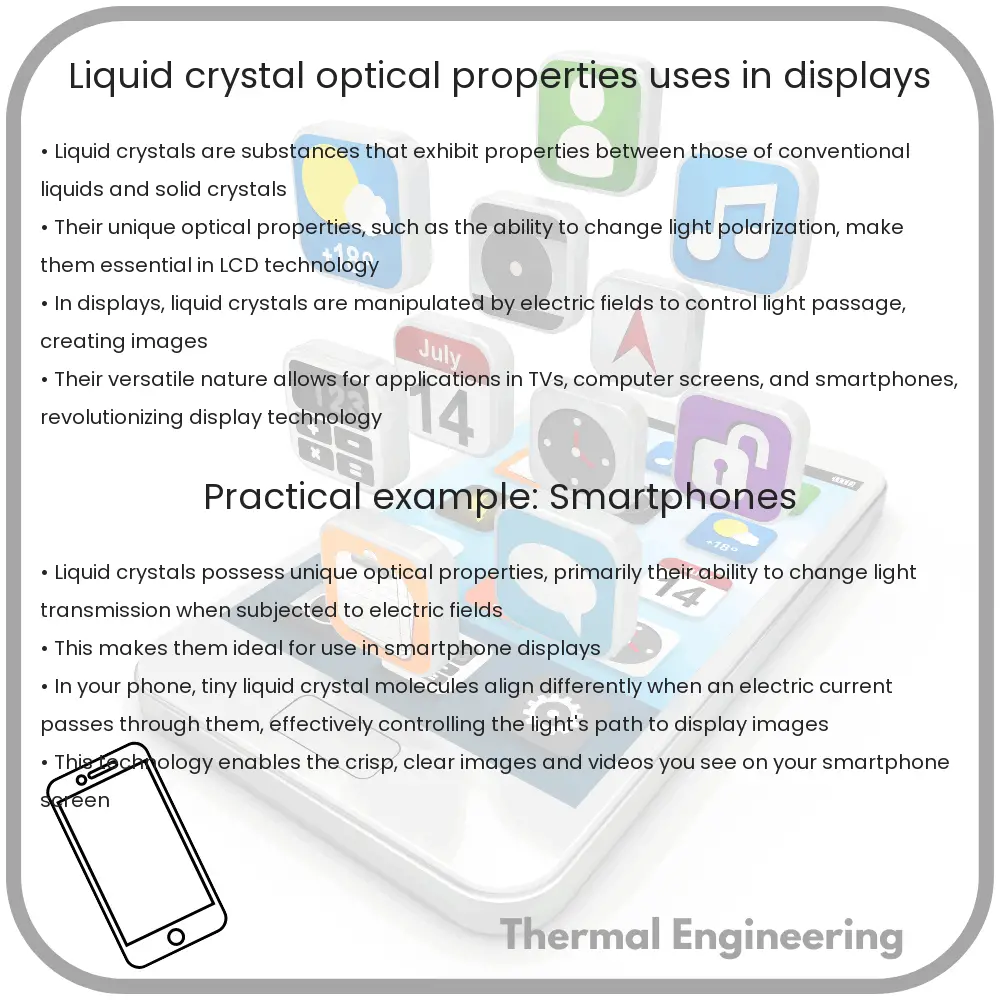
Introduction to Liquid Crystals
Liquid crystals are substances that exhibit a phase of matter that has properties between those of conventional liquids and solid crystals. For instance, a liquid crystal may flow like a liquid, but its molecules may be oriented in a crystal-like way. These unique properties make liquid crystals extremely useful in various applications, particularly in display technologies.
Optical Properties of Liquid Crystals
The unique optical properties of liquid crystals are primarily due to their ability to change the orientation of their molecules when exposed to electrical fields. This attribute is based on the fact that liquid crystals are anisotropic, meaning that their properties vary depending on the direction along which they are measured. This anisotropy affects how light interacts with the material, leading to phenomena such as birefringence, where a ray of light is split into two rays by the crystal, each traveling at different speeds.
Uses in Displays
Liquid crystal displays (LCDs) are the most common application of liquid crystal technology. The basic operation of an LCD is based on the manipulation of light in order to display images. Here’s a breakdown of how this is achieved:
- Structure: An LCD consists of several layers. These include two polarized panels with their lines arranged at 90 degrees to each other, a layer of liquid crystal, and electrodes that apply the necessary electrical field to the crystal layer.
- Operation: When an electric current flows through the liquid crystals, it changes their alignment and alters the way light travels through them. This process is used to increase or decrease light intensity at each pixel on the display.
- Color Production: To generate different colors, LCDs use a combination of red, green, and blue sub-pixels, which can be independently adjusted to produce a full spectrum of colors.
Advantages of Liquid Crystal Displays
LCDs have several advantages that make them suitable for a wide range of applications, including:
- Energy Efficiency: They require less power compared to other display technologies like cathode ray tubes (CRTs) and plasma displays, making them suitable for use in battery-powered electronic devices such as laptops and smartphones.
- Thin Profile: The structure of LCDs allows them to be much thinner than CRTs and other display technologies, which is ideal for portable devices and modern, slim televisions.
- Image Stability: LCDs do not flicker since each pixel is controlled by its own dedicated transistor, providing a stable image that is easier on the eyes.
Summary
Liquid crystals are fascinating materials characterized by their unique optical properties and practical usability in display technologies. Their ability to modulate light with high precision makes them indispensable in the manufacture of LCDs, which are prevalent in many of our everyday electronic devices. As technology progresses, the use and development of liquid crystals continue to expand, promising even more innovative applications in the future.