Explore the benefits and applications of Microchannel Heat Exchangers (MCHEs), innovative devices enhancing heat transfer efficiency in compact formats.
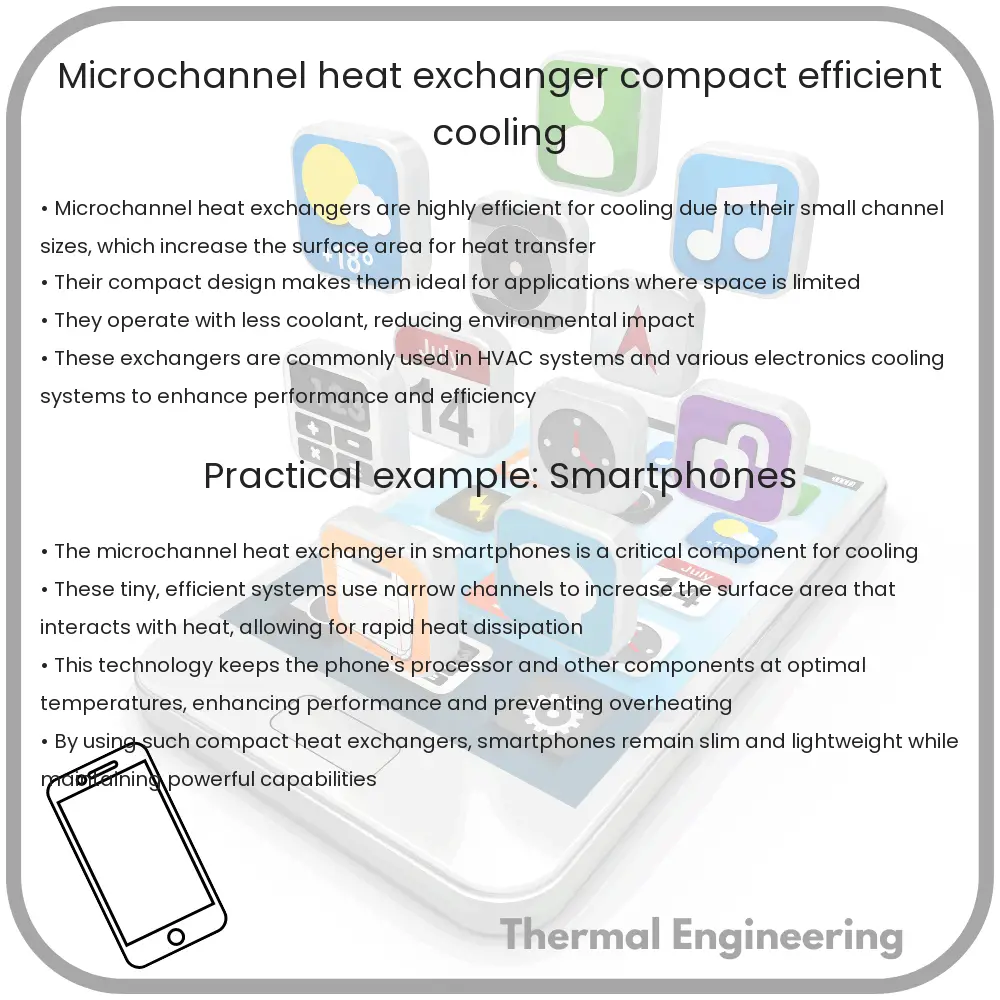
Understanding Microchannel Heat Exchangers: Compact and Efficient Cooling Solutions
Microchannel heat exchangers (MCHEs) represent a significant advancement in heat exchange technology, offering enhanced heat transfer capabilities in a compact package. Particularly prevalent in HVAC systems (Heating, Ventilation, and Air Conditioning) and various industrial applications, these exchangers are prized for their efficiency and size advantages.
What is a Microchannel Heat Exchanger?
A microchannel heat exchanger consists of multiple small channels that fluids pass through to transfer heat. They are fabricated using metals like aluminum, which combines lightweight with excellent thermal conductivity. The channels typically measure less than 1 mm in hydraulic diameter, allowing the exchanger to provide a high surface area to volume ratio, which significantly enhances the heat exchanger’s efficiency.
Design and Working of Microchannel Heat Exchangers
The design of MCHEs involves arrays of flat tubes containing the microchannels, and these are often layered with fins to further increase the surface area and thus the heat transfer rate. The working principle of a microchannel heat exchanger involves convective heat transfer and phase transition (boiling or condensation) of the working fluid within these microchannels.
When a hot fluid enters the microchannels, it comes into contact with the cooler surfaces of the channel walls, transferring its heat to the walls by convection. This transferred heat is then removed by another fluid (cooling fluid) flowing outside the microchannels or by air in the case of air-cooled MCHEs. The greatly increased surface area due to the micro-scale channels leads to more efficient heat transfer than traditional heat exchangers with larger channels.
Advantages of Microchannel Heat Exchangers
- High Efficiency: The small-scale channels in a microchannel heat exchanger provide a massive surface area for heat transfer, which significantly increases the heat transfer coefficient.
- Compact Size: Due to their high efficiency, MCHEs can be designed much smaller than traditional heat exchangers while achieving the same or even better cooling performance. This compactness is particularly valuable in applications where space is at a premium.
- Reduced Refrigerant Charge: Microchannel heat exchangers require less refrigerant volume than traditional systems, which not only reduces costs but also mitigates environmental impact.
- Lightweight: The use of aluminum and the reduced material volume needed both contribute to a lower overall weight, facilitating easier installation and maintenance.
- Cost-effective: The simplicity of their design and the lower quantities of raw materials needed make MCHEs cost-effective solutions particularly in mass production.
Applications of Microchannel Heat Exchangers
Microchannel heat exchangers are utilized in various sectors, highlighting their versatility and efficiency:
- Automotive: Used in radiators, condensers, and evaporators in automotive air conditioning systems.
- HVAC Systems: Employed in residential, commercial, and industrial HVAC systems to enhance energy efficiency and system performance.
- Power Electronics: Used in the cooling of power electronics, especially where high heat loads and compactness are critical factors.
- Aerospace: Perfect for aerospace applications due to their lightweight and compact design, helping to manage the thermal loads in aircraft and spacecraft efficiently.
In conclusion, microchannel heat exchangers exemplify how precise engineering and advancements in materials science can result in significantly improved performance in heat exchange technology. Their widespread adoption across various industries attests to their effectiveness in providing compact, efficient cooling solutions.