Learn about isothermal processes in gases, where temperature remains constant during system changes, essential in various engineering fields.
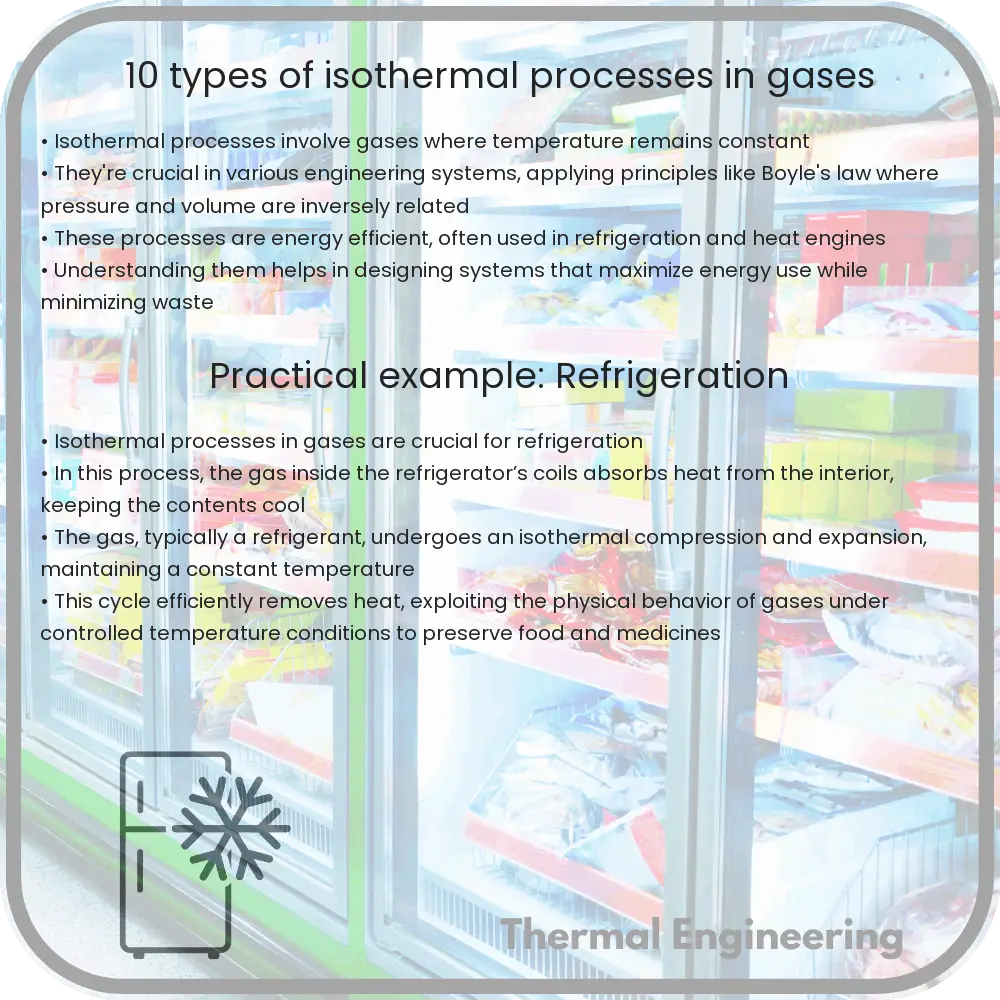
Understanding Isothermal Processes in Gases
An isothermal process in thermodynamics is a change in a system, in which the temperature remains constant. This occurs typically in systems involving gases where the system’s temperature is maintained through heating or cooling. Understanding different types of isothermal processes helps grasp how they are applied in various engineering disciplines like chemical engineering, mechanical engineering, and refrigeration. Here are 10 types of isothermal processes commonly encountered in gases:
1. Isothermal Compression in Refrigeration Cycles
- In refrigeration cycles, isothermal compression helps maintain the refrigerant at a constant temperature while it is being compressed by external work. This process is crucial for the efficiency of refrigeration and air-conditioning systems.
2. Isothermal Expansion in Heat Engines
- Ideal heat engines, such as the Carnot engine, utilize isothermal expansion to convert thermal energy into work. Here, the gas expands in a controlled manner at constant temperature, producing work against an external pressure.
3. Isothermal Gas Injection in Petroleum Engineering
- Used to maintain pressure in a reservoir, isothermal gas injection involves injecting gas at a constant temperature into an oil well to improve oil recovery through enhanced oil recovery methods.
4. Isothermal Gas Lifting
- This technique helps to increase the flow rate of fluids from a well. Injected gas reduces the overall fluid density in the tubing, allowing the fluid mixture to flow out of the well at constant temperature.
5. Isothermal Storage of Compressed Gases
- Storing gases like hydrogen and natural gas in tanks at constant temperature is essential to maintain gas integrity and volume. This process is vital for applications in fuel storage and transport.
6. Isothermal Battery Systems
- In advanced battery technologies, maintaining isothermal conditions during discharge and charge cycles can improve performance and longevity by avoiding thermal imbalances.
7. Molecular Sieve Regeneration in Isothermal Process
- Molecular sieves used to dry gas streams are regenerated under constant temperature conditions. This allows for the efficient removal of absorbed fluids without thermal degradation of the sieve material.
8. Isothermal Chemical Reactors
- Certain chemical reactions require maintaining the reactants and products at constant temperature for optimal reaction rates and yield. Isothermal reactors control the temperature to achieve these conditions.
9. Isothermal Fermentation
- In biochemical engineering, maintaining isothermal conditions during fermentation processes ensures uniform growth rates and metabolic activity, which is crucial for product consistency.
10. Laboratory Experiments and Calibration
- Various scientific experiments and calibration processes require gas behavior to be studied under constant temperature conditions to ensure accurate results and standards.
Conclusion
The concept of isothermal processes in gases encompasses a wide range of applications across many fields of engineering and science. Understanding these processes is crucial for designing systems that efficiently utilize the physical properties of gases, thereby enhancing performance and conserving energy. Whether in theoretical designs or practical applications, grasping the fundamentals of isothermal processes proves indispensable.