Learn about the various mechanisms of heat transfer essential in chemical engineering, such as conduction, convection, and radiation.
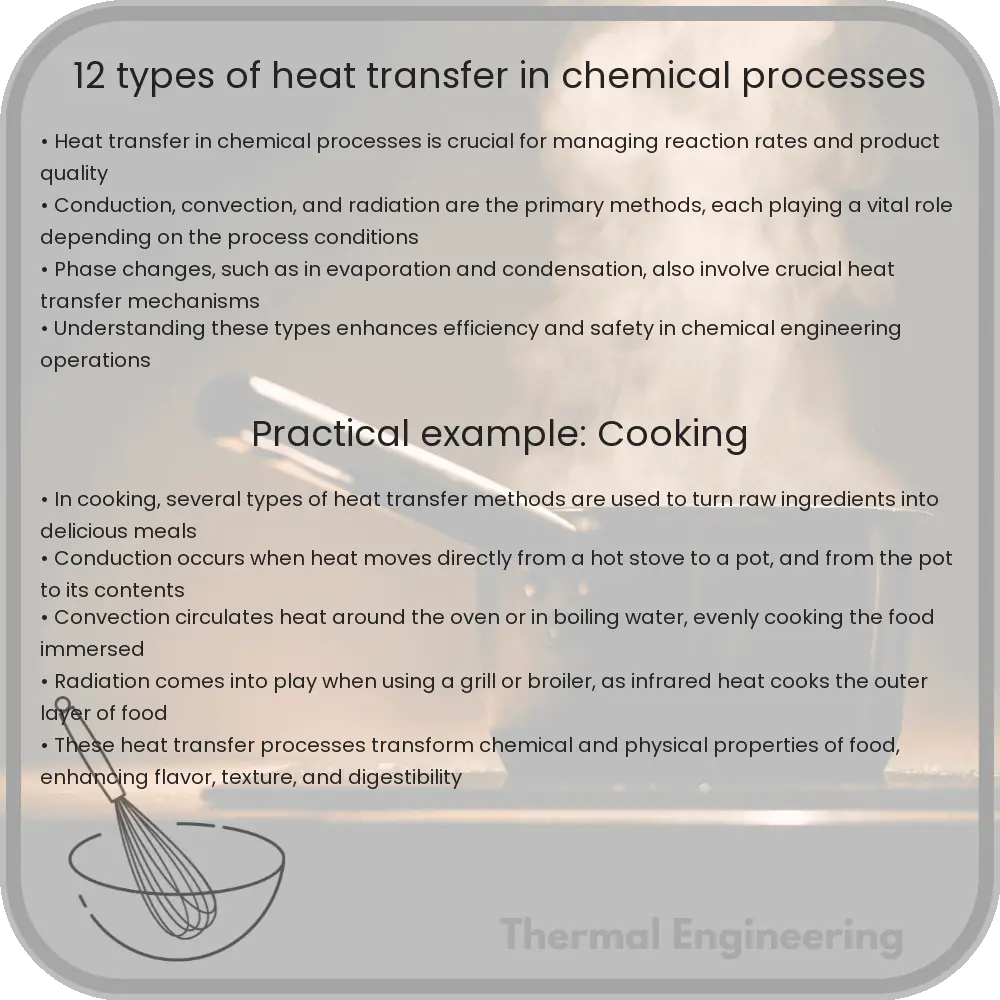
Understanding Heat Transfer in Chemical Processes
Heat transfer is a fundamental aspect of chemical engineering that involves the movement of thermal energy from one point to another. It plays a critical role in various chemical processes, affecting reaction rates, equipment design, energy efficiency, and safety. Here, we explore twelve types of heat transfer mechanisms commonly found in chemical engineering processes.
Conduction
Conduction refers to the transfer of heat through a solid or stationary fluid (liquid or gas) via the vibrations and movements of molecules and electrons. It is described by Fourier’s law:
\[ q = -k \nabla T \]
where \(q\) is the heat flux, \(k\) is the thermal conductivity, and \(\nabla T\) is the temperature gradient.
Convection
Convection is the transfer of heat by the physical movement of a fluid (which may include mixtures of gases and liquids). It can be natural, driven by buoyancy forces (due to density variations from temperature differences), or forced by external means (like pumps or fans).
Radiation
Radiation is the transfer of energy by electromagnetic waves. Every body emits radiation whose intensity depends on its temperature, according to the Stefan-Boltzmann law:
\[ E = \sigma T^4 \]
where \(E\) is the emissive power, \(\sigma\) is the Stefan-Boltzmann constant, and \(T\) is the absolute temperature.
Conductive Heat Transfer in Solids
- Direct Transmission: Heat moves through a solid directly from atom to atom or molecule to molecule.
- Heat Pipes: Utilize phase change and capillary action to transfer heat efficiently across distances within a device.
Convective Heat Transfer in Fluids
- Single-phase Convection: Involves heat being carried by a fluid in a single phase (either liquid or gas).
- Two-phase Convection: Occurs during boiling or condensation, where heat transfers include both the latent and sensible heat.
Radiative Heat Transfer
- Gaseous Radiation: Gas molecules emit and absorb electromagnetic radiation due to temperature differences.
- Surface Radiation: Surfaces emit radiation depending on their material properties and finish.
Heat Transfer in Combustion Processes
Heat is generated through chemical reactions, typically involving fossil fuels or biomass. This process releases thermal energy, which is then transferred by conduction, convection, and radiation.
Heat Transfer in Heat Exchangers
Heat exchangers are devices designed to transfer heat between two or more fluids at different temperatures. They play a crucial role in optimizing energy use in chemical processes.
Heat Transfer in Reactive Systems
Reactive systems, such as reactors, involve simultaneous reaction and heat transfer, making the dynamics complex but critical for controlling product quality and process stability.
Phase Change Heat Transfer
This involves heat transfer during phase changes (e.g., melting, freezing, vaporization, condensation), which includes the absorption or release of large amounts of latent heat.
Heat Transfer with Change of Pressure
Changes in pressure within a system can affect heat transfer rates, particularly in gas-mediated processes where compressibility is significant.
Heat Transfer in Distillation Columns
Heat management is essential in distillation processes to achieve efficient separation of compounds based on their volatilities via staged vaporization and condensation.
Each type of heat transfer plays its role in chemical engineering applications, and understanding these mechanisms is vital for designing efficient and safe processes. Mastery of heat transfer principles enables engineers to optimize the energy consumption and improve the overall effectiveness of chemical plants and processes.