Understanding and optimizing convective heat transfer enhancements for improved efficiency in engineering applications.
Introduction to Convective Heat Transfer Enhancements
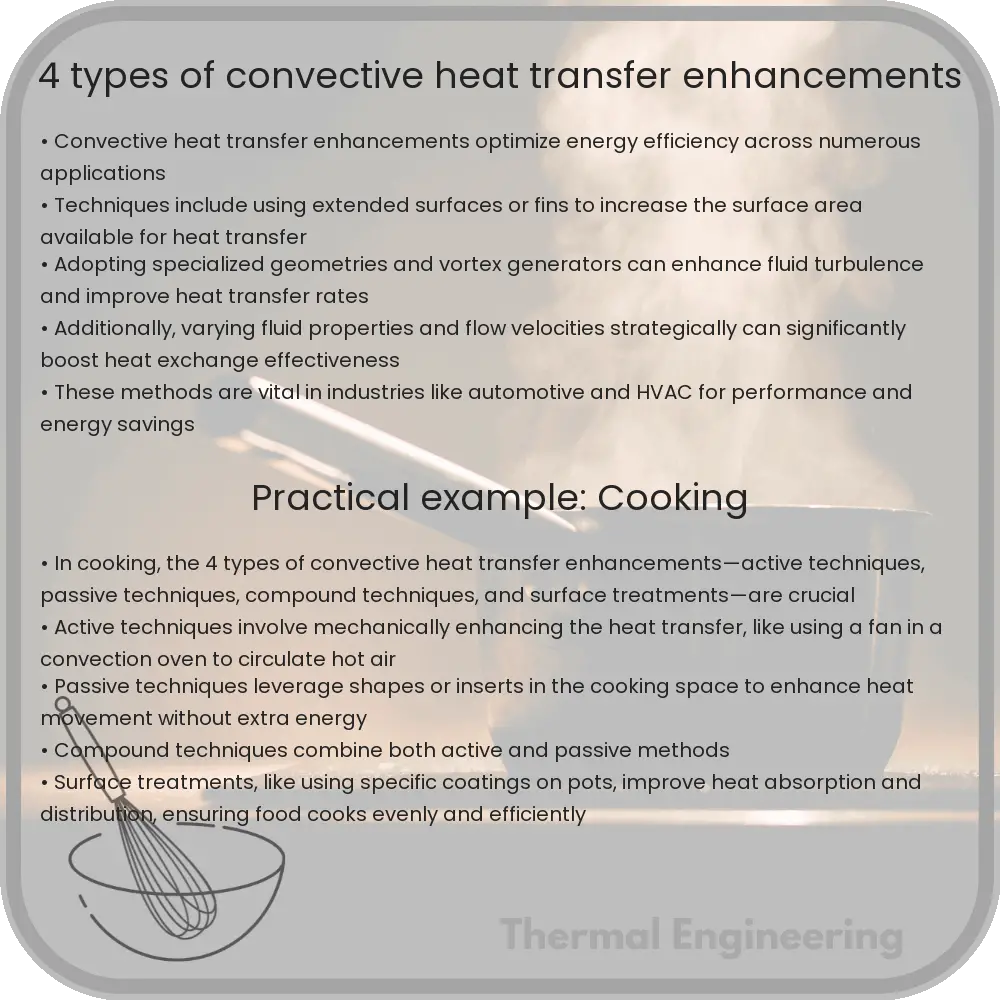
Convective heat transfer is a fundamental concept in engineering, representing the transport of thermal energy between a physical boundary and a moving fluid. Enhancing convective heat transfer can significantly improve the efficiency of various thermal processes in automotive, aerospace, electronics cooling, and HVAC applications. There are several techniques to augment the heat transfer rate, and understanding these can be crucial for optimal design and efficient energy use.
1. Active Enhancement Techniques
Active techniques involve external energy inputs to increase the convective heat transfer rate. This may include mechanical aids, surface vibration, fluid vibration, and electrostatic fields. Active methods often result in higher heat transfer coefficients but at the cost of additional energy consumption.
- Mechanical aids: Implementation of devices such as fans and stirrers that enhance the fluid motion relative to the heat transfer surface.
- Surface vibration: Applying oscillatory motions to the surface can disturb the boundary layer, enhancing the heat transfer rate.
- Fluid vibration: Oscillation of the fluid itself increases turbulence, thereby improving the thermal transport properties.
- Electrostatic fields: Using electric fields can enhance heat transfer in dielectric fluids by influencing fluid motion through dielectrophoresis or electrohydrodynamics.
2. Passive Enhancement Techniques
Unlike active techniques, passive methods do not require any external energy. They typically involve modifications to the heat transfer surface or the addition of special additives to the fluid. These changes usually increase the effective surface area or disrupt the flow to enhance mixing.
- Extended Surfaces: Incorporates fins or other geometric modifications to increase the surface area available for heat transfer.
- Rough surfaces: Introducing roughness elements on the surface breaks up laminar sublayers and increases turbulence, which enhances heat transfer.
- Displaced enhancements: Items like inserts or twisted tapes are used inside tubes to disrupt the core flow, increasing heat transfer effectiveness through better mixing.
- Additives for fluids: The addition of nanoparticles or fibers to the fluid can significantly alter the thermal conductivity and viscosity, enhancing the convective heat transfer.
3. Compound Techniques
Compound techniques combine active and passive methods to benefit from both approaches. An example is the use of a stirrer (active) along with fins (passive) within a system. The synergy from such combinations often leads to more significant enhancement than the sum of individual effects.
4. Geometric Optimization
Optimizing geometry, from the shape of the heat exchanging surfaces to the entire heat exchanger configuration, is a subtle yet powerful way to enhance convective heat transfer. Tailoring geometry can involve:
- Channel shaping: Modifying the channel geometry where the fluid flows can significantly affect flow patterns and heat transfer rates.
- Pinch points: Designing narrow passages in heat exchangers to increase the velocity at certain points, enhancing the local heat transfer rates.
- Swirl flow devices: Utilizing devices that induce a swirling motion in the fluid increases centrifugal forces and disrupts the boundary layer, hence increasing the heat transfer rate.
Conclusion
Enhancing convective heat transfer is pivotal in optimizing thermal systems, making them more energy-efficient and effective. Each of the methods discussed offers unique advantages and can be selected based on the application requirements, existing system design, and efficiency needs. By integrating these techniques thoughtfully, engineers can design more sophisticated and effective cooling and heating systems in various industrial applications.