Learn how heat transfer in oceans and seas via conduction, convection, radiation, and advection affects global climate and marine ecosystems.
Understanding Heat Transfer in Oceans and Seas
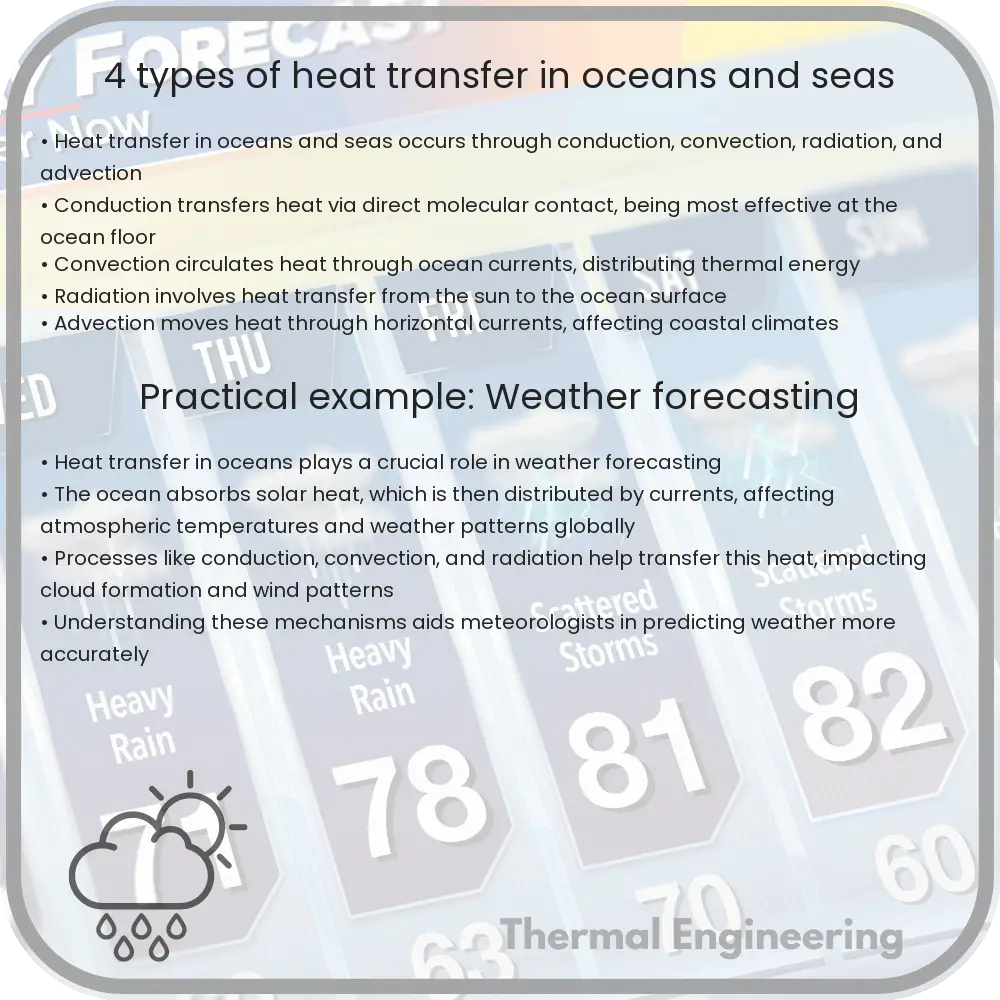
Heat transfer in oceans and seas is a fundamental aspect of understanding global climate systems, ocean currents, and weather patterns. There are four primary types of heat transfer mechanisms that play crucial roles in how heat is moved through these large bodies of water. These mechanisms are conduction, convection, radiation, and advection. Each type of heat transfer has unique characteristics that help explain the distribution of temperature and influence marine environments.
1. Conduction
Conduction is the process of heat transfer through direct contact. In the oceans, this occurs when water molecules at different temperatures come into contact with each other. Warmer water molecules vibrate more vigorously and transfer some of their kinetic energy to cooler neighboring molecules. Although conduction is generally slower in water than in solid materials, it still plays an integral role in the heat balance within the ocean layers.
2. Convection
Convection involves the movement of heat by the physical movement of fluid itself. In seas and oceans, convection currents are driven by the heating and cooling of water, combined with the effects of Earth’s rotation and other environmental factors. Warm water tends to rise because it is less dense, while cooler water sinks. This process can create convection currents that can distribute heat throughout different layers of the ocean. Convection is primarily responsible for the vertical movement of heat within the waters.
3. Radiation
Radiation refers to the transfer of energy through electromagnetic waves. In the context of oceans and seas, solar radiation is the most significant source. The sun radiates its energy through space to the Earth’s surface, including the oceans. Water absorbs this solar energy, which warms the surface layer. This energy is then gradually transferred downward within the ocean, though much of it is re-radiated back into the atmosphere or transferred to the poles.
4. Advection
Advection is the horizontal movement of heat by the flow of a fluid. In oceans, this is seen as large-scale movements of water masses, commonly known as ocean currents. These currents, such as the Gulf Stream in the Atlantic or the Kuroshio in the Pacific, carry warm waters from equatorial regions toward the poles and cold waters from the poles toward the equator. Advection plays a key role in regulating global climate by redistributing heat across the planet.
In conclusion, understanding the four types of heat transfer in oceans and seas—conduction, convection, radiation, and advection—provides insights into marine and atmospheric sciences. These heat transfer processes not only play crucial roles within the local marine environments but also affect global weather patterns and climate change dynamics. Knowing how these processes function helps scientists predict changes in Earth’s climate and informs conservation and management efforts for marine ecosystems.