Learn about orbital engines, a unique type of rotary engine that offers continuous motion and potential efficiency gains in various applications.
Introduction to Orbital Engines
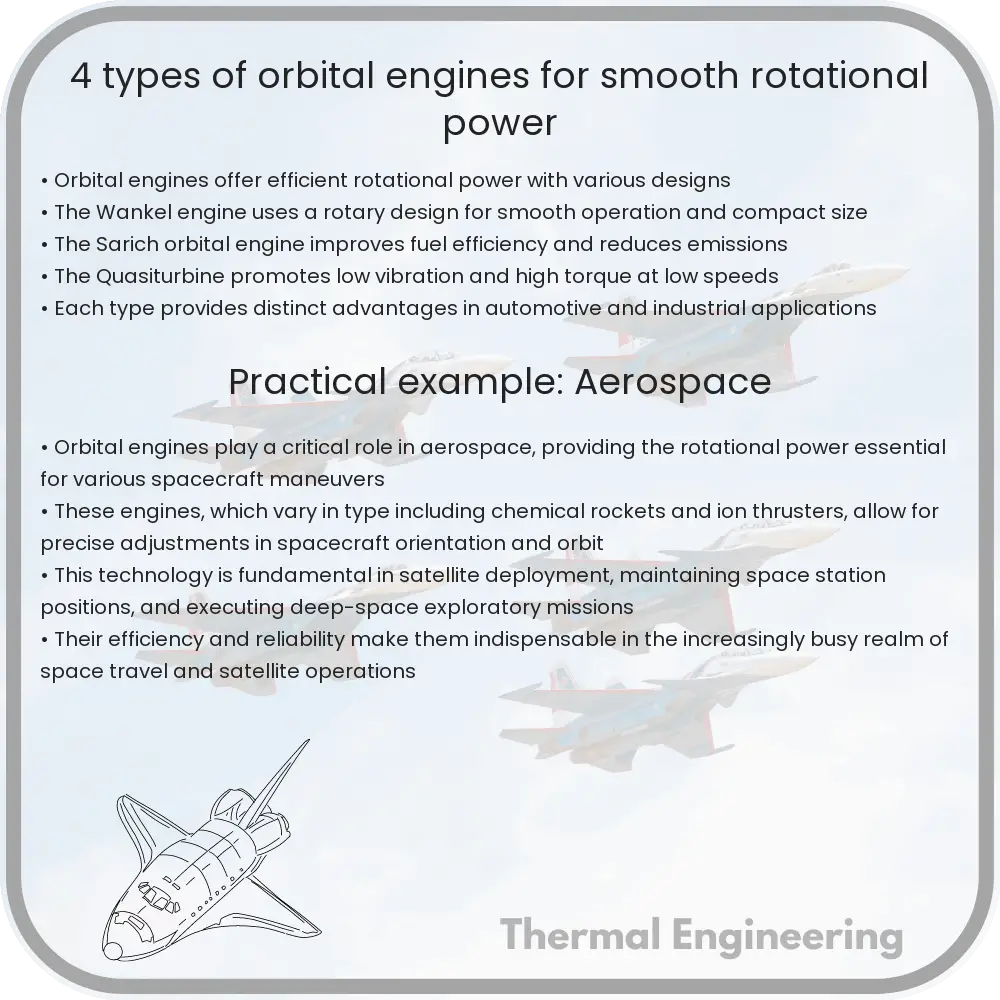
Orbital engines, a fascinating subcategory of rotary engines, stand out due to their unique mechanism that allows for continuous rotational motion. Distinct from the more well-known piston engines, orbital engines deliver power through a circular motion, offering enhanced smoothness and potential efficiency gains. This article explores four distinct types of orbital engines, each characterized by their specific design and application.
1. Wankel Rotary Engine
The Wankel engine is perhaps the most famous type of orbital engine, popularized by its use in automobiles like the Mazda RX series. Unlike conventional piston engines, the Wankel engine uses a rotor that orbits in an epitrochoidal motion inside a roughly oval-shaped housing. The engine’s design allows for three power pulses per rotor revolution, contributing to its compact size and smooth operation.
- Advantages: Compact, smooth power delivery, and lower number of moving parts.
- Disadvantages: Fuel efficiency and emissions can be problematic, often due to incomplete combustion.
2. Orbital Piston Engine
In an orbital piston engine, the pistons move in a circular path around a fixed crankshaft. This contrasts with traditional engines where the crankshaft rotates. This design reduces vibrations and tends to have a higher balance due to the circular motion of the pistons.
- Advantages: Reduced vibration and improved engine balance.
- Disadvantages: Complex mechanical design can lead to increased manufacturing and maintenance costs.
3. Sarich Orbital Engine
Developed by the Australian inventor Ralph Sarich, the Sarich orbital engine is another innovative variation. It uses an orbital combustion process and introduces a multi-chambered orbital design. The engine is known for its theoretical efficiency and potential to use multiple fuel sources.
- Advantages: Potential for high efficiency and multi-fuel capability.
- Disadvantages: Has not been widely adopted, suggesting possible practical or economic limitations.
4. LiquidPiston Engine
The LiquidPiston engine introduces a new approach by reversing the Wankel engine concept – the engine’s housing orbits around a stationary gear, with the shape of the housing being the epitrochoid. This design aims to address some typical drawbacks of the traditional rotary engines, such as sealing and thermal efficiency.
- Advantages: Improved thermal efficiency and sealing compared to traditional rotary engines.
- Disadvantages: Still under development, which limits current applications and real-world testing data.
Conclusion
Orbital engines offer an intriguing alternative to traditional piston engines, with various designs that improve on specific aspects of performance and efficiency. From automotive applications to potential uses in aerospace, these engines continue to inspire innovation and hold promise for future applications. While each type has its own set of challenges and benefits, the exploration of orbital engines underscores an ongoing pursuit for engineering solutions that are both effective and sustainable.