Understand vapor compression refrigeration cycles, used in cooling technologies like refrigerators and air conditioners, focusing on their components and efficiency.
Introduction to Vapor Compression Refrigeration Cycles
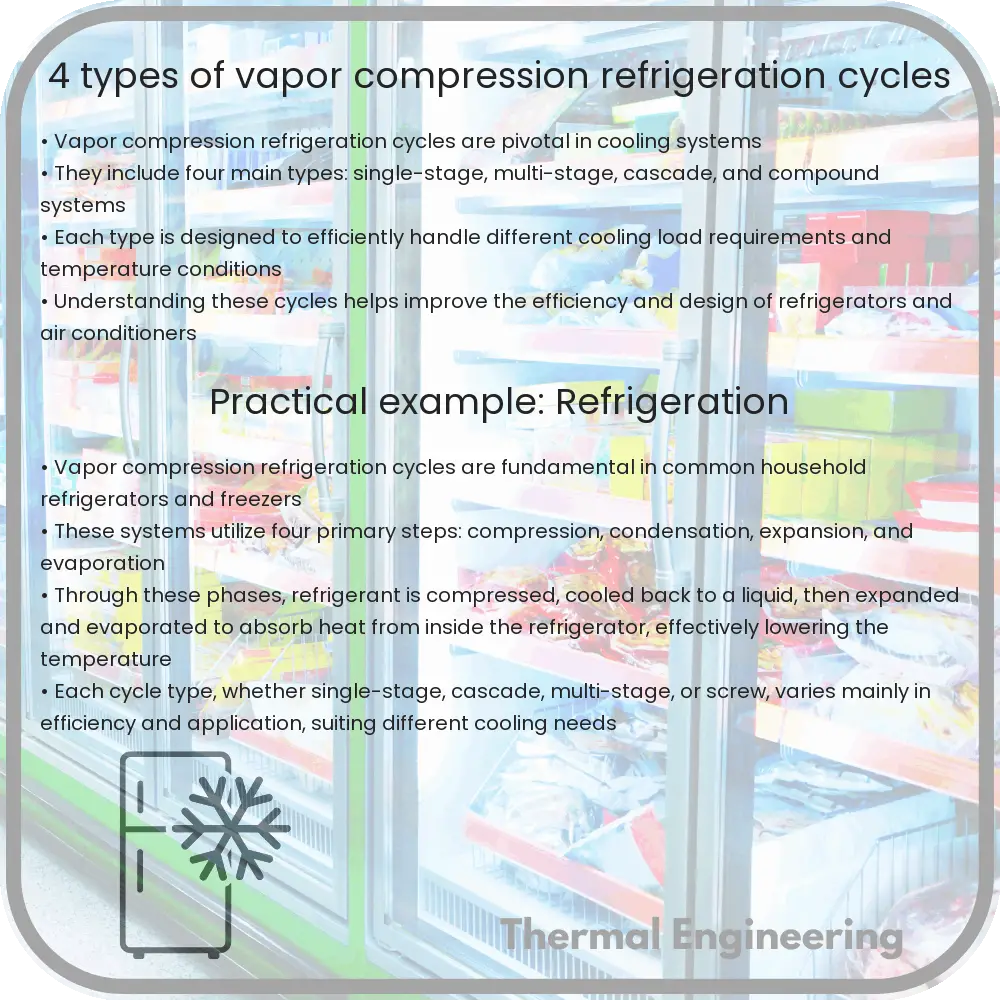
The vapor compression refrigeration cycle is a crucial method used in refrigerators, air conditioners, and heat pumps to transfer heat from one area to another. The process is based on the phase change of a refrigerant substance between its liquid and gaseous states. In this article, we will explore four common variants of the vapor compression refrigeration cycle and understand their applications and efficiencies.
1. Basic Vapor Compression Cycle
The basic vapor compression cycle involves four primary components: the compressor, condenser, expansion valve, and evaporator. The refrigerant flows through these components, undergoing various changes in state and pressure:
- Compression: The compressor pumps the refrigerant vapor under high pressure, raising its temperature.
- Condensation: The hot vapor then flows through the condenser where it releases heat to the surroundings and condenses into a high-pressure liquid.
- Expansion: This high-pressure liquid passes through an expansion valve, reducing its pressure and causing it to cool down rapidly.
- Evaporation: The low-pressure, cool liquid enters the evaporator where it absorbs heat from the environment and evaporates back into a vapor, thereby cooling the surrounding area.
2. Multi-stage Compression Cycle
In more complex systems, particularly where very low temperatures are needed, multi-stage compression cycles are used. These cycles incorporate multiple compressors and, in some cases, intercoolers between these compressors. The main purpose of using multiple compression stages is to improve the efficiency and capacity of the cycle:
- Intercooling: Between the stages, the refrigerant is cooled using an intercooler, which reduces the work required by subsequent compression stages.
- Phase Separation: An internal heat exchanger can also be included to provide subcooling and increase the cooling capacity.
3. Cascade Refrigeration Cycle
The cascade refrigeration cycle consists of two or more individual vapor compression cycles operating in series. Each cycle uses a different refrigerant and operates at a different temperature range, making the system suitable for applications requiring extremely low temperatures:
- High-Temperature Side: Operates like a standard vapor compression cycle.
- Low-Temperature Side: Uses the output from the high-temperature cycle to condense its refrigerant, allowing it to reach lower temperatures.
4. Economizer Cycle
The economizer cycle, also known as a subcooling cycle, adds an extra component called an economizer that increases the refrigeration effect without increasing the compressor’s work. This cycle is characterized by:
- Economizer: Diverts some of the high-pressure liquid refrigerant through an expansion valve into the economizer where it evaporates and cools the remaining high-pressure liquid.
- Improved Efficiency: This process effectively increases the cooling capacity and efficiency of the cycle by utilizing the same amount of compressor work more effectively.
Conclusion
Vapor compression refrigeration cycles come in various configurations, each designed to meet specific cooling requirements and efficiency standards. From simple household appliances to large-scale industrial systems, understanding these cycles helps in selecting the right refrigeration solution for your needs. Whether increasing the efficiency through multi-stage compression or achieving lower temperatures with cascade systems, these cycles form the backbone of modern refrigeration technology.