Learn about boundary layers in fluid mechanics, fundamental to understanding fluid flow phenomena in various engineering contexts.
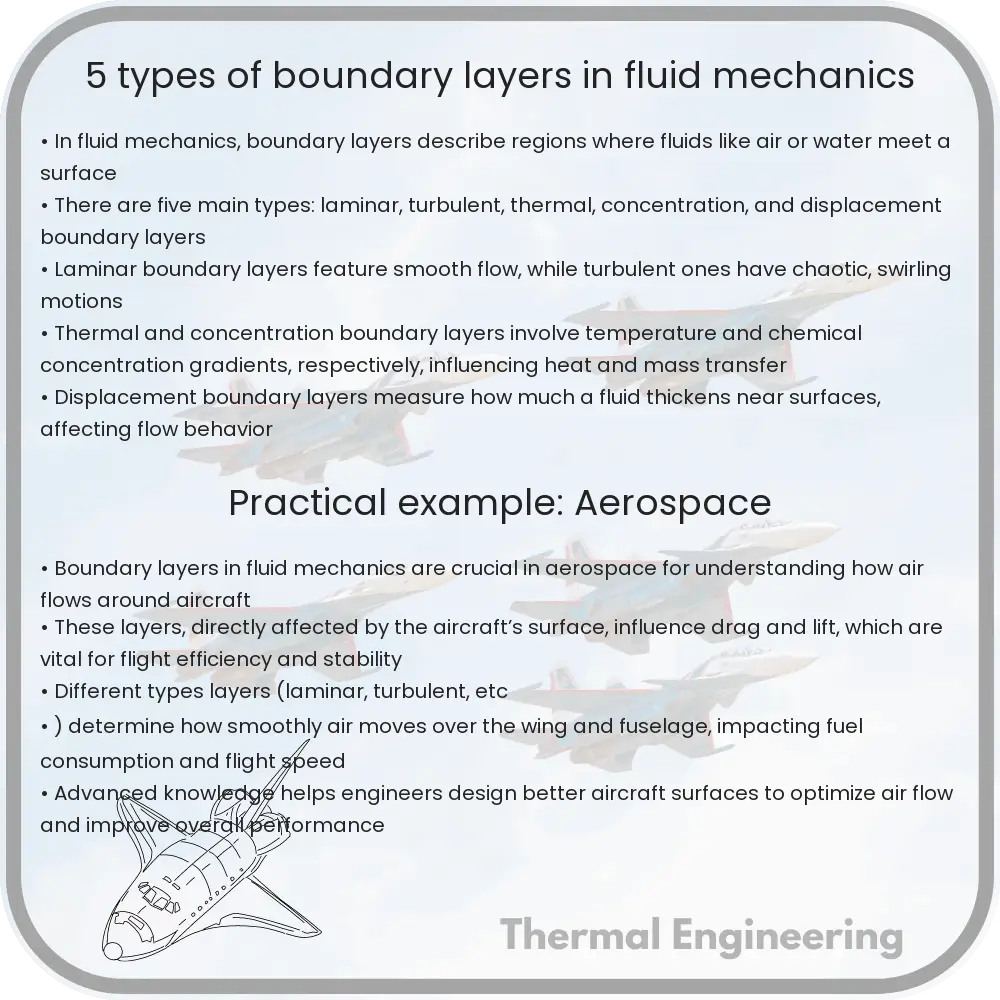
Introduction to Boundary Layers in Fluid Mechanics
In the study of fluid mechanics, the boundary layer is a fundamental concept describing the layer of fluid in the immediate vicinity of a bounding surface where effects of viscosity are significant. Here, we explore five types of boundary layers that are crucial in understanding different fluid flow phenomena around objects in engineering applications such as in aerodynamics, hydrodynamics, and within various fluid machinery.
1. Laminar Boundary Layer
A laminar boundary layer is characterized by the smooth, orderly flow of fluid particles where viscous forces are dominant. In this layer, fluid moves in parallel layers with no disruption between them. This type of flow typically occurs at lower Reynolds numbers (Re) and is significant in applications involving precision and minimal drag, such as in microfluidics. The transition from laminar to turbulent flow depends on factors like surface roughness, flow velocity, and fluid characteristics.
2. Turbulent Boundary Layer
Unlike the laminar layer, a turbulent boundary layer involves chaotic fluid motion where inertial forces overpower viscous forces, leading to mixing. Turbulent flows increase thermal exchange efficiency and momentum but also contribute to higher energy loss due to friction. They typically occur at high Re and are common in many industrial processes and natural phenomena, such as weather systems and ocean currents.
3. Thermal Boundary Layer
The thermal boundary layer forms when a temperature gradient exists between the fluid and a surface. In this region, heat transfer takes place between the fluid and the interface, affecting the fluid’s temperature and density. The thickness of this layer varies with the thermal conductivity of the fluid and influences the overall heat transfer rate in processes like cooling of electronic devices or heating in boilers.
4. Blasius Boundary Layer
The Blasius boundary layer describes the steady two-dimensional laminar flow of an incompressible fluid over a flat plate, which is aligned at a zero angle to the flow. Developed by Paul Richard Heinrich Blasius, it’s governed by the Blasius equation, a third-order nonlinear ordinary differential equation, given by:
\( \frac{d^3f}{d\eta^3} + \frac{1}{2}f \frac{d^2f}{d\eta^2} = 0 \)
This equation helps predict the boundary layer thickness and velocity profile along the plate.
5. Von Kármán Boundary Layer
The Von Kármán boundary layer deals with the flow of viscous fluid past a spinning object. Named after Theodore von Kármán, this type of boundary layer captures the effects of rotation which introduces centrifugal and Coriolis forces, complicating the flow dynamics. It’s particularly crucial in the design and analysis of turbines and swirled flow equipment.
Conclusion
Understanding these different types of boundary layers forms a cornerstone in fluid dynamics studies, impacting the design, operation, and analysis of many engineering systems. Each type presents unique challenges and opportunities, making the exploration of fluid behaviors near surfaces both complex and fascinating.