Learn about heat absorbing glass and its role in enhancing building energy efficiency and occupant comfort.
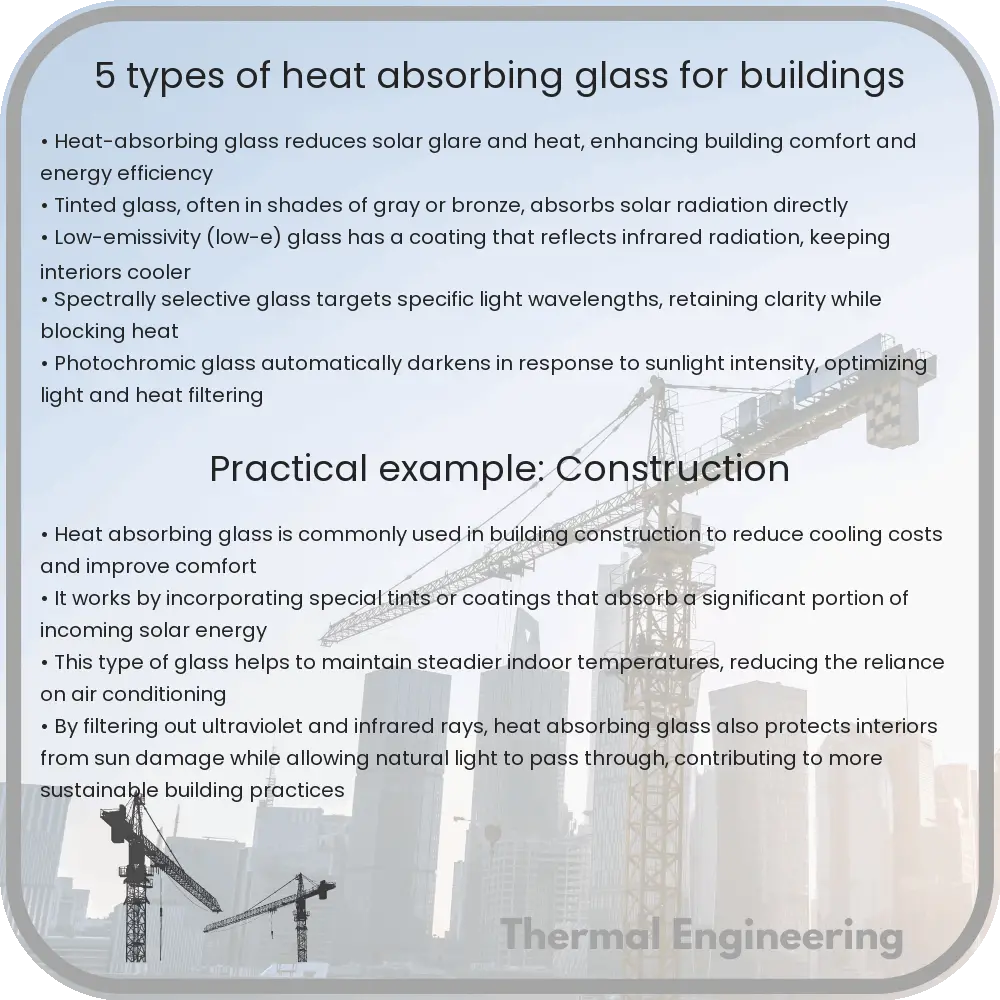
Introduction to Heat Absorbing Glass
Heat absorbing glass is a crucial component in modern building design, particularly in regions experiencing high temperatures and intense sunlight exposure. These specialized types of glass help in managing indoor temperatures, reducing cooling costs, and enhancing occupant comfort. By absorbing and reflecting solar heat, this glass plays a vital role in energy efficiency and environmental sustainability of buildings.
1. Tinted Glass
Tinted glass achieves its heat-absorbing properties through the addition of colorants during the glass manufacturing process. Common colors include bronze, grey, green, and blue. These additives help the glass absorb a significant amount of the incoming solar radiation, thereby reducing the heat transmitted into the building. Tinted glass not only lowers energy costs by reducing air conditioning needs but also minimizes glare for improved indoor comfort.
2. Coated Glass
Coated glass, particularly solar control coated glass, is coated with a thin layer of metallic or non-metallic materials on one side. These coatings are designed to reflect and absorb solar radiation. There are two main types of coated glass: passive coatings, designed to maximize solar heat absorption, and solar control coatings, which reflect solar radiation. This type of glass is effective not only in heat reduction but also in blocking harmful UV rays while maintaining adequate light transmittance.
3. Low-Emissive (Low-E) Glass
Low-emissivity glass has a microscopically thin, transparent coating that reflects thermal radiation or heat. The low-E coatings help in keeping the heat inside during the winter and outside during the summer, making this type of glass ideal for climate-controlled buildings. The effectiveness of low-E glass in blocking solar heat gain is measured by its solar heat gain coefficient (SHGC), which is typically lower than that of standard glass.
4. Insulated Glass Units (IGUs)
Insulated Glass Units consist of two or more glass panes spaced apart and hermetically sealed, creating an insulated air space between the panes. This configuration helps in reducing the heat transfer due to conduction and convection. IGUs can be combined with other heat-absorbing and low-E coatings to enhance their performance, making them highly effective in energy conservation and noise reduction.
5. Smart Glass or Electrochromic Glass
Smart glass, also known as electrochromic glass, represents the cutting edge of heat absorbing glass technology. This glass can change its light transmission properties based on the electrical voltage applied, allowing control over the amount of heat and light passing through. This characteristic makes smart glass extremely useful in optimizing indoor environments, achieving significant energy efficiencies by reducing reliance on air conditioning and artificial lighting.
Conclusion
The development of specialized heat absorbing glass types offers significant benefits in terms of energy efficiency, comfort, and environmental impact. From tinted and coated glass to innovative solutions like smart glass, these technologies continue to evolve, playing a critical role in modern architectural design. Choosing the right type of heat absorbing glass can dramatically enhance the performance and sustainability of any building project.