Explore design enhancements in heat exchangers to improve efficiency, reduce costs, and optimize performance in industrial applications.
Introduction to Heat Exchanger Design Enhancements
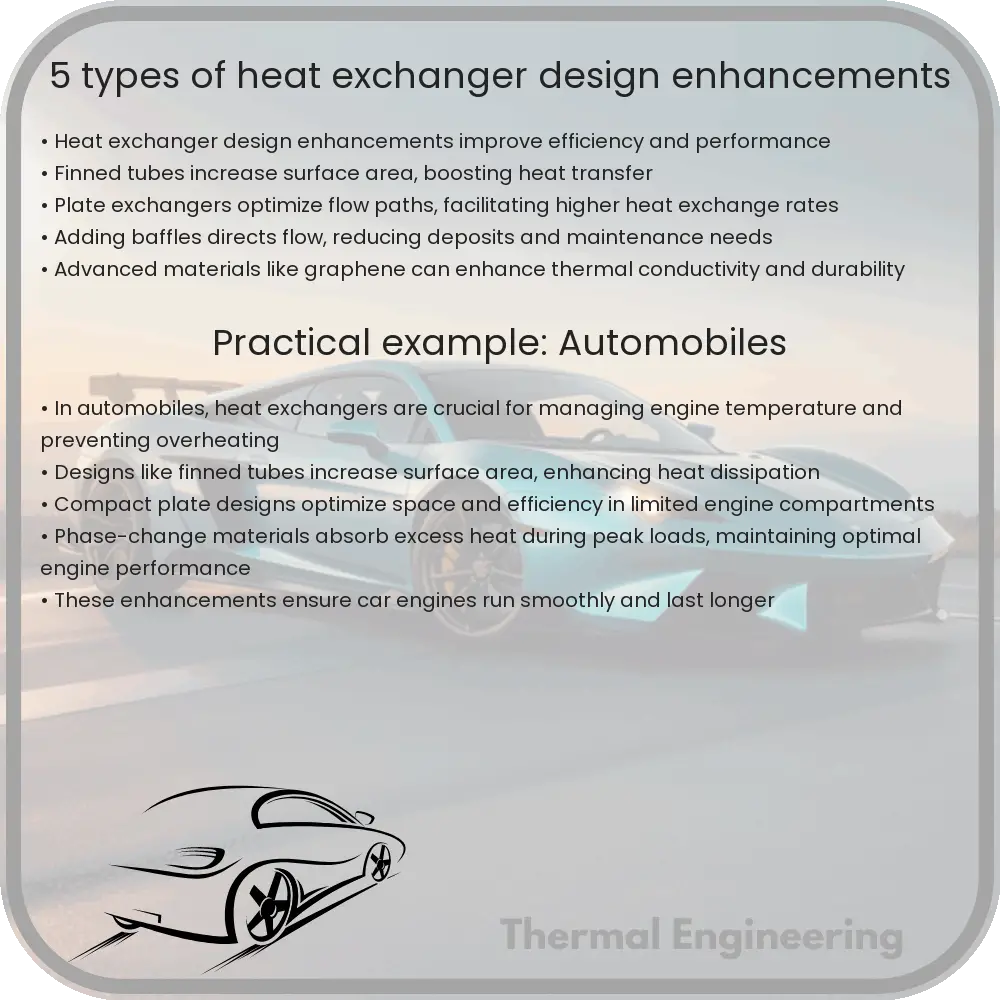
Heat exchangers are crucial devices in engineering, used to transfer heat between two or more fluids, between a solid and a fluid, or between solid particulates and a fluid, at different temperatures and in thermal contact. In various industries, the efficiency of heat exchangers can profoundly influence energy consumption, operating costs, and environmental impact. Design enhancements in heat exchangers aim to improve thermal efficiency, reduce fouling, and maximize energy recovery. Here, we explore five compelling types of design enhancements for heat exchangers.
1. Enhanced Surface Area
Increasing the surface area available for heat transfer is a direct method to enhance the performance of heat exchangers. This can be achieved through several designs:
- Fin-Tube Designs: Adding fins to tubes increases the exterior surface area, which enhances the heat transfer rate. This is particularly effective in air heat exchangers where the heat transfer coefficient of air is relatively low.
- Plate Heat Exchangers: These exchangers use corrugated plates that form complex channels through which the working fluids can flow. The corrugations increase the surface area and turbulence, thereby improving the heat transfer efficiency.
2. Use of Nanofluids
The thermal conductivity of a fluid plays a crucial role in the efficiency of heat exchangers. Nanofluids, which are fluids engineered by suspending nanometer-sized particles in a base liquid, have been shown to enhance thermal conductivity. The particles effectively increase the heat transfer surface area at the molecular level, leading to significant improvements in thermal performance.
3. Phase-change Materials (PCMs)
Incorporating PCMs in heat exchanger systems can improve thermal energy storage, thereby balancing heat loads and enhancing system stability. PCMs absorb or release heat at a constant temperature, acting as a heat reservoir. Integrating PCMs can be particularly beneficial in systems subject to cyclic thermal loads or where heat recovery is essential.
4. Flow Arrangement Modifications
Optimizing the flow arrangement can have a profound impact on a heat exchanger’s effectiveness. Common enhancements include:
- Counterflow Arrangements: In counterflow heat exchangers, the hot and cold fluids move in opposite directions, which can achieve a greater temperature difference and a higher heat transfer rate.
- Multi-pass and Cross-flow Configurations: Using multiple passes on one or both sides of the heat exchanger allows more time for the heat transfer process, thereby increasing efficiency. Cross-flow arrangements, where the fluids move perpendicular to each other, are also effective in certain applications.
5. Intelligent Control Systems
Advanced control systems using sensors and automated controls can significantly enhance the performance of heat exchangers. These systems monitor and adjust operating conditions in real time, optimizing the heat exchange rates based on immediate needs and external conditions. Intelligent control systems can also predict and mitigate issues like fouling, thus maintaining efficiency and prolonging the equipment’s lifecycle.
Conclusion
Enhancements in heat exchanger design are pivotal for improving energy efficiency and operational effectiveness in many industrial applications. Through innovations like increased surface areas, the use of nanofluids, integration of phase change materials, optimized flow configurations, and intelligent controls, engineers can substantially uplift the performance of heat exchangers. Each method provides unique benefits and can be tailored to meet specific operational requirements, showcasing the versatility and ongoing advancements in heat exchanger technology.