Learn about the role of heat transfer in food processing, including conduction, convection, radiation, induction, and evaporation methods.
Understanding Heat Transfer in Food Processing
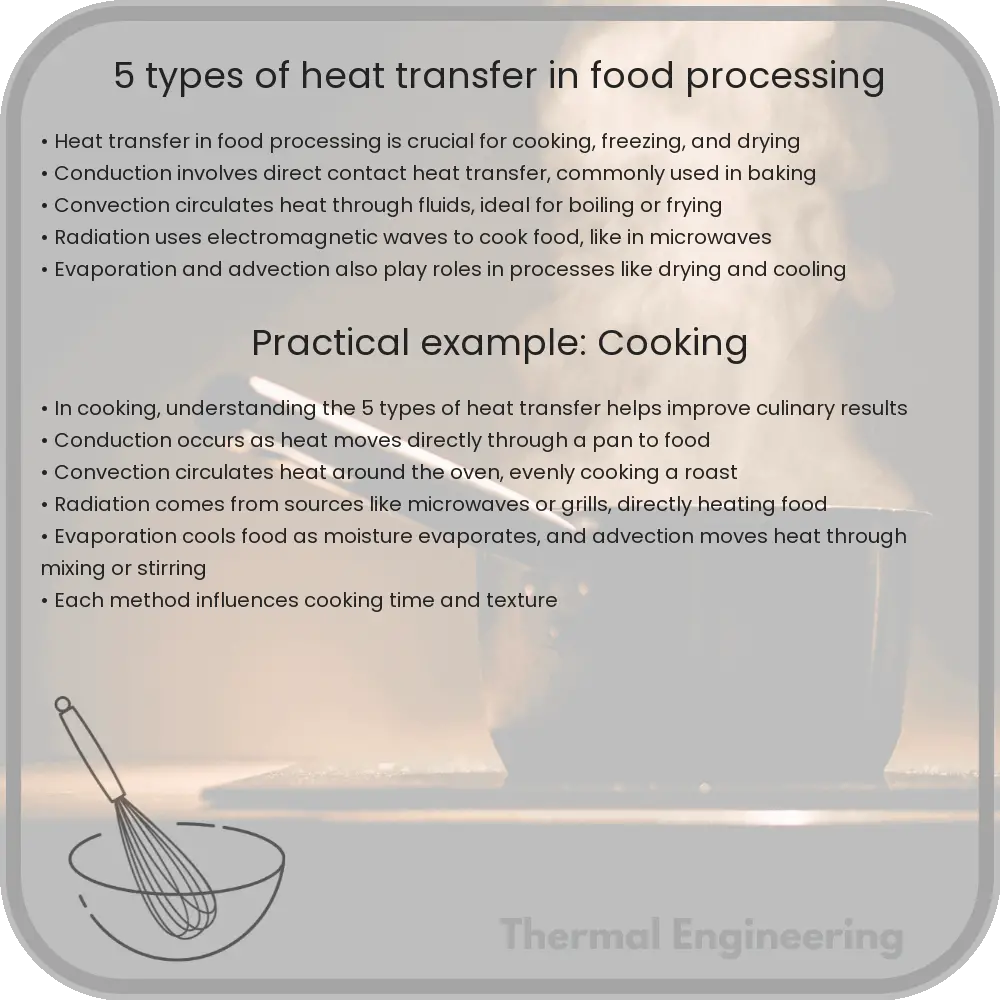
In the world of food processing, heat transfer plays a critical role in ensuring that foods are safely and efficiently processed for consumption. Heat transfer refers to the movement of thermal energy between physical systems depending on the temperature and properties of the materials involved. Here are five primary types of heat transfer mechanisms utilized in the food processing industry:
1. Conduction
Conduction is the transfer of heat through a solid material from one molecule to another without any movement of the material as a whole. In food processing, conduction occurs when heat moves through food placed directly on a hot surface, such as a grill or pan. An example would be grilling a steak or frying pancakes.
- Example: Cooking a burger on a griddle involves heat transfer from the hot surface to the burger through conduction.
2. Convection
Convection involves the transfer of heat through a fluid, which can be a liquid or a gas. This occurs when heated particles transfer energy to the surrounding cooler particles, which then heat up and rise, creating a circulating flow. In food processing, convection is used in practices like boiling, deep-frying, and steam cooking.
- Example: Baking bread in an oven uses convection as hot air circulates around the dough, cooking it evenly.
3. Radiation
Radiation heat transfer occurs through electromagnetic waves, such as infrared radiation. Food does not need to directly contact the heat source for radiation to occur. In food processing, this is commonly seen in processes that involve grills or microwave ovens.
- Example: Toasting bread in a toaster involves heat transfer through infrared radiation emanating from the toaster’s heating elements.
4. Induction
Induction heating is another method used in food processing. It involves the generation of heat through electromagnetic induction. Under this process, an electrically conducting object (usually a metal pan) is placed in a changing magnetic field, causing electric currents (eddy currents) to flow through the metal and heat it up.
- Example: Using an induction cooktop to heat a saucepan. The cooktop itself does not get hot; the heat is generated by the electric currents within the pan.
5. Evaporation and Condensation
While often overlooked, the processes of evaporation and condensation are significant in food processing. Evaporation involves the removal of heat through the vaporization of moisture (water or other cooking fluids), which helps in processes like concentration and drying. Condensation is the process where vapor turns back into liquid, releasing heat and is utilized in techniques such as distillation.
- Example: Concentrating fruit juice by heating it to promote evaporation of water, thus thickening the juice and intensifying flavors.
In conclusion, understanding these types of heat transfer in food processing helps in optimizing manufacturing processes, ensuring energy efficiency, and achieving the desired quality in food products. Integrating the appropriate heat transfer methods can significantly influence the texture, flavor, and shelf-life of processed foods.