Learn about the crucial role of thermal management in aerospace engineering and its various methods ensuring spacecraft functionality.
Introduction to Thermal Management in Aerospace
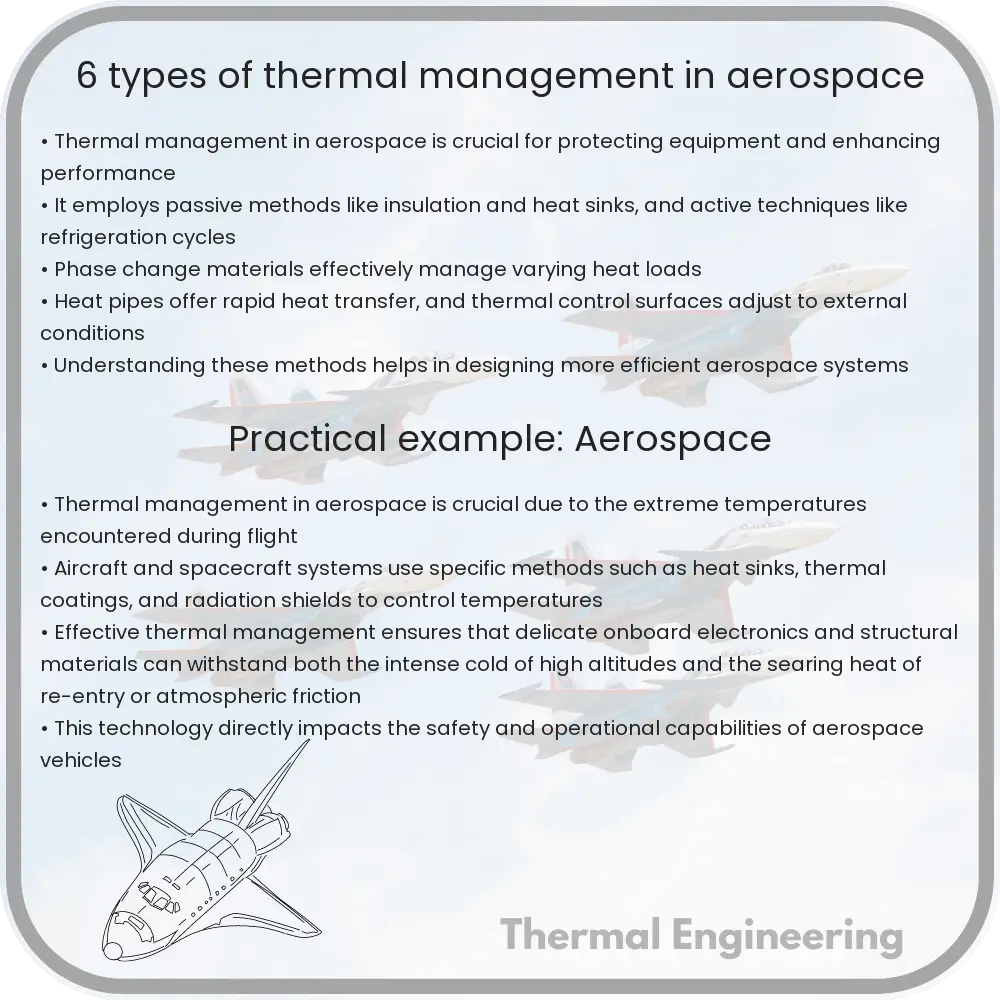
Thermal management is a critical aspect of aerospace engineering. It involves controlling the temperatures of aerospace vehicles, whether they are orbiting the Earth, traversing the atmosphere, or exploring other planets. Effective thermal management ensures the functionality and longevity of onboard systems and structures while facing extreme temperatures and rapid changes in environmental conditions. Here we explore six key types of thermal management used in the aerospace industry.
1. Heat Sinks
Heat sinks are components that facilitate heat transfer from a hotter object to a cooler fluid, typically air or liquid. In aerospace applications, they are used to dissipate heat from electronics and other critical components. Heat sinks are designed to maximize surface area in contact with the cooling medium. They are often made of materials with high thermal conductivity, such as aluminum or copper.
2. Heat Pipes
A heat pipe is a sealed system that uses the principles of phase change and conduction to transfer heat efficiently. A working fluid inside the heat pipe absorbs heat at the source, evaporates, travels to a cooler region of the pipe, condenses, and then returns as a liquid to repeat the cycle. Heat pipes are particularly useful in aerospace for their ability to transfer heat over significant distances with minimal temperature loss.
3. Thermal Insulation
Thermal insulation is used to reduce the rate of heat transfer between objects in thermal contact or in range of radiative influence. In aerospace, insulation can protect sensitive equipment from the extreme cold of space or the searing heat of atmospheric entry. Materials such as aerogel, Mylar, and reinforced carbon-carbon are commonly used based on their low thermal conductivity and high temperature resistance.
4. Radiators
Radiators in aerospace are used to expel heat into space, a crucial function especially in satellites and spacecraft, where internal heat must be continuously removed to maintain operational temperatures. These systems typically utilize large surface areas to radiate heat and are often coupled with heat pipes or fluid loops to maximize efficiency.
5. Phase Change Materials (PCMs)
PCMs absorb and release heat at a relatively constant temperature as they undergo changes in state (from solid to liquid and vice versa). In aerospace applications, PCMs can be used to regulate the temperature of batteries in satellites or electronics in spacecraft by absorbing excess heat generated during operation and releasing it when the temperature drops.
6. Active Refrigeration and Heat Pumps
Active refrigeration systems and heat pumps use work to move heat from a cooler area to a warmer one, contrary to natural heat flow. This approach is essential for applications where passive systems like radiators or heat pipes are insufficient. In aerospace, these systems can be critical for maintaining optimal temperature conditions for crew members and sensitive electronic components across varying mission phases.
Conclusion
The various methods of thermal management in aerospace underscore the complexity and importance of temperature control in harsh environments. Through the use of advanced materials and innovative technologies, engineers are able to protect equipment and enhance performance in spacecraft, satellites, and other aerospace vehicles, ensuring mission success under extreme conditions.