Learn about erosion in fluid dynamics, its impact on engineering systems, and strategies for mitigation.
Introduction to Erosion in Fluid Dynamics
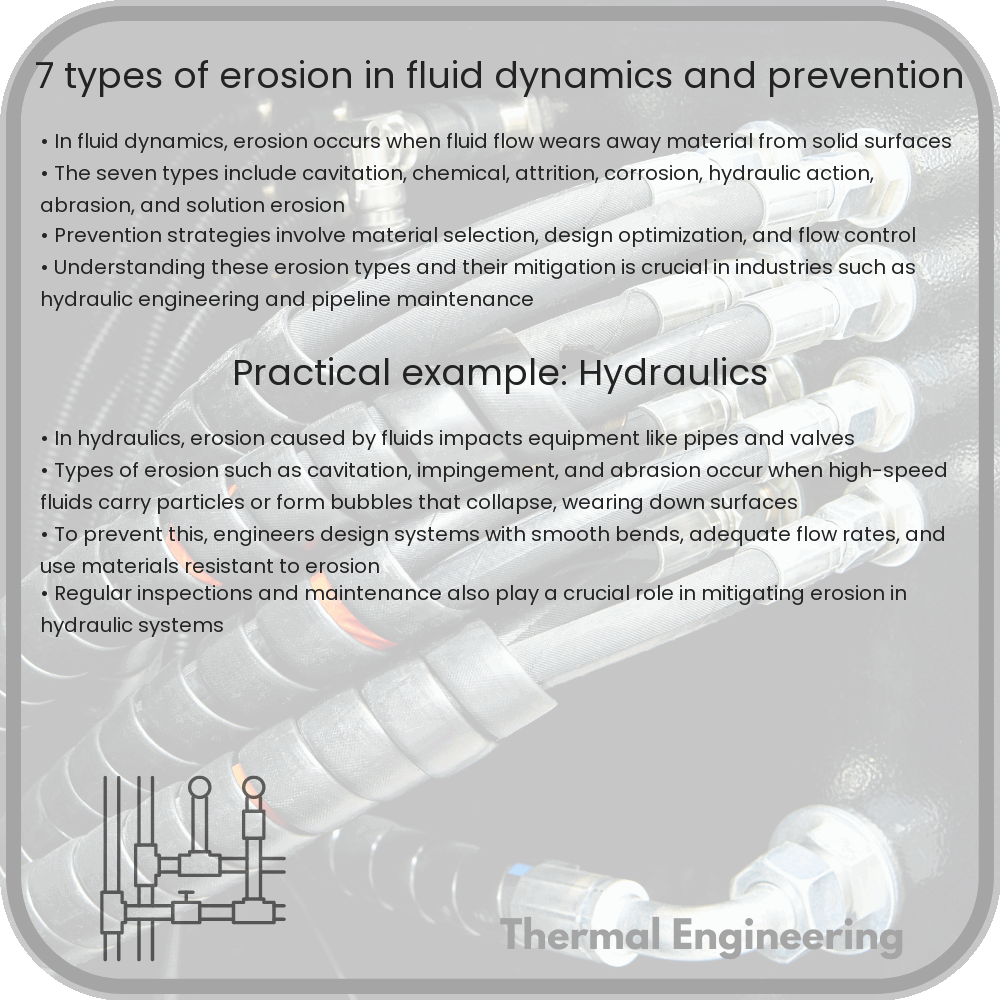
Erosion in fluid dynamics refers to the wear and tear of material surfaces due to the mechanical action of fluids, which can include liquids or gases. This phenomenon can have significant impacts on the structural integrity and functionality of engineering systems such as pipelines, turbines, and pumps. Understanding the different types of erosion and their prevention measures is crucial for engineers to design more durable and reliable systems.
Types of Erosion in Fluid Dynamics
- Cavitation Erosion: Occurs when vapor bubbles in a liquid collapse near a surface, causing shock waves that progressively damage the surface. Cavitation typically arises in areas of high velocity flow where local pressure drops below vapor pressure.
- Impingement Erosion: Happens when high-velocity fluid particles strike a surface at an angle. This type of erosion is common in bends, elbows, and restrictions in pipe flows where directional changes cause increased momentum impacts on surfaces.
- Abrasive Erosion: Caused by hard particles in a flowing medium that mechanically wear down a surface. This is frequently observed in slurry flows and sand-laden water affecting hydraulic machinery and sediment transport systems.
- Corrosive Erosion: Results from the combined action of chemical attack and fluid motion, leading to accelerated material loss. This type is prevalent in chemically active environments like seawater exposure in marine applications.
- Particle Erosion: Seen when streams of solid particles are carried by a fluid and directed against a surface. The severity typically depends on particle concentration, velocity, and hardness, as well as the angle of impact.
- Thermal Erosion: Occurs due to significant temperature differences between the fluid and the surface, causing thermal stresses that lead to material degradation and surface wear. This can be observed in heat exchangers and cooling systems.
- Fluid-structure interaction: This broader category encompasses effects resulting from dynamic interactions between fluid flows and structures, potentially causing vibrations, oscillations, and resultant material fatigue and erosion.
Prevention and Mitigation Strategies
- Material Selection and Treatment: Employing erosion-resistant materials like stainless steel or applying surface treatments such as hard coatings can help mitigate erosion.
- Flow Modification: Altering the flow dynamics by changing velocities, patterns, or redirecting flows through smoother transitions can reduce erosion occurrences.
- Protective Structures: Utilizing sacrificial liners or shields in high-wear areas can absorb the initial impact and prolong the life of the primary structure.
- Chemical Inhibitors: In cases of corrosive erosion, applying chemical inhibitors can reduce the reactive potential of the fluid environment.
- Regular Maintenance: Scheduled inspections and maintenance allow for the early detection and repair of erosion damage, which prevents further degradation.
- Operational Adjustments: Modifying operational parameters such as flow rates and pressures to less erosive conditions can significantly manage erosion control.
Conclusion
Understanding the types of erosion that can occur in fluid dynamic systems and implementing strategic prevention measures is critical in protecting equipment from premature failure. With the correct application of engineering principles and materials science, the impact of erosion can be minimized, leading to more sustainable and cost-effective operations.