Learn about seven types of liquid flow measurement devices used in various industries to ensure accurate liquid management.
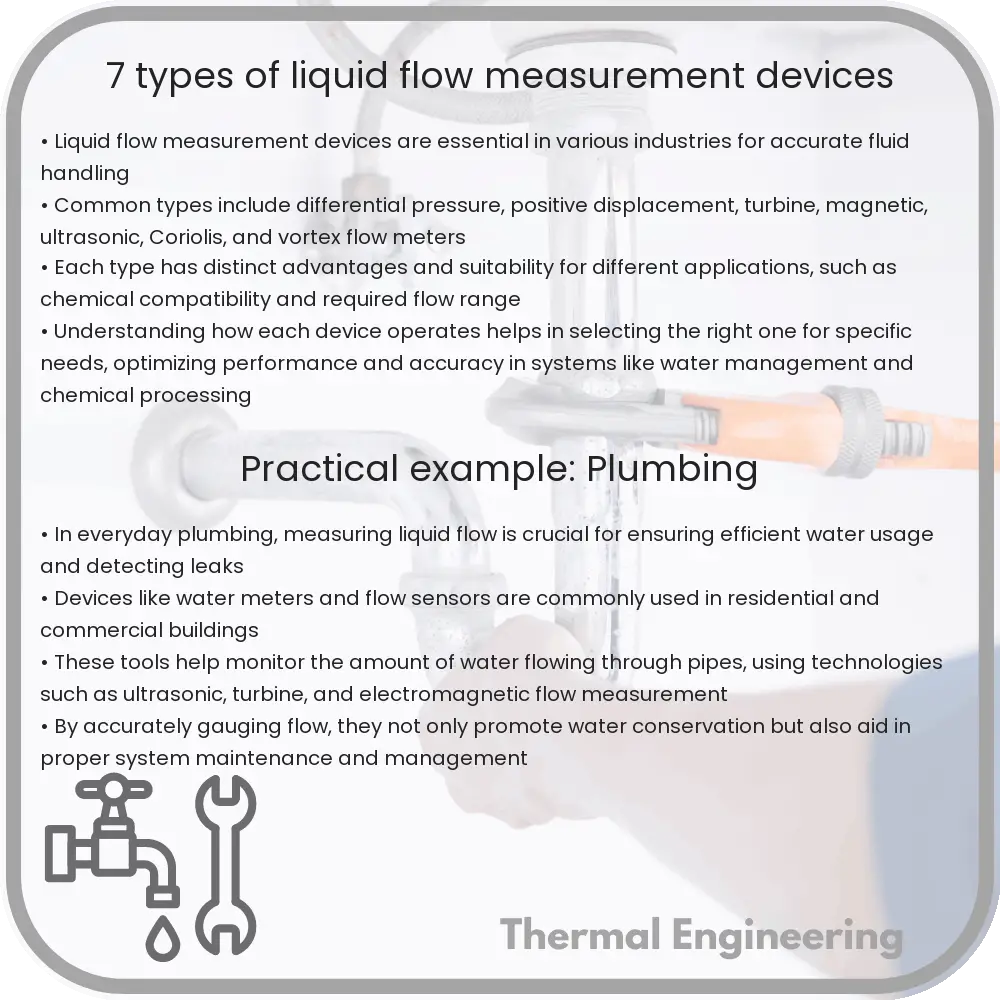
7 Types of Liquid Flow Measurement Devices
Liquid flow measurement is crucial in many industries ranging from water treatment to chemical processing. There are several types of devices designed to accurately measure the flow of liquids. Each type uses a different principle and technology suitable for varying flow conditions and fluids.
1. Differential Pressure Flow Meters
Differential pressure flow meters work by measuring the pressure drop over an obstruction inserted in the flow path. The most common forms include orifice plates, flow nozzles, and Venturi tubes. The flow rate can be calculated using Bernoulli’s principle, which relates the pressure differential to the fluid velocity and the pipe diameter. The formula used for calculating flow rate Q can be expressed as:
Q = C * A * sqrt(ΔP / ρ)
- C – discharge coefficient
- A – area of the orifice
- ΔP – pressure drop
- ρ – fluid density
2. Electromagnetic Flow Meters
Electromagnetic flow meters operate based on Faraday’s law of electromagnetic induction. They are ideal for measuring the flow of electrically conductive liquids without any obstruction in the flow path. The voltage generated by the fluid as it flows through a magnetic field is proportional to the flow velocity. Therefore, the flow rate can be calculated by measuring this voltage.
3. Ultrasonic Flow Meters
Ultrasonic flow meters use sound waves to determine the flow rate of a liquid. They can be configured in either a transit-time or a Doppler shift version. Transit-time ultrasonic flow meters measure the time difference between sound pulses traveling upstream and downstream. The Doppler shift version measures the frequency shift of an ultrasonic signal when it is reflected off suspended particles or gas bubbles in motion within the liquid.
4. Turbine Flow Meters
Turbine flow meters have a turbine wheel placed in the flow stream. The flowing fluid impinges on the turbine blades, causing the wheel to spin at a rate proportional to the fluid velocity. Sensors detect the rotational speed and convert it into a flow rate measurement.
5. Positive Displacement Flow Meters
Positive displacement flow meters divide the incoming fluid into discrete volumes and count these volumes over time. They provide extremely accurate measurements for a wide variety of fluids, making them suitable for applications requiring precise flow measurements, like in fuel dispensing and batch processes.
6. Coriolis Flow Meters
Coriolis flow meters are distinguished by their ability to measure both mass flow and density of a liquid, providing a direct mass flow measurement. These meters function by vibrating a tube through which the fluid passes. Changes in the vibration frequency or phase shift are measured and related to mass flow rate.
7. Vortex Flow Meters
Vortex flow meters measure the vortices generated by a fluid as it passes around a bluff body embedded in the flow stream. The frequency of vortex shedding is directly proportional to the flow rate. These meters are well-suited for high-temperature and high-pressure flow measurements.
Each type of liquid flow measurement device offers specific advantages and limitations, making them more or less suitable for different applications, operational environments, and fluid characteristics. Understanding these can help in selecting the most appropriate meter for a given application.