Learn about the core functions and components of thermal power plants, key players in global electricity production and their environmental impacts.
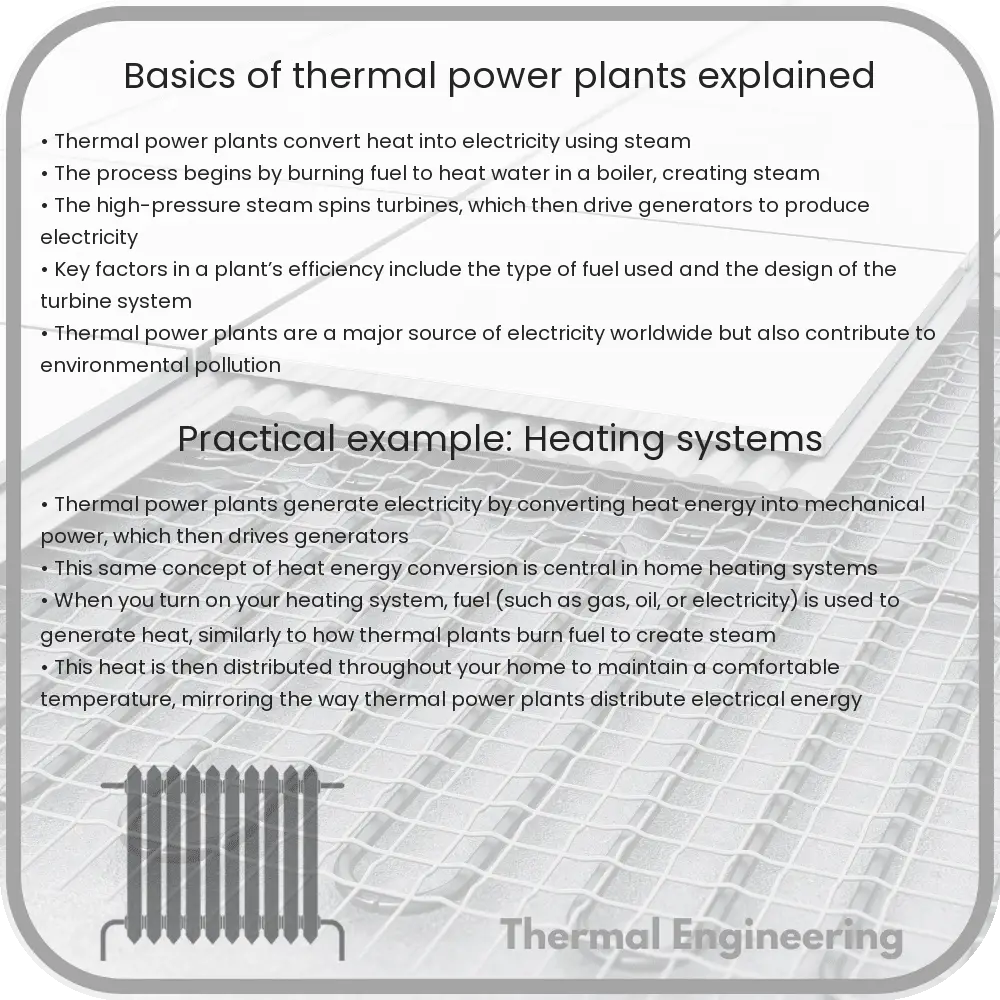
Basics of Thermal Power Plants Explained
Thermal power plants are a cornerstone of the energy industry, producing a significant portion of the world’s electricity. They convert heat energy into electrical energy, predominantly by burning fossil fuels like coal, natural gas, or oil. This article explores the fundamental principles behind thermal power plants and their operation.
How Thermal Power Plants Work
The basic operation of a thermal power plant involves four main steps: heating, steam production, electricity generation, and cooling.
- Heating: The fuel (typically coal, oil, or natural gas) is burned in a large boiler to heat water. The combustion produces a large amount of heat, which turns water into steam.
- Steam Production: The intense heat from burning fuel converts water in the boiler into high-pressure steam. This steam is then directed to a turbine at high speed.
- Electricity Generation: The high-pressure steam turns the blades of a steam turbine, which is connected to a generator. As the turbine blades turn, they rotate a generator, which converts the mechanical energy of the spinning turbine into electrical energy through electromagnetic induction.
- Cooling: After the steam passes through the turbine, it needs to be cooled back into water so it can be reused in the boiler. This is done in a cooling tower or by using water from nearby natural sources like rivers or lakes. The cooled water is then returned to the boiler, and the cycle begins again.
Key Components of a Thermal Power Plant
- Boiler: The boiler is the heart of the thermal power plant, where the fuel is burned to create heat. Boilers are typically very large and need to be able to handle enormous volumes of water and steam.
- Turbine: The turbine converts the energy of high-pressure steam into mechanical energy. The design of the turbine blades plays a crucial role in their efficiency.
- Generator: Connected to the turbine, the generator is responsible for producing electricity. It works on the principle of electromagnetic induction, where a moving magnetic field causes electrons to move, producing electricity.
- Cooling System: This system cools down the steam used in the turbine to convert it back into water, which can be reused. Cooling towers, which release heat into the atmosphere, or once-through systems using river or sea water, are common.
- Control Room: Modern thermal power plants are equipped with sophisticated control systems that monitor and adjust the plant’s operations, ensuring efficiency and safety.
Environmental Impact
Thermal power plants are significant contributors to global greenhouse gas emissions because they burn fossil fuels. These emissions include not only carbon dioxide (CO2), a major greenhouse gas, but also other pollutants such as sulfur dioxide (SO2), nitrogen oxides (NOx), and particulate matter, which can cause air pollution and health problems. Modern plants incorporate various technologies to reduce emissions, such as flue gas desulfurization and electrostatic precipitators.
Conclusion
Despite the rise of renewable energy sources, thermal power plants continue to be a vital part of the global energy landscape, particularly for baseline load electricity generation. Understanding the basic components and operation of thermal power plants is essential for anyone studying energy production and its impacts on our world today.