Learn about battery electrolytes, their types, functions, and safety considerations in modern energy storage systems.
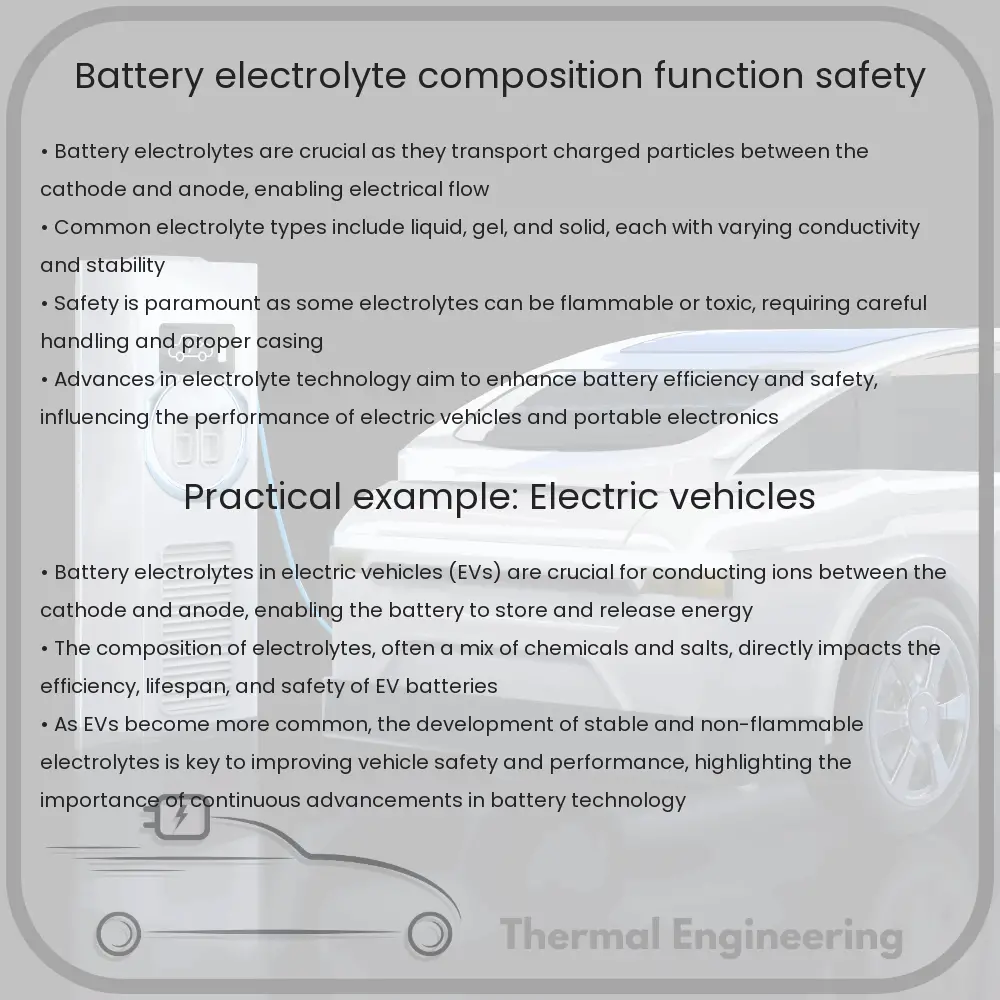
Understanding Battery Electrolytes: Composition, Function, and Safety
Batteries are a crucial component of many modern devices, powering everything from smartphones to electric vehicles. At the heart of every battery is the electrolyte, a key ingredient that plays multiple critical roles in the battery’s operation. This article explores the composition of battery electrolytes, their functions, and the safety considerations associated with them.
Composition of Battery Electrolytes
Battery electrolytes exist in several forms: liquid, gel, and solid. However, they all serve the same fundamental purpose. Here’s a closer look at each type:
- Liquid Electrolytes: These are typically a mixture of solvents and salts. The solvents usually consist of organic chemicals like ethylene carbonate or diethyl carbonate, and the most common salt is lithium hexafluorophosphate (LiPF6).
- Gel Electrolytes: These include a gelling agent that thickens the liquid components. This helps in reducing leakage and spillage risks.
- Solid Electrolytes: They use a solid ion-conducting material such as lithium phosphorus oxynitride or ceramic compounds. Solid electrolytes are gaining interest for their safety and stability.
Function of Battery Electrolytes
The primary function of the electrolyte in a battery is to conduct ions between the cathode and anode. When a battery is charging or discharging, ions need to flow freely through the electrolyte to enable the chemical reactions necessary for storing or releasing energy. Here’s how it works:
- Ion Conduction: Upon device operation, positively charged ions move through the electrolyte from the anode to the cathode during discharge, and vice versa during charging.
- Electrical Insulation: While it allows for ion flow, the electrolyte does not conduct electrons; thus, it also acts as an electrical insulator between the battery’s two electrodes.
- Maintenance of Electrode Structure: By allowing the movement of ions and not electrons, electrolytes help in maintaining the integrity of the electrodes.
Safety Considerations with Battery Electrolytes
Though battery electrolytes are vital for the operation of batteries, they also bring several safety challenges:
- Chemical Stability: Electrolytes must be chemically stable. Reactive or unstable electrolytes can decompose and potentially cause fires or explosions in the battery.
- Toxicity: Many electrolytes, particularly those containing lithium hexafluorophosphate, are toxic and hazardous. Safe handling and disposal are crucial to avoid health risks.
- Leakage Issues: Liquid and gel electrolytes can leak if the battery casing is damaged. This not only poses a safety risk but also compromises the battery’s function.
- Thermal Management: Overheating of the battery can lead to electrolyte failure and potentially dangerous thermal runaway, where escaping gases and chemicals might ignite.
In summary, battery electrolytes play a crucial role in the functionality and efficiency of batteries. There is continuous research aimed at finding safer, more efficient, and less toxic electrolytes, especially within the realm of solid-state and polymer electrolytes. Ensuring the safety and effectiveness of battery technology continues to be a top priority as our reliance on energy storage evolves.