Calorimetry is a precise technique used in material science to measure heat effects in material phase transitions, reactions, and physical changes.
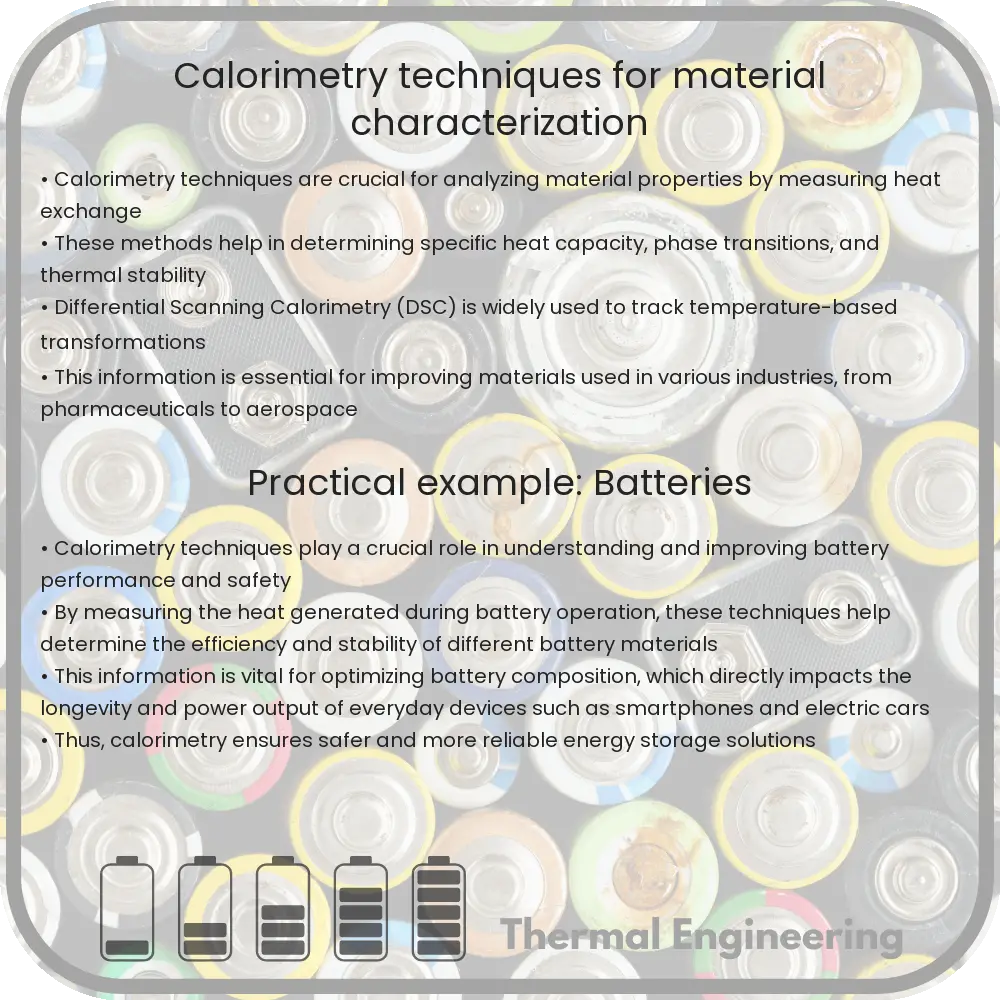
Understanding Calorimetry Techniques for Material Characterization
Calorimetry is a fundamental technique used in material science to measure the heat effects associated with material phase transitions, reactions, and physical changes. This method provides critical insights into material properties such as specific heat capacity, enthalpy changes, and kinetic reactions. Understanding these aspects is essential for applications ranging from manufacturing processes to energy storage and pharmaceuticals.
Basic Principles of Calorimetry
At its core, calorimetry involves measuring the amount of heat absorbed or released by a material under a controlled set of conditions. The basic equation used in calorimetry is based on the principle of conservation of energy:
Q = m * c * ΔT
where:
- Q is the heat absorbed or released,
- m is the mass of the material,
- c is the specific heat capacity of the material, and
- ΔT is the change in temperature.
Types of Calorimeters
There are several types of calorimeters, each suited to different types of analysis:
- Differential Scanning Calorimetry (DSC): This technique measures how much heat a sample absorbs or releases as it is heated, cooled, or held at constant temperature. It’s particularly useful for studying melting, crystallization, and other phase transitions.
- Isoperibol Calorimetry: Often used in reaction calorimetry, this type maintains the surrounding temperature constant while observing the heat exchange related to chemical reactions.
- Adiabatic Calorimetry: Common in safety testing, this type isolates the system thermally from its environment, closely monitoring the temperature changes caused by exothermic reactions without loss or gain of heat to the surroundings.
- Microcalorimetry: This is used for measuring very small changes in enthalpy at the microscale, essential in biochemical and pharmacological applications.
Applications of Calorimetry in Material Characterization
Calorimetry serves a broad range of applications in material science, including:
- Evaluating Thermal Properties: By measuring specific heat and other thermal transitions, calorimetry helps in determining material stability and performance under various temperature conditions.
- Studying Kinetic Processes: Reaction rate constants and activation energies are derived from calorimetric data, informing chemical reaction kinetics.
- Quality Control: In industries, calorimetry ensures the consistency and quality of materials by detecting impurities and deviations in compound structure.
- Energy Storage Materials: Characterization of batteries and supercapacitors to understand and improve energy efficiency and storage capabilities.
Challenges and Innovations in Calorimetry
Despite its wide applications, calorimetry faces challenges such as sensitivity to experimental conditions and limitations in scale. Innovations are continually being developed to enhance the precision, sensitivity, and applicability of calorimetric methods. Advances in microcalorimetry and the integration of computational methods have markedly increased the accuracy and scope of calorimetric analysis, pushing forward the boundaries in material research and development.
Calorimetry remains a pivotal technique in material characterization, providing detailed insights into material properties and behaviors that are critical for both research and industry applications.