Learn about thermal shock resistance in ceramics, its importance in various industries, and factors impacting its effectiveness.
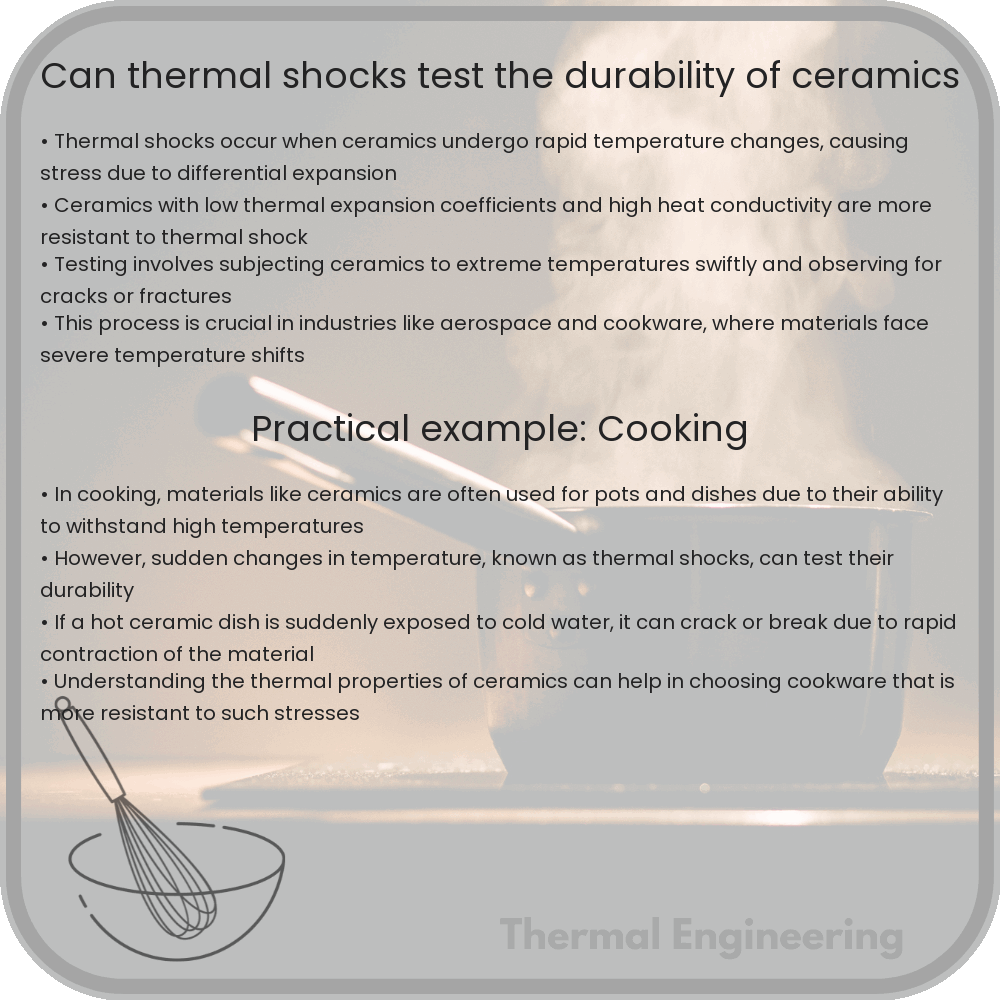
Understanding Thermal Shock Resistance in Ceramics
Thermal shock is a critical factor when assessing the durability and reliability of ceramic materials. Ceramics, widely used in various engineering applications due to their high melting points, excellent hardness, and chemical stability, may still succumb to failure under rapid temperature changes. This article explores how thermal shocks can test the durability of ceramics, describing the process and implications of thermal shock resistance.
What is Thermal Shock?
Thermal shock occurs when a material experiences a rapid change in temperature, causing differential expansion or contraction within its structure. This phenomenon results in mechanical stress within the material, potentially leading to the development of cracks and ultimately, failure. For ceramics, which are typically brittle, the ability to withstand these rapid temperature changes is governeded by their thermal shock resistance.
Factors Affecting Ceramic’s Thermal Shock Resistance
- Thermal Conductivity: Higher thermal conductivity helps in the uniform distribution of temperature within the material, thereby reducing thermal gradients and the associated stresses.
- Elastic Modulus: Materials with a lower elastic modulus can absorb more mechanical stress, enhancing their ability to withstand thermal shocks.
- Thermal Expansion Coefficient: A lower coefficient of thermal expansion indicates less expansion or contraction for a given temperature change, minimizing stress.
- Strength and Fracture Toughness: Higher mechanical strength and fracture toughness can resist crack initiation and propagation induced by thermal stress.
Testing Thermal Shock Resistance
To evaluate the thermal shock resistance of ceramics, several standardized testing methods can be employed. These tests involve subjecting the ceramic to cycles of extreme heating followed by rapid cooling, commonly using methods like quenching the material in water or air from a predetermined high temperature. The differences in temperatures, the rate of temperature change, and number of cycles can vary depending on the specific testing protocol and the targeted application of the ceramic.
Applications and Importance
Ceramics that can withstand severe thermal shocks are essential in industries such as aerospace, where materials face extreme and rapid temperature changes. Space shuttle tiles are a prime example of ceramics designed to handle thermal shocks, as they must endure high temperatures during re-entry into Earth’s atmosphere followed by a rapid cooldown. Similarly, ceramics in automotive applications, like brake discs and engine components, must resist thermal shock due to sudden temperature changes during operation.
Conclusion
In conclusion, testing the thermal shock resistance of ceramics is imperative for applications where materials are subjected to rapid temperature fluctuations. Understanding and improving thermal shock resistance can prevent failure, ensuring the longevity and reliability of ceramic components in critical applications. Engineering advancements continue to develop ceramics with enhanced properties to meet these demanding conditions, thereby broadening the horizon for new applications and performance improvements in existing ones.