Explore the potential of thermoelectric generators (TEGs) as a renewable energy source for powering wearable technology, focusing on their principles, challenges, and future prospects.
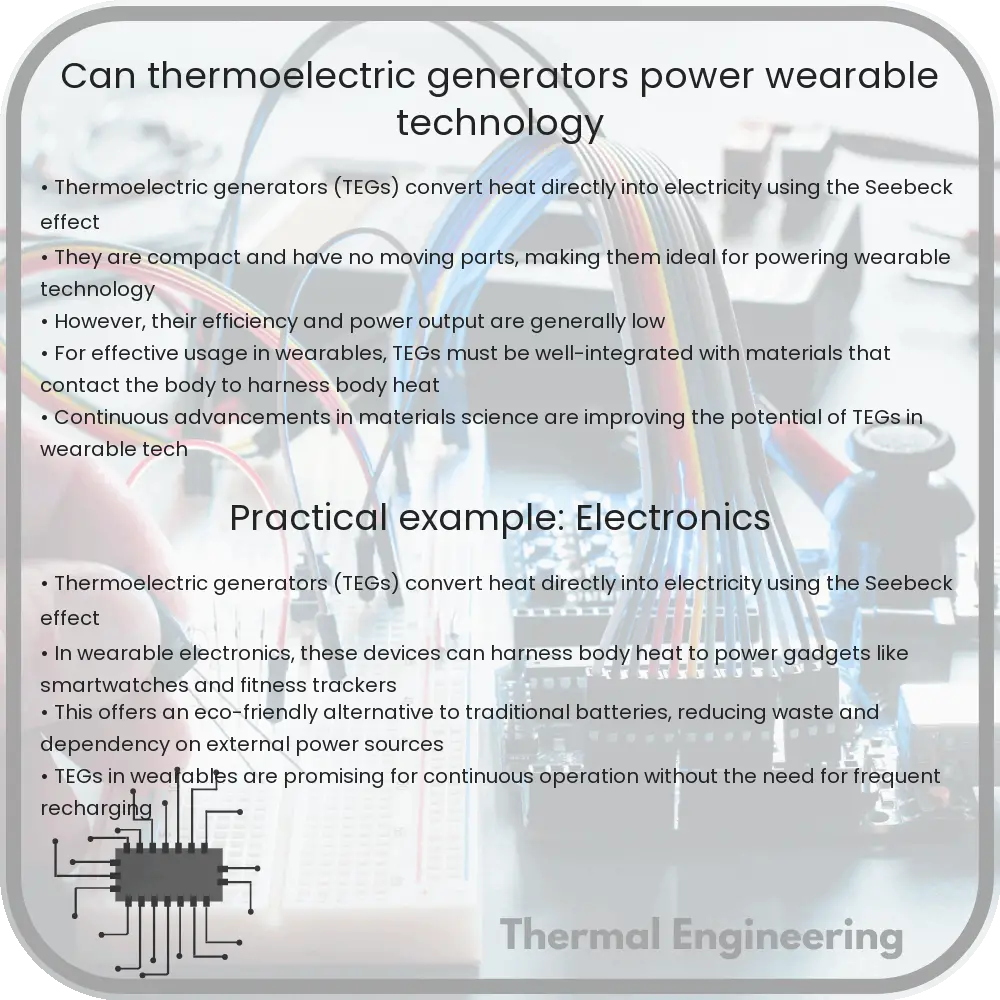
Can Thermoelectric Generators Power Wearable Technology?
Thermoelectric generators (TEGs) are a fascinating piece of technology that convert temperature differences directly into electrical energy, based on the Seebeck effect. This physical principle has prompted researchers and engineers to consider whether TEGs could be an effective power source for the growing field of wearable technology.
Understanding the Operation of Thermoelectric Generators
TEGs operate on the principle that when two dissimilar conductors or semiconductors are subjected to a temperature gradient, a voltage is generated between the different materials. Mathematically, this can be expressed as:
V = S * ΔT
where V is the voltage produced, S is the Seebeck coefficient of the materials used, and ΔT is the temperature difference across the materials.
Applicability to Wearable Technology
Wearable technology, such as smartwatches, fitness trackers, and health monitoring devices, requires a compact, reliable, and efficient energy source. Thermoelectric generators come into the picture as a potential solution that can harness body heat and convert it into electrical energy to power these devices.
The Prospects of TEGs in Wearables
- Advantages:
- Continuous power generation as long as there is a temperature difference.
- No moving parts, which promotes durability and longer product lifespans.
- Potential to reduce or eliminate the need for battery replacements or recharging in some applications.
- Challenges:
- Relatively low power output compared to traditional batteries and the current power needs of most wearable devices.
- Dependency on significant temperature gradients for efficient energy conversion, which can be variable in wearable scenarios.
- Integration challenges related to the bulk and heat of the generators themselves, which might affect the design and comfort of wearables.
Real-World Applications and Future Potential
Although the application of TEGs in wearable technology is still in the experimental and developmental phases, there have been some promising prototypes and studies. For example, researchers are exploring TEG bands that could wrap around parts of the body, like the wrist, to generate power from human skin temperature.
The future of TEGs in wearables requires advances in materials science to enhance the Seebeck coefficient and thermal conductivity of the materials used. These improvements could potentially increase the power output and efficiency of TEGs, making them more viable for practical applications in wearable tech.
Conclusion
Thermoelectric generators hold potential for self-powered wearable technology by capitalizing on the abundant and renewable source of body heat. While current TEG technology is not yet powerful enough to fully operate modern wearable devices on its own, ongoing research and development could pave the way for more integrated and efficient solutions. This technology promises a future where the simple act of using our bodies could keep our devices powered and operational.