Learn about entropy production in turbulent flows, a crucial concept in thermodynamics and fluid dynamics, and its impact on engineering systems.
Understanding Entropy Production in Turbulent Flows
In the realm of thermodynamics and fluid dynamics, entropy is a fundamental concept, often described as the measure of disorder or randomness in a system. The production of entropy in turbulent flows is a critical area of study, particularly because of its implications in energy systems, environmental science, and engineering processes. This article aims to explain the basics of entropy production in turbulent flows, making it accessible and interesting for beginners and those passionate about engineering.
What is Entropy?
Entropy is a thermodynamic quantity that represents the unavailability of a system’s thermal energy for conversion into mechanical work, often interpreted as the degree of disorder or randomness in the system. The second law of thermodynamics states that in an isolated system, entropy tends to increase over time, meaning that systems naturally progress towards a state of maximum disorder.
Basics of Turbulent Flow
Turbulent flow is a type of fluid (gas or liquid) motion characterized by chaotic changes in pressure and flow velocity. It is in contrast to a laminar flow, which occurs when a fluid flows in parallel layers, with no disruption between the layers. One common example of turbulent flow is cigarette smoke in a still environment, which initially rises in a straight line (laminar flow) before dispersing in many directions (turbulence).
Entropy Production in Turbulent Flows
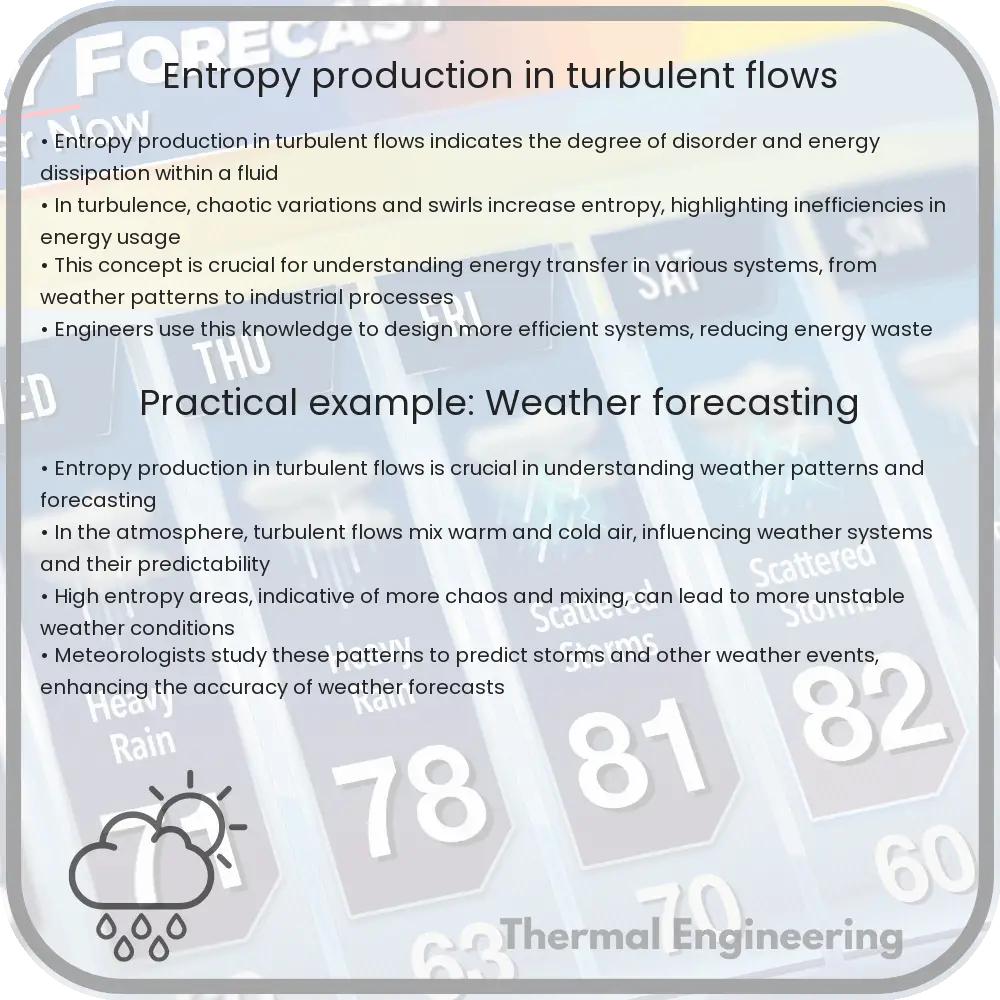
Entropy production in turbulent flows is intricately linked to the disorder and mixing inherent in turbulence. Turbulence enhances the rate of mixing and momentum transfer in fluids, which in turn affects how entropy is generated. The key parameters that influence entropy production in turbulent flows include:
- Viscosity: In fluid dynamics, viscosity is the measure of a fluid’s resistance to deformation at a given rate. In turbulent flows, the viscous dissipation (the process by which kinetic energy is converted to thermal energy) is a primary contributor to entropy production.
- Thermal Conductivity: The capability of a material to conduct heat influences the rate of entropy production. In turbulence, the effective thermal conductivity is increased due to the chaotic mixing, leading to enhanced heat transfer and entropy generation.
- Compressibility: For gases, compressibility (the ability to reduce in volume under pressure) affects the nature of turbulence and subsequently the entropy generation, especially under high-speed flow conditions like those found in jet engines or supersonic flight.
Mathematical Representation of Entropy Production
Entropy production in turbulent flows can be quantitatively described by the following equation:
\(\dot{S} = \int (\frac{\phi}{T}) dV\)
where:
- \(\dot{S}\) is the rate of entropy production,
- \(\phi\) represents the dissipation function, which includes effects due to viscosity and thermal conductivity,
- \(T\) is the absolute temperature,
- \(dV\) is the differential volume element over which the integration is performed.
The dissipation function, \(\phi\), is notably affected by the turbulence and can be expressed as a function of turbulent velocity fluctuations and gradients in mean flow properties. This function acts as a sink term in the energy equation of a turbulent flow, converting mechanical energy into thermal energy, thereby increasing entropy.
Implications of Entropy Production in Turbulent Flows
Understanding entropy production in turbulent flows has significant implications in various engineering applications. For instance, in the design of efficient combustion systems, minimizing unnecessary entropy production can lead to better energy efficiency and reduced environmental impact. Similarly, in aerodynamics, controlling the turbulence-induced entropy can improve the aerodynamic efficiency and performance of aircraft.
In conclusion, entropy production in turbulent flows is a complex but fundamental aspect of thermodynamics and fluid dynamics, playing a key role in the efficiency and environmental impact of many fluid-related processes and systems. For engineers and scientists, grasping these concepts is essential for optimizing designs and improving the overall effectiveness of technology in our daily lives.