Learn about evaporative coolers, their energy-efficient cooling technology that leverages the science of evaporation, suitable for dry climates.
Understanding Evaporative Coolers: Eco Models and the Science of Evaporation
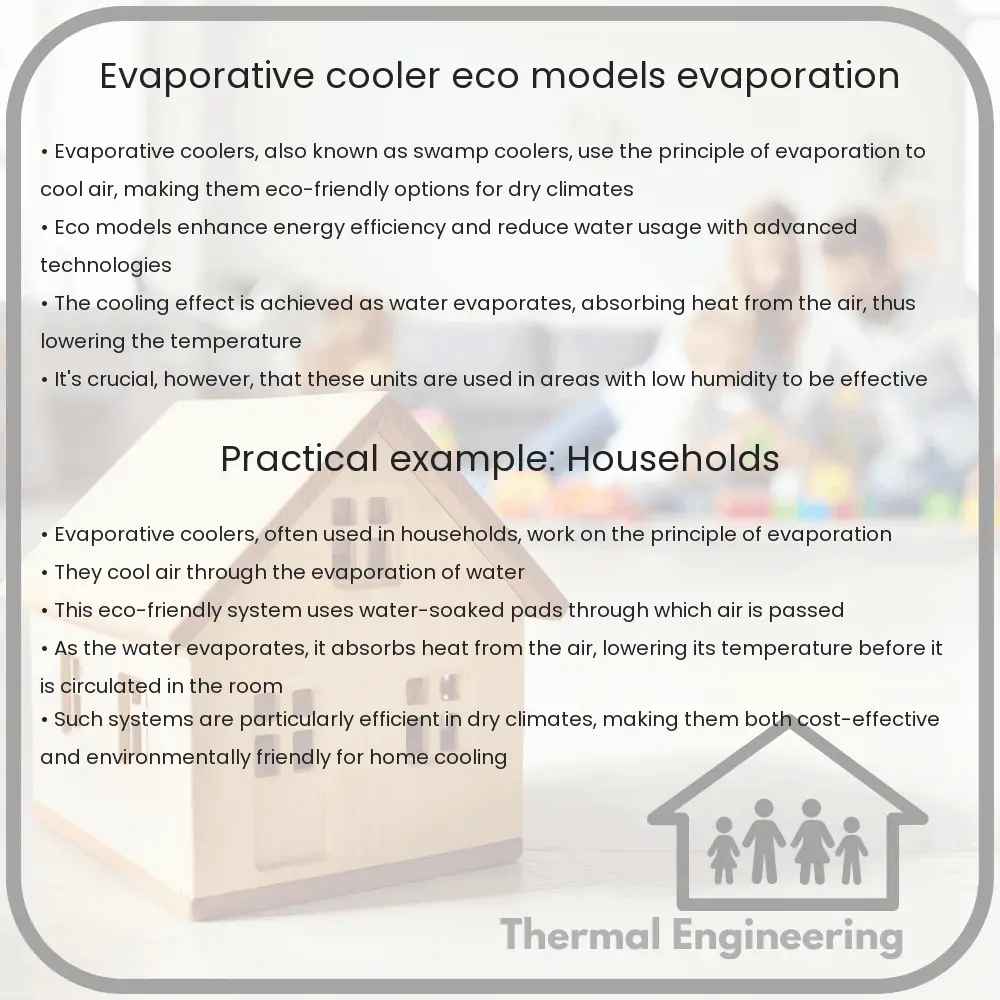
Evaporative coolers, often referred to as swamp coolers, offer an energy-efficient way to cool indoor spaces, particularly in hot, dry climates. This technology harnesses the principles of evaporation to reduce air temperature, using significantly less energy compared to traditional air conditioning systems. This article explores how evaporative coolers work, the benefits of eco-friendly models, and the fundamental physics of evaporation that make this all possible.
How Evaporative Coolers Work
At its core, an evaporative cooler cools air through the process of evaporation. The device consists of a fan, a water reservoir, and a moistened pad. Air is drawn into the cooler and passes over the wet pad. As hot, dry air moves across the pad, water molecules on the surface of the pad absorb some of the air’s heat and then evaporate. This phase change from liquid to vapor removes heat from the air, cooling it before it is circulated back into the room.
The Role of Climate in Evaporative Cooling
Evaporative cooling is most effective in areas with low humidity levels because dry air has a higher capacity to absorb water vapor. As the relative humidity increases, the efficiency of evaporative cooling decreases. This is because moist air has less room to hold additional moisture, reducing the rate of evaporation and consequently the cooling effect.
Eco-Friendly Models of Evaporative Coolers
Eco models of evaporative coolers are designed to maximize energy efficiency and minimize environmental impact. These models often incorporate features such as:
- Energy-efficient motors and fans that reduce electricity consumption.
- Materials that are more durable and/or recyclable to reduce waste.
- Smart technologies that optimize water and energy usage based on real-time climate conditions.
By choosing an eco model, users not only contribute to environmental conservation but also benefit from lower operating costs in terms of energy and maintenance.
Physics Behind Evaporation
The cooling effect of evaporative coolers can be explained through the laws of thermodynamics, particularly the concept of latent heat of vaporization. The latent heat of vaporization is the amount of heat that needs to be absorbed for a liquid to transform into a gas. For water, this value is approximately 2260 Joules per gram at 100°C
Here is the formula for the amount of heat absorbed during the evaporation:
Q = m * Lv
Where:
- Q is the heat absorbed (in Joules)
- m is the mass of water evaporated (in grams)
- Lv is the latent heat of vaporization of water (about 2260 J/g at 100°C)
Through this process, the air temperature is lowered without the need for chemical refrigerants, making evaporative cooling a natural and environmentally friendly method.
Conclusion
Evaporative coolers represent a compelling option for sustainable cooling, particularly in suitable climates. By understanding the basic principles of evaporation and the design of eco-friendly models, consumers can make informed decisions that benefit both their own comfort and the environment. The adoption of such technology could be a significant step towards more sustainable living, leveraging the natural process of evaporation in lieu of more energy-intensive alternatives.