Learn about the design, operation, and applications of Fire Tube Boilers, a fundamental boiler type used since the 18th century.
Introduction to Fire Tube Boilers
Fire tube boilers are a type of boiler in which hot gases from a fire pass through one or more tubes running through a sealed container of water. The heat of the gases is transferred through the walls of the tubes by thermal conduction, heating the water and ultimately creating steam. These boilers are one of the oldest types of boilers and have been in use since the 18th century.
Design of Fire Tube Boilers
The design of fire tube boilers involves a cylindrical shell, closed at both ends, with a horizontal set of tubes that passes through the cylindrical shell. The fire itself is burned in a furnace that is an integral part of the boiler, but could also be separate, depending on the boiler configuration. Here’s how these components are typically arranged:
- Shell: This is the outer cylindrical portion of the boiler, enclosing the water, steam, and the tubes through which the hot gases pass.
- Tubes: A large number of small tubes running through the boiler help in the heat transfer process. The hot gases pass through these tubes, and the water surrounds these tubes.
- Furnace/Firebox: This is where the fuel is burned to generate heat. The resulting hot gases are then directed into the tubes.
- Smokestack: After the gases have passed through the tubes, they are expelled out of the boiler system through the smokestack or chimney.
- Fire Door: It allows technicians to access the firebox for maintenance and fuel loading.
Operation of Fire Tube Boilers
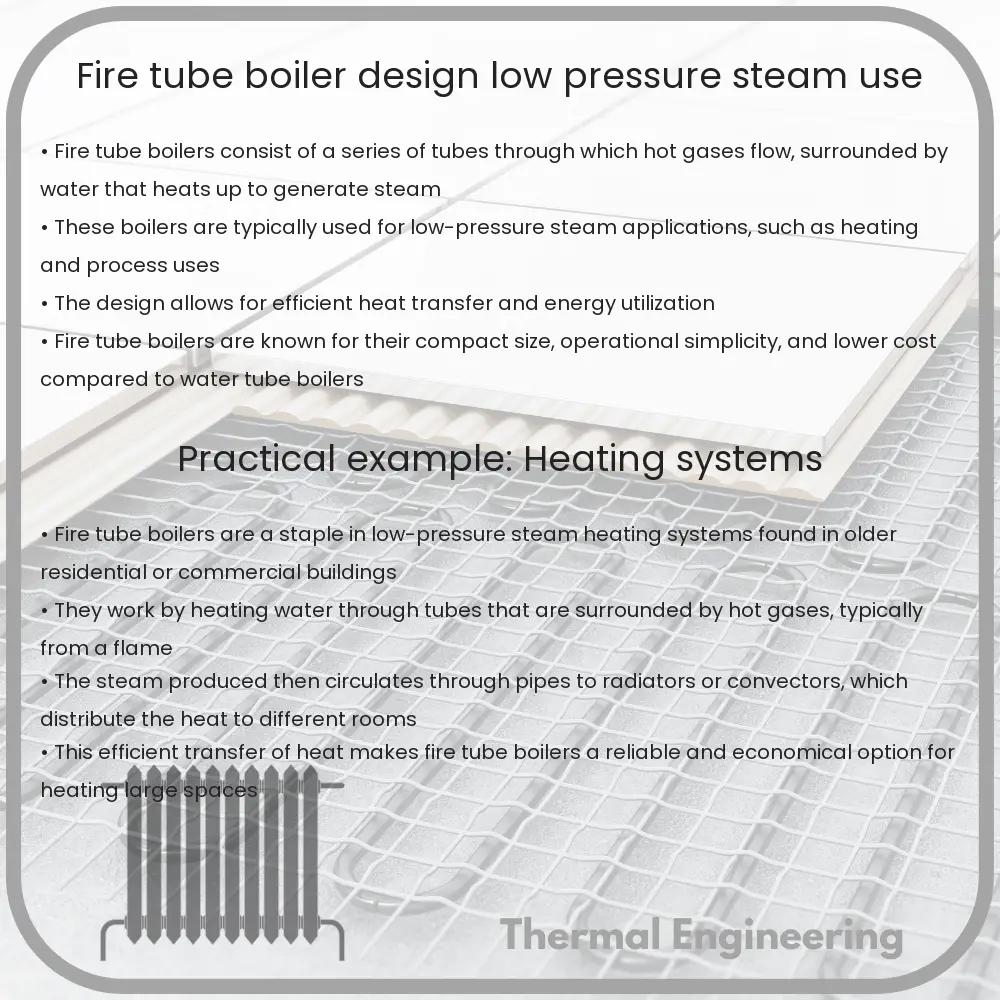
The operation of a fire tube boiler is relatively simple. Fuel, often coal, wood, oil, or gas, is burned in the firebox, producing hot gases. These gases flow through the tubes, surrounded by water in the main body of the boiler. Heat from the gases passes into the water, turning it into steam.
Advantages and Disadvantages of Fire Tube Boiler
- Advantages:
- Simple construction makes them cheaper to manufacture and easier to maintain.
- They have a compact shape and small water volume, which means they can produce steam at a faster rate.
- Operational simplicity and reliability.
- Disadvantages:
- Lower efficiency in generating high pressure steam.
- Not suitable for high power applications in which large volumes of steam are required.
- Higher risk of explosion due to the large amount of water contained within the boiler shell.
Applications of Low-Pressure Steam in Fire Tube Boilers
Low-pressure steam generated by fire tube boilers is predominantly used in a variety of applications:
- Heating applications in buildings and facilities.
- Provision of steam for industrial processes at lower pressures.
- Culinary uses such as steam for baking and cooking.
- Steam for cleaning and sterilization processes.
Conclusion
While fire tube boilers are not suitable for high power or high pressure applications, their simplicity and cost-effectiveness make them a valuable tool for many heating tasks and low-pressure steam needs. With their extensive usage in non-power generation sectors, they remain a crucial component in many industrial and commercial setups.