Learn about flow-induced corrosion (FAC), a significant concern where materials degrade faster due to liquid flow, impacting structural integrity.
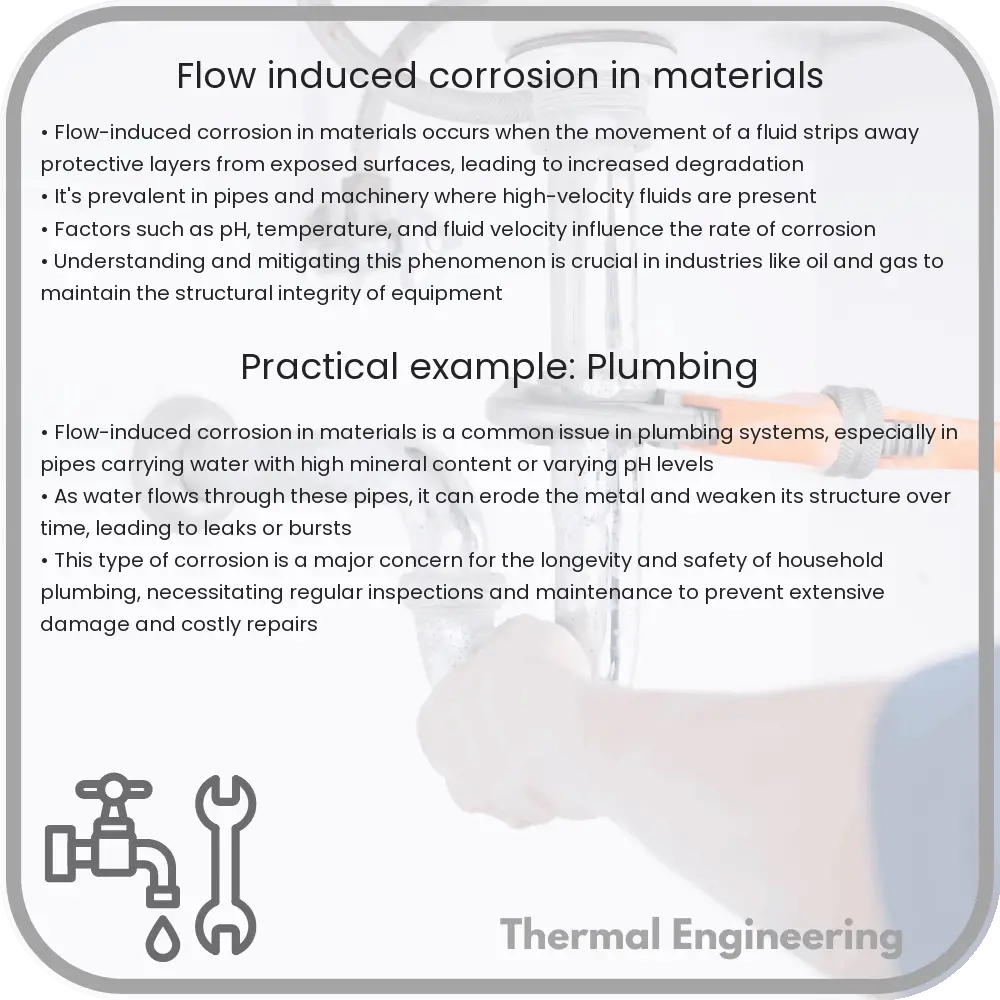
Understanding Flow-Induced Corrosion in Materials
Flow-induced corrosion, also known as flow-accelerated corrosion (FAC), is a significant engineering concern in scenarios where materials are exposed to flowing liquids. The mechanism hinges not only on the chemical interactions between the material and its environment but also on hydrodynamic factors, leading to an escalated degradation rate. This type of corrosion primarily affects metals and can lead to severe consequences if not properly managed, such as the thinning of pipes and failure of structural components.
How Flow-Induced Corrosion Occurs
Flow-induced corrosion happens when a protective oxide layer on a metal surface is continuously removed due to the physical force of a liquid flowing against it. This is particularly critical in cases where water or steam is involved. The rate at which this corrosion occurs depends on several factors:
- Fluid velocity: Higher velocities can increase the rate of corrosion as they enhance the rate of removal of the protective layer.
- Chemistry of the fluid: Certain ions or a low pH in the fluid can accelerate the corrosion process.
- Temperature: Elevated temperatures can increase the corrosiveness of the fluid, as well as the rate of reaction.
- Material properties: Some materials are inherently more resistant to flow-induced corrosion due to their chemical composition and the stability of their oxide layers.
The corrosive process is often described by the equation:
Rcor = k * (vn)
Where Rcor represents the corrosion rate, k is a constant specific to the system, v is the fluid velocity, and n is an exponent that provides insight into the sensitivity of the corrosion rate to changes in velocity.
Real-World Implications and Prevention
In industrial settings, such as power plants and refineries, flow-induced corrosion can lead to failures in systems that are crucial for safety and operation, such as cooling systems or steam lines. The economic implications include not only repair and replacement costs but also potential downtime and losses due to operational interruptions.
Preventing flow-induced corrosion involves several strategies:
- Material selection: Using materials with higher resistance to corrosion can significantly reduce the risk. Alloys containing chromium, for example, might form more stable oxide layers that resist removal.
- Fluid treatment: Chemical additives can adjust the pH or reduce corrosive ions in the fluid, thus mitigating the corrosion process.
- Design adjustments: Engineers can design systems in a way that minimizes high-velocity zones and turbulent flows, which are hot spots for severe flow-induced corrosion.
- Regular monitoring: Implementing corrosion monitoring techniques, such as corrosion coupons, ultrasonic thickness measurement, and erosion-corrosion probes, can help detect early signs of FAC and prevent catastrophic failures.
Understanding flow-induced corrosion is crucial in both designing new systems and maintaining existing infrastructures. With appropriate materials, designs, and maintenance strategies, the detrimental effects of flow-induced corrosion can be significantly mitigated, enhancing both safety and efficiency in various applications.
Conclusion
Flow-induced corrosion continues to be a challenge in many industries, prompting ongoing research and development in material science and engineering strategies. By better understanding the dynamics of this destructive process, engineers can design more durable systems and contribute to longer-lasting and safer infrastructures and machinery.