Exploring the essentials of flow optimization in process engineering for improved efficiency and reduced operational costs.
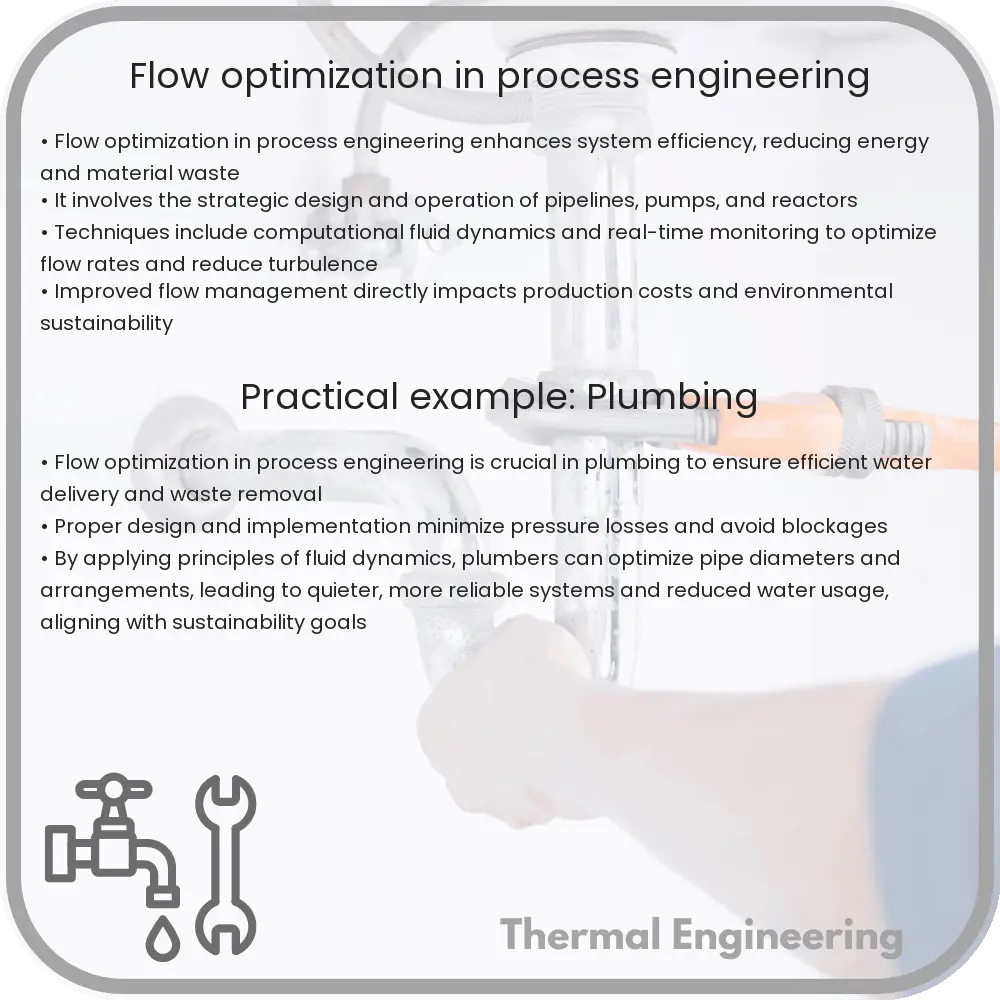
Understanding Flow Optimization in Process Engineering
Flow optimization in process engineering is a crucial aspect that focuses on enhancing the efficiency and effectiveness of fluid movement within industrial processes. This practice aims to streamline operations, reduce costs, and improve product quality by meticulously designing and managing the flow paths of liquids and gases. By optimizing flow, companies can achieve higher safety standards, minimize environmental impact, and bolster overall process performance.
Key Principles of Flow Optimization
At its core, flow optimization involves a number of fundamental principles:
- Laminar vs. Turbulent Flow: Understanding the nature of the flow—whether it is laminar (smooth and orderly) or turbulent (chaotic and swirling)—is essential. Laminar flow generally occurs at lower velocities and higher viscosities and is often more desirable in process systems as it minimizes energy losses and wear.
- Reynolds Number: This dimensionless quantity helps predict flow patterns in different fluid flow situations. The Reynolds number (Re) is calculated as
Re = (ρ * v * L) / μ, where ρ is the fluid density, v is the flow velocity, L is a characteristic linear dimension (like pipe diameter), and μ is the dynamic viscosity of the fluid. Generally, a Re below 2000 indicates laminar flow, while a Re above 4000 suggests turbulent flow. - Pressure Drop and Energy Loss: Minimizing pressure drops and associated energy losses is critical in flow optimization. Engineers strive to design systems that maintain sufficient flow rates while using the least amount of energy and maintaining pressure stability.
Methods Used in Flow Optimization
To achieve optimal flow, multiple methods and tools are employed in process engineering:
- Computational Fluid Dynamics (CFD): CFD is a powerful computational tool used to simulate fluid flow using numerical analysis and data structures. It helps predict flow patterns, temperature distribution, and possible points of inefficiency or failure without needing physical prototypes.
- Piping and Instrumentation Design: Effective layout and sizing of pipes, valves, and fittings are paramount. Engineers use specific design criteria and standards to ensure smooth flow, easy maintenance, and operational safety.
- Use of Optimal Materials: Selecting appropriate materials for pipes and components that minimize friction and resist wear, corrosion, and chemical attacks is crucial for long-term system reliability.
Real-World Applications
Flow optimization finds applications across a breadth of industrial settings:
- Chemical Manufacturing: Optimizing the flow of chemicals through reactors, columns, and transfer lines, ensuring precise control over reaction times and product quality.
- Oil and Gas: In refineries and pipelines where the efficient, safe, and economical transport of oil and gas is vital.
- Water Treatment: Ensuring that water flows through filtration systems efficiently for maximum purification with minimal energy usage.
In conclusion, flow optimization in process engineering plays a pivotal role in enhancing industrial operations across various sectors. By leveraging advanced tools like CFD, adhering to meticulous design standards, and selecting optimal materials, engineers can achieve remarkable improvements in system performance, sustainability, and cost-effectiveness.