Learn how fluid coupling facilitates smooth automotive starts, reduces wear, and enhances vehicle efficiency.
Understanding Fluid Coupling for Smooth Automotive Starts
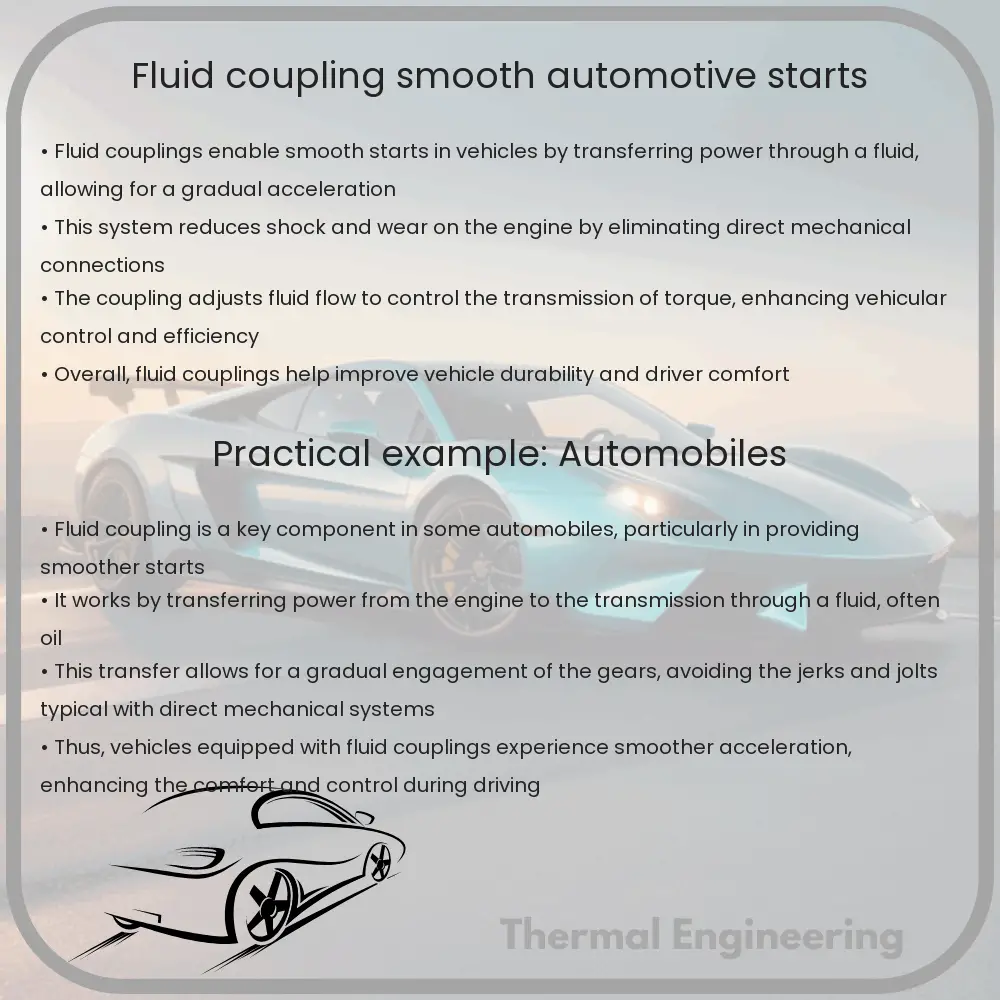
Fluid coupling is an integral component used in automotive powertrains to facilitate smooth and controlled transfer of power from the engine to the transmission system. Unlike hard couplings, fluid couplings allow for a slip between the input and output connections, which provides a range of benefits including reduced wear on components and smoother vehicle starts.
How Fluid Couplings Work
At its core, a fluid coupling consists of two primary parts: the pump (or impeller) and the turbine. Both components are shaped like shells and are filled with hydraulic fluid. The impeller is connected to the engine (input) and as it rotates, it propels the hydraulic fluid centrifugally. This accelerated fluid impacts the blades of the turbine (output), which is connected to the transmission. The motion and energy of the fluid are thus converted back into rotational motion by the turbine, completing the power transmission process.
- Slip Characteristic: One of the defining features of a fluid coupling is its ability to ‘slip’. Unlike a mechanical clutch, there is always a certain amount of RPM difference between the impeller and the turbine, which can be advantageous during gradual start or variable load conditions.
- Smooth Acceleration: The slip also allows for smoother acceleration, as it absorbs shocks and vibrations between the moving parts. This is especially beneficial in preventing jerks and enhancing ride comfort during the initial acceleration from a standstill.
- Torque Conversion: Fluid couplings can also adapt to varying torque demands, which aids in efficient vehicle performance across different speeds and load conditions. The fluid dynamics within the coupling adjust naturally, offering greater control over the torque output.
Advantages of Using Fluid Coupling in Vehicles
- Protective to Drive System: By mitigating mechanical shocks during torque transfer, the fluid coupling extends the lifespan of gearbox and other drivetrain components.
- Reduction in Maintenance Costs: The wear and tear on parts are reduced, leading to lower maintenance and repair costs.
- Increased Fuel Efficiency: Through more efficient power transfer and the ability to adapt to varying load conditions, fluid couplings can contribute to better fuel economy in some cases.
- Enhanced Driver Comfort: The smoothing effect on power transmission greatly enhances driving comfort, a crucial factor in commercial and public transportation vehicles.
Applications Beyond Automotive
While prevalent in the automotive industry, fluid couplings are also widely used in other areas such as marine, industrial, and railway engines. Their ability to handle high inertial loads and provide controlled start-up without shock loading makes them ideal for heavy machinery and applications requiring precise speed control and load management.
Fluid couplings depict a fascinating application of fluid dynamics in power transmission. By enabling smoother starts and offering protection against mechanical wear, these devices play a crucial role in enhancing vehicle performance and lifespan.
In conclusion, the integration of fluid couplings in automotive engineering not only aids in smooth vehicular starts but also contributes to overall system durability and efficiency. As vehicle technology evolves, the role of components like fluid couplings remains pivotal in meeting the increasingly stringent performance and efficiency standards.