Learn how Pressure Relief Valves (PRVs) function as critical safety devices in engineering systems to prevent overpressure and ensure safety.
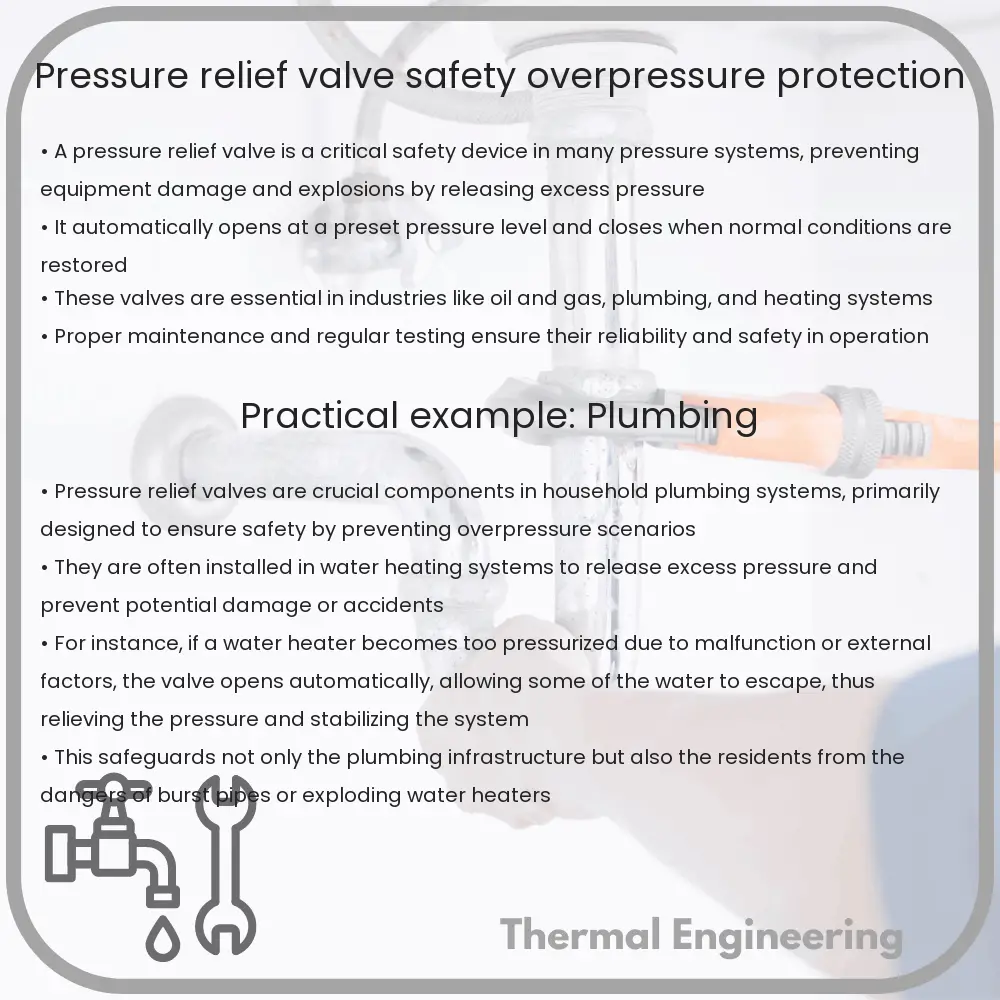
Understanding Pressure Relief Valves: Ensuring Safety and Overpressure Protection
Pressure relief valves (PRVs) are critical safety devices in engineering systems where pressure can build up and exceed the design limits of the system components. These valves play an essential role in protecting equipment, preventing catastrophic failures, and ensuring the safety of personnel. The basic function of a PRV is to automatically release pressure from a boiler, pressure vessel, or other system when the pressure or temperature exceeds preset limits.
How Pressure Relief Valves Work
The operation of pressure relief valves involves a mechanical setup where the valve is typically kept closed by a spring or other mechanical force. The force exerted by the spring is calibrated against the maximum allowable working pressure (MAWP) of the system. When the system pressure exceeds this set limit, the force of the pressure overcoming the spring opens the valve, allowing the excess gas or fluid to escape, thereby relieving the pressure.
Types of Pressure Relief Valves
- Safety Valves: Often used in gas or vapor systems such as steam boilers, safety valves are designed to open rapidly (pop action) and fully at a set pressure.
- Relief Valves: More commonly used in liquid systems, these valves open gradually, allowing the fluid to escape as the pressure increases beyond the threshold.
- Safety Relief Valves: These are versatile valves capable of functioning in both liquid and gas systems, providing the features of both safety and relief valves.
Key Components and Features
- Set Pressure: The predetermined pressure at which the PRV will start to open to release pressure.
- Overpressure: The percentage of increase in pressure above the set pressure; typically, systems are designed to handle a certain level of overpressure (e.g., 10% above MAWP).
- Blowdown: The difference between the pressure at which the valve opens and the pressure at which it reseats or closes, ensures that the valve does not frequently open and close around the set point.
Material and Design Considerations
The design and manufacturing materials of pressure relief valves are critical factors that affect their reliability and effectiveness. Common materials include brass, bronze, and stainless steel, each chosen based on the application, chemical compatibility, and required strength. Design considerations often involve temperature handling capability, corrosion resistance, and the physical properties of the fluids involved.
Sizing and Installation
Sizing a pressure relief valve correctly is crucial to its performance. An undersized valve might not be able to effectively discharge pressure quickly enough, leading to potential system failures. Conversely, an oversized valve could lead to improper sealing and frequent leakage. Installation involves strategic placement where the valve is most effective, typically at high points or near pressure sources in a system. Installation also requires regular maintenance and testing to confirm that the valve operates correctly.
Applications and Importance
Pressure relief valves find applications across a wide range of industries, including oil and gas, pharmaceuticals, and manufacturing, where they help manage the systems’ internal pressures. In domestic environments, they are used in water heating systems, where they prevent potential overpressure caused by thermal expansion.
The importance of PRVs cannot be overstated, as these valves directly contribute to the operational safety and efficiency of many industrial and residential systems. By understanding their functionality, types, and proper maintenance routines, users can significantly mitigate the risks associated with overpressure.
Overall, pressure relief valves serve as a fundamental safeguard, highlighting the intricate balance between operational efficiency and safety in engineering systems.