Learn how fluid mechanics optimizes painting and coating processes, focusing on viscosity, surface tension, and flow patterns for better application.
Understanding the Fluid Mechanics of Painting and Coating Processes
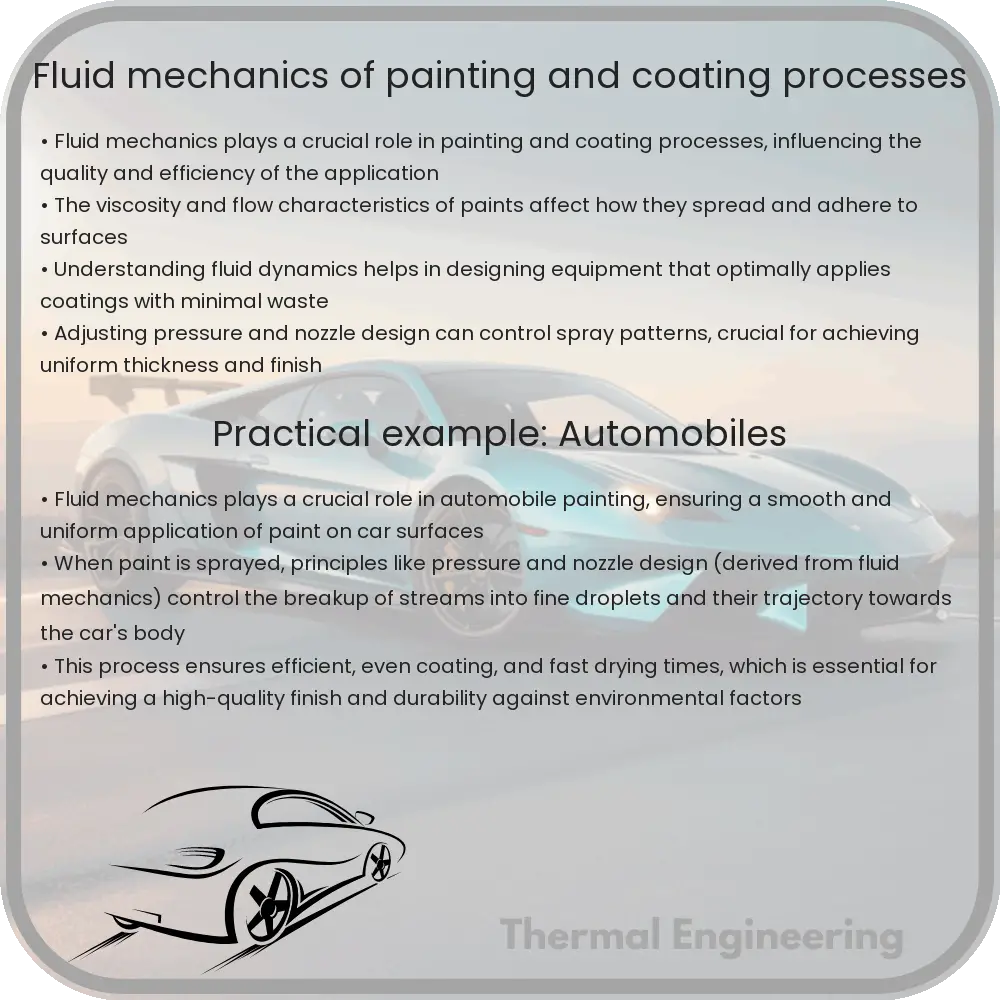
Fluid mechanics plays a crucial role in various engineering applications, one of which is in the processes of painting and coating. This field of study focuses on the behavior of fluids (liquids and gases) in motion and at rest, which is pivotal in optimizing and controlling the application of paints and coatings in manufacturing and industrial settings. Here, we explore the principles and dynamics involved in the fluid mechanics of these processes.
Key Concepts in Fluid Mechanics for Painting and Coating
The application of fluid mechanics in painting and coating involves several fundamental concepts:
- Viscosity: Viscosity is a measure of a fluid’s resistance to gradual deformation by shear or tensile stress. In painting, viscosity affects how paint flows and spreads on surfaces, influencing the ease of application and the quality of the finish.
- Surface Tension: This refers to the elastic tendency of a fluid surface which makes it acquire the least surface area possible. Surface tension affects the wetting and spreading behavior of paints on different substrates, impacting the final appearance and adhesion.
- Reynolds Number (Re): This is a dimensionless quantity in fluid mechanics used to predict flow patterns in different fluid flow situations. The Reynolds number can indicate whether the flow will be laminar or turbulent, which is critical for ensuring uniform paint coats without defects.
- Nozzle Design and Atomization: The design of nozzles in spray painting equipment affects atomization – the breakup of liquid into droplets. Effective atomization is crucial for achieving a uniform thin layer of paint across surfaces.
Mathematical Modeling in Paint Application
Numerous equations and models describe the behavior of fluids in painting and coating processes. Some key equations include:
- Continuity Equation: This equation, given by ∉(dρ/dt) + ∇∙(ρv) = 0 where ρ is the fluid density and v is the velocity field, helps in understanding the conservation of mass in a flowing fluid as it passes through the nozzle of a spray gun.
- Navier-Stokes Equations: These equations describe how the velocity field behaves in viscous fluid dynamics. They can predict the flow characteristics of paint under different pressures and velocities, critical for automated painting systems.
- Bernoulli’s Principle: This principle is fundamental in understanding pressure changes in fluid flows. It is often applied to design spray painting equipment to manage the flow rate and pressure of the paint for optimal application.
Practical Applications and Considerations
Effective application of fluid mechanics in painting and coating processes requires attention to several practical aspects:
- Precision in Application: Ensuring uniform thickness and optimal drying times necessitates precise control over the fluid dynamics parameters like flow rate, nozzle pressure, and spray pattern.
- Equipment Maintenance: Regular maintenance of spraying equipment to prevent clogging and wear, which can significantly alter flow patterns and degrade the quality of the application.
- Environmental Conditions: Temperature and humidity can affect the viscosity and drying rate of paint, thus requiring careful adjustments in application methods based on environmental monitoring.
In conclusion, understanding the fundamentals of fluid mechanics not only enhances the efficiency and quality of painting and coating applications but also drives innovation in the methods and technologies used in these processes. By leveraging these principles, engineers can develop more sophisticated and precise application systems that meet the evolving needs of industries.