Learn about hydraulic systems, their efficiency, components, and applications in various industries through a comprehensive exploration of fluid power transmission.
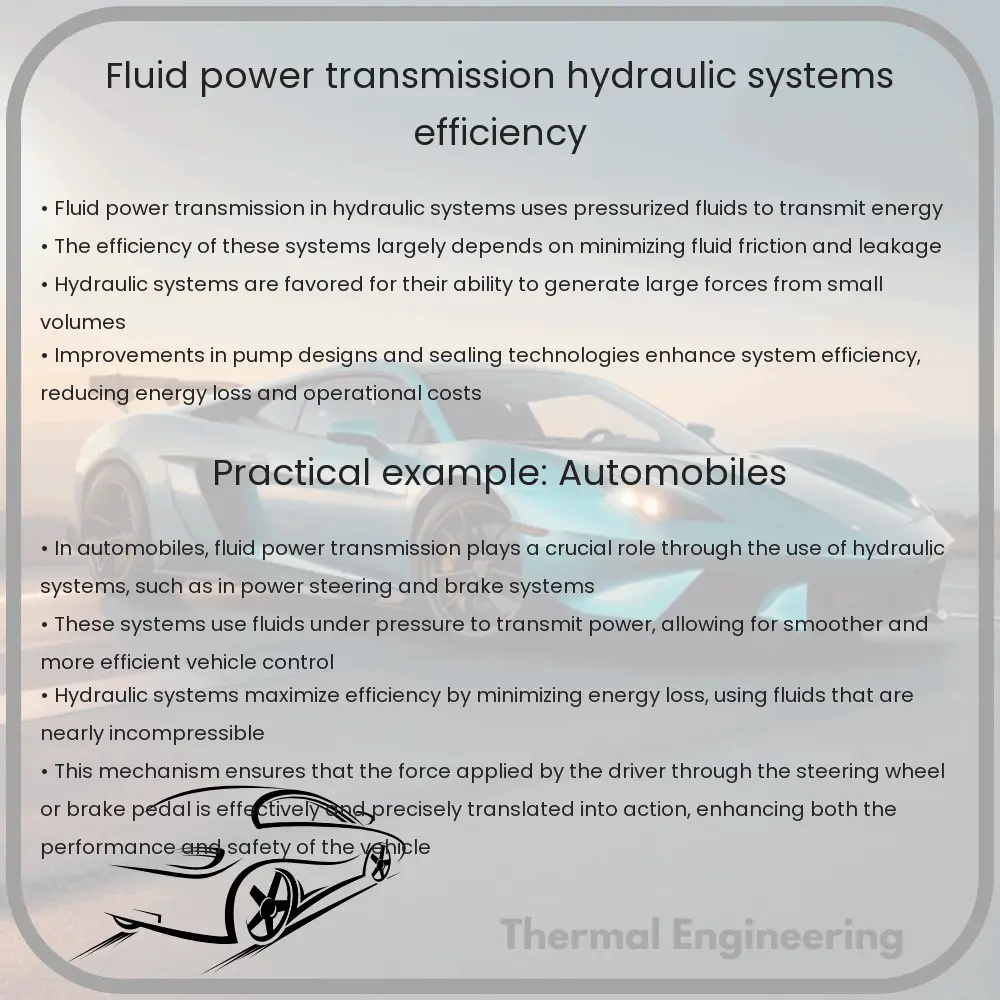
Understanding Fluid Power Transmission: Hydraulic Systems & Efficiency
Fluid power transmission plays a crucial role in modern engineering by using fluids under pressure to transmit energy. Among the most impactful applications of this principle are hydraulic systems, which can be found in everything from automotive brakes to industrial machinery. This article explores the basics of hydraulic systems, their efficiency, and their applications.
How Hydraulic Systems Work
Hydraulic systems operate on the principle of Pascal’s Law, which states that pressure applied to a fluid in a closed system is transmitted equally in all directions. The system typically consists of several key components:
- Reservoir: Stores the hydraulic fluid.
- Pump: Moves the fluid from the reservoir to other parts of the system, converting mechanical energy into fluid energy.
- Valves: Control the flow and direction of the fluid.
- Actuators (Cylinders or Motors): Convert the fluid energy back into mechanical energy to perform work.
- Pipes and Hoses: Channels through which the fluid travels.
When a hydraulic fluid is pumped into an actuator, it creates pressure that leads to mechanical force or motion, enabling devices and machinery to perform various tasks with high power output relative to their size.
Efficiency in Hydraulic Systems
Efficiency in hydraulic systems is generally evaluated based on how well they convert input energy (from the pump) to output energy (at the actuator). However, there are inevitably some losses, primarily due to:
- Fluid Friction: Resistance created by the movement of fluid through pipes and components.
- Leakage: Loss of fluid from the system, which decreases the overall system pressure and efficiency.
- Heat Generation: Caused by fluid friction and inefficiencies in the pump and actuators. This heat needs to be managed because excessive heat can reduce system performance and damage components.
The overall efficiency of a hydraulic system can typically be improved by using high-quality components, maintaining optimal fluid cleanliness, and using properly sized hoses and pipes to minimize resistance and leakage.
Applications of Hydraulic Systems
Due to their ability to generate large amounts of force from relatively small inputs, hydraulic systems are extensively used in various fields:
- Automotive: Brake systems and hydraulic power steering.
- Construction: Heavy equipment such as excavators, forklifts, and bulldozers.
- Manufacturing: Industrial presses and machinery where precision and power are crucial.
- Aerospace: Control surfaces and landing gear operation.
- Maritime: Steering mechanisms and load handling systems.
The adaptability and power of hydraulic systems make them indispensable in situations where substantial force and precise movement are required.
Conclusion
Hydraulic systems exemplify an essential application of fluid power transmission in engineering, characterized by their efficiency and the powerful output they can produce. Ongoing innovations and improvements in hydraulic technology continue to expand their applications and efficiency, making them even more integral to modern machinery and device operations. Understanding the basic principles behind these systems provides a valuable insight into how much of our mechanized world functions.