Fluid-Structure Interaction (FSI) is a fundamental concept in civil engineering, critical for designing safe and enduring structures in fluid environments.
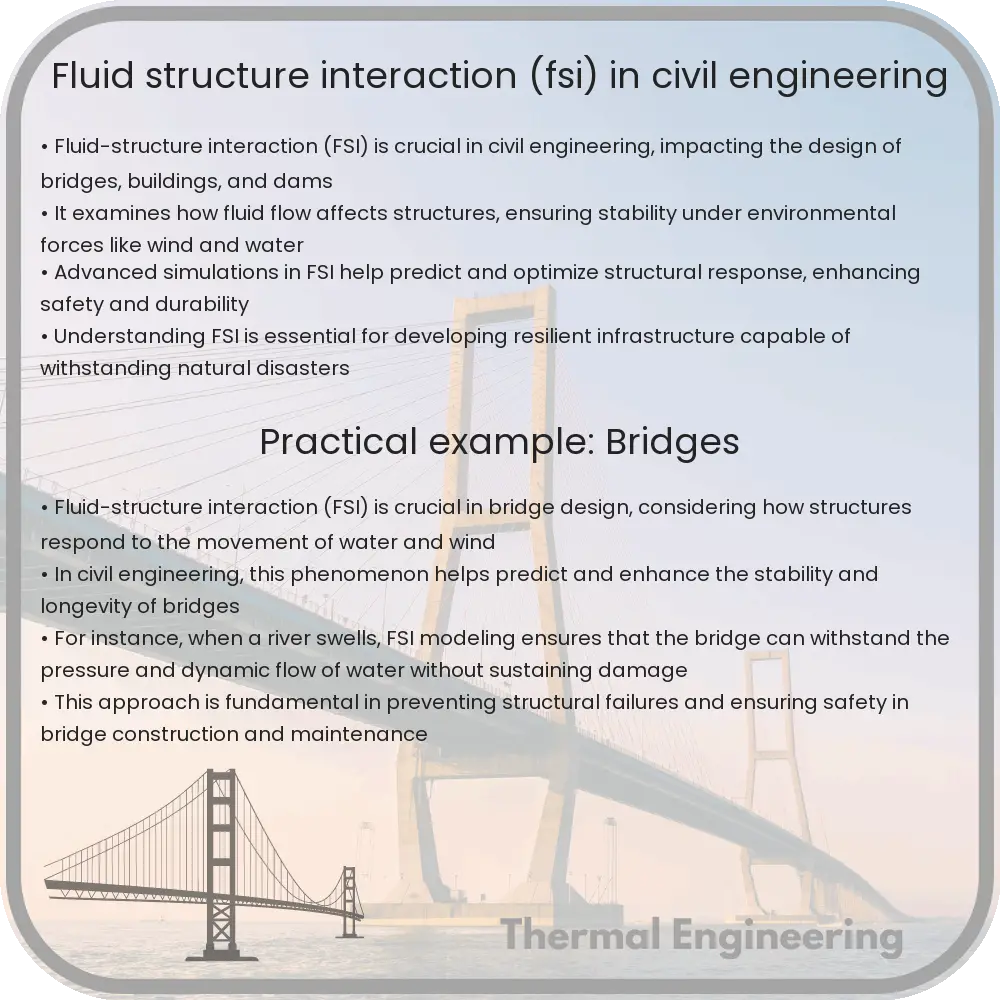
Understanding Fluid-Structure Interaction (FSI) in Civil Engineering
Fluid-Structure Interaction (FSI) is a crucial consideration in civil engineering, affecting the design and integrity of structures exposed to fluid environments. This interaction occurs when a fluid (such as water or air) comes into contact with a structural element, causing both the fluid and the structure to influence each other’s performance. Understanding FSI is essential for ensuring the safety and longevity of infrastructures like bridges, skyscrapers, offshore platforms, and dams.
Key Concepts in Fluid-Structure Interaction
FSI can be broken down into two main categories: one-way FSI and two-way FSI. One-way FSI means the fluid’s effect on the structure is significant, but the structure’s impact on the fluid flow is negligible. This is common in scenarios where the structure is substantially stiffer than the fluid force. In contrast, two-way FSI means both the fluid dynamics and structural responses significantly affect each other, typical in lightweight or flexible structures.
Importance of FSI in Civil Engineering Projects
Integrating FSI analysis in civil engineering projects helps engineers predict and mitigate potential issues arising from dynamic and potentially destabilizing fluid-structural interactions. Here are some areas where FSI is particularly impactful:
- Bridges: Wind and water currents can cause vibrations or oscillations in bridge components, affecting stability and structural integrity. This was famously demonstrated in the collapse of the Tacoma Narrows Bridge in 1940, dominated by aerodynamic flutter and torsional oscillations.
- High-rise Buildings: Skyscrapers are subjected to wind loads that can cause sway, requiring designs that counteract these effects efficiently while maintaining comfort for occupants.
- Offshore Structures: Platforms and wind turbines face constant interaction with maritime environments, needing robust design strategies to handle forces from waves, sea currents, and wind.
- Dams and Spillways: Water interactions with dams are complex, involving pressures, undercurrents, and the potential for scouring, all of which must be analyzed for safety assessments.
Methods of Analysis in FSI
Engineering analysis of FSI usually involves computational methods that simulate the interactions between fluids and structures. The most common approaches include:
- Computational Fluid Dynamics (CFD): Used to simulate fluid flow around and through structures, providing data on pressure, force, and flow patterns.
- Finite Element Analysis (FEA): Used to simulate structural response to loads, including those imposed by fluid interactions.
- Coupled CFD and FEA: Integration of both methods provides a more comprehensive analysis, crucial for understanding complex interactions in real-world scenarios.
Advanced software tools enable the simulation of FSI in a virtual environment, allowing for optimization and testing of designs under various scenarios. This reduces physical prototyping costs and potential risks during the construction phase.
Challenges and Innovations in FSI
Despite advancements in technology, FSI analysis remains complex and computationally intensive. The accuracy of simulations heavily depends on the quality of the mathematical models and input parameters used in the software. Ongoing research and innovation in FSI are directed towards developing more robust and efficient computational techniques, multi-scale models, and real-time monitoring technologies for better prediction and management of these interactions.
In conclusion, understanding and mastering Fluid-Structure Interaction is vital in civil engineering, ensuring structures can withstand and function in their fluid environments. As technologies improve, so too will our ability to create safer, more resilient infrastructure in fluid-interactive contexts.