Learn about foaming agents and their role in enhancing culinary, firefighting, and cleaning applications by reducing surface tension to create stable foams.
Understanding Foaming Agents: Applications in Culinary, Firefighting, and Cleaning
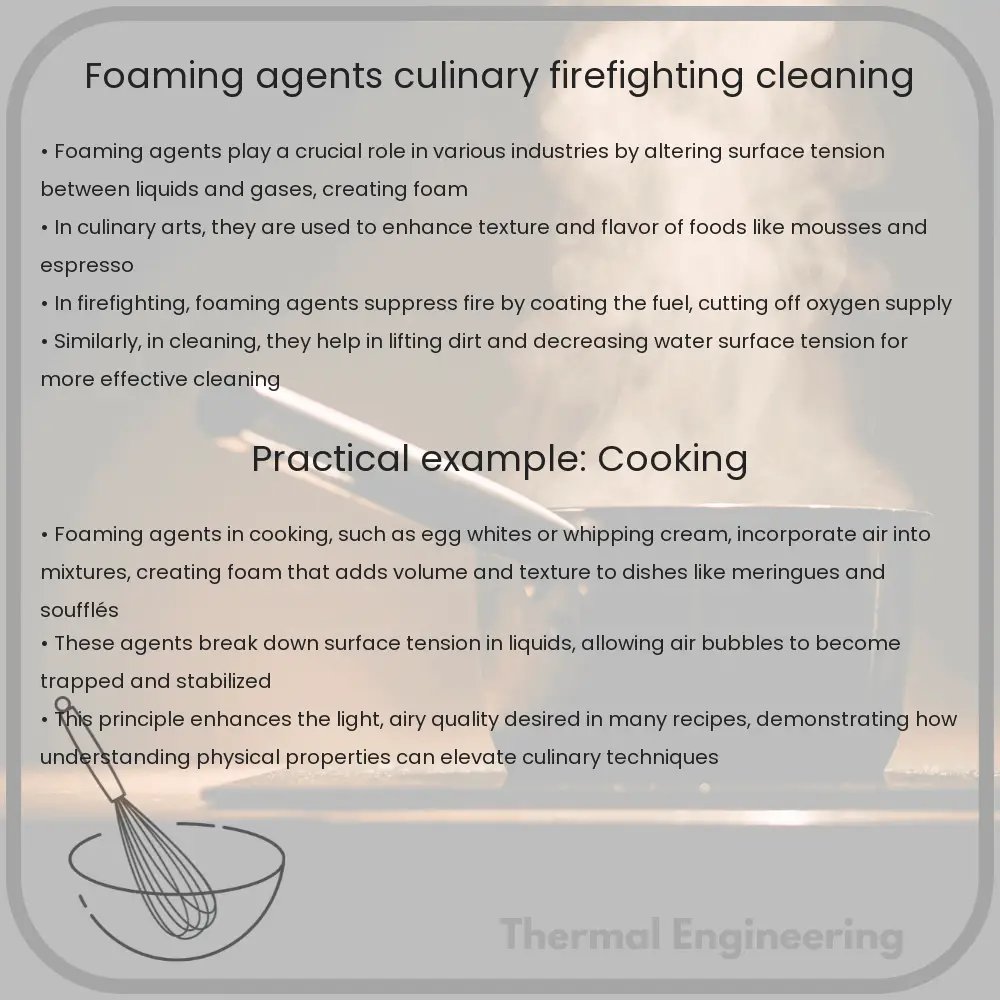
Foaming agents are substances that facilitate the formation of foam or bubbles in various liquids. These agents are critical in numerous fields, including culinary arts, firefighting, and cleaning domains. This article will explore how foaming agents work, their properties, and their applications across these diverse areas.
How Foaming Agents Work
Foaming agents operate by reducing the surface tension of a liquid, allowing air or other gases to become trapped under a layer of the liquid, forming stable bubbles or foam. In technical terms, they consist of surfactants which have two parts: a hydrophilic (water-attracting) head and a hydrophobic (water-repelling) tail. When added to a liquid, these molecules arrange themselves at the surface and around air pockets, stabilizing the interface and facilitating foam formation.
Culinary Uses of Foaming Agents
- Whipped Cream: In culinary applications, foaming agents like lecithin (found in egg yolks) and saponins (found in quillaja) are used to stabilize whipped creams and foams. These agents help retain the air incorporated by whipping, maintaining the structure and volume of the foam.
- Molecular Gastronomy: Ingredients such as methyl cellulose and xanthan gum are used in the innovative field of molecular gastronomy to create unique textures and presentations by stabilizing foams and emulsions.
Firefighting Applications of Foaming Agents
- Class A Foams: Used primarily for wildfires, these foams make water more effective by reducing its surface tension, allowing it to spread and penetrate more effectively over combustible materials.
- Class B Foams: These are used to combat flammable liquid fires. Foaming agents like aqueous film-forming foams (AFFF) form a barrier between the fuel and the air, effectively cutting off the oxygen supply and suppressing the fire.
Cleaning Applications of Foaming Agents
- Detergents and Soaps: Foaming agents in soaps and detergents help in trapping dirt and oils within foam bubbles which can then be easily washed away. Sodium lauryl sulfate (SLS) and sodium laureth sulfate (SLES) are common examples used in domestic and industrial cleaning products.
- Industrial Cleaners: In more rigorous cleaning applications such as in machinery or automotive industries, foaming agents help in breaking down and removing stubborn greases and residue effectively.
Safety and Environmental Considerations
While foaming agents play a critical role in various applications, their impact on health and the environment is also noteworthy. Substances like SLS and SLES, while effective, can pose skin irritation and other health risks with prolonged exposure. Additionally, environmental concerns such as the biodegradability and aquatic toxicity of these chemicals are significant. Alternatives such as naturally derived saponins are being explored for their reduced environmental footprint.
In conclusion, foaming agents are versatile substances that enhance the effectiveness of products across culinary, firefighting, and cleaning applications. Understanding their properties and mechanisms helps industries and consumers utilize them more efficiently and responsibly.