Learn about gear pumps, their mechanism, applications in lubrication systems, and how to calculate their efficiency and flow rates for optimal use.
Understanding Gear Pumps in Positive Displacement and Lubrication Systems
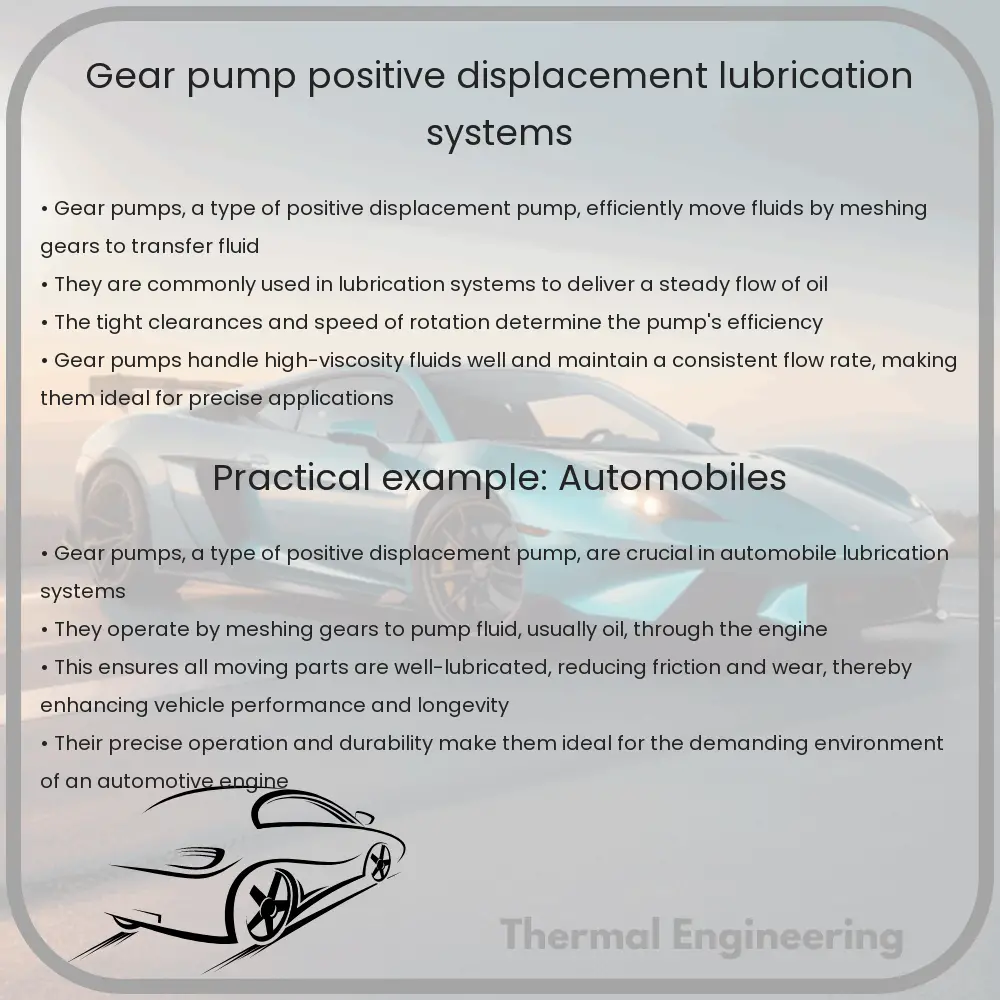
Gear pumps are a type of positive displacement pump, used extensively in fluid power applications, particularly for the hydraulic and lubrication systems. These pumps are renowned for their simplicity, efficiency, and ability to pump viscous fluids effectively. In this article, we’ll delve into how gear pumps operate, their applications in lubrication systems, and some basic calculations relevant to their operation.
How Gear Pumps Work
A gear pump utilizes the meshing of gears to pump fluid by displacement. They are commonly used for pumping high-viscosity fluids at relatively low pressures. The basic components of a gear pump include two gears, a casing, and a pair of bearings. There are primarily two types of gear pumps:
- External Gear Pump: Consists of two identical gears meshing with each other, with one gear being driven by a motor and it in turn drives the other gear.
- Internal Gear Pump: Consists of a gear (rotor) that is nested inside a larger gear (idler). The internal gear has one tooth fewer than the external gear.
As the gears rotate, fluid is drawn into the spaces between the teeth and the casing on the inlet side. The meshing of the gears displaces the fluid and directs it around the casing to the outlet side where the meshing of the gears displaces the fluid out of the discharge port.
Applications in Lubrication Systems
The precision and reliability of gear pumps make them well-suited for lubrication systems, which are critical for industrial machinery and automotive engines. In these systems, the pump delivers a steady flow of oil or grease to critical parts to reduce friction, wear, and overheating. Key applications include:
- Delivering a precise flow of lubricant to bearings and gear meshes in machinery.
- Pumping and circulating oil in engines and turbines.
- Acting as hydraulic power pumps in power transmission systems.
Basic Gear Pump Calculations
To understand the performance of a gear pump, certain key parameters need to be calculated, primarily flow rate and pump efficiency.
Flow Rate: The flow rate of a gear pump can be calculated using the formula:
Q = (n * Vg * ηv) / 231
where:
- Q is the flow rate in gallons per minute (GPM),
- n is the speed of the pump in revolutions per minute (RPM),
- Vg is the displacement per revolution in cubic inches,
- ηv is the volumetric efficiency of the pump (a unitless ratio), and
- 231 is the number of cubic inches in a gallon.
Pump Efficiency: Gear pump efficiency is typically affected by fluid viscosity, operating pressure, and wear. Efficiency can be broken down into:
- Volumetric efficiency (ηv), which measures the effectiveness of the pump in converting input volume into output volume without leakage.
- Mechanical efficiency (ηm), which accounts for losses due to friction and other mechanical factors.
The overall efficiency (ηtotal) of a gear pump can be estimated by the product of its volumetric and mechanical efficiencies:
ηtotal = ηv * ηm
Conclusion
Gear pumps are a vital component in many engineering applications, particularly in lubrication systems. Their ability to handle high-viscosity fluids and their operational reliability make them indispensable in industrial and automotive settings. Understanding how they work and how to calculate important parameters like flow rate and efficiency helps in selecting the right pump for a specific application and ensures optimal operational performance.