An in-depth exploration of the vortex tube, a device that separates compressed air into hot and cold streams without moving parts or chemicals.
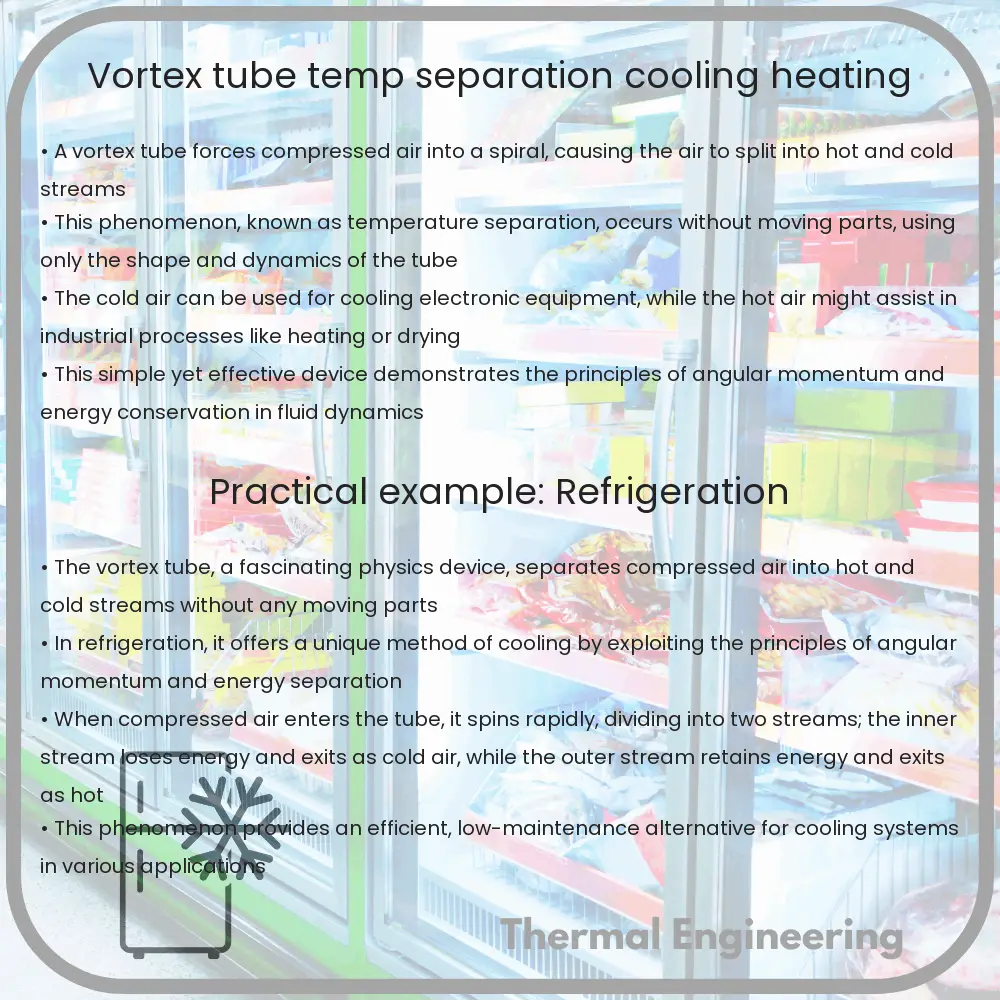
Understanding the Vortex Tube: A Marvel of Temperature Separation
The vortex tube is a fascinating device used in various industrial applications to provide heating and cooling simultaneously without requiring any moving parts or chemicals. Also known as the Ranque-Hilsch vortex tube, it operates on the principle of compressed air expansion and vortex generation to separate air into hot and cold streams. This article explores how a vortex tube works, its applications, and the underlying principles of physics that make it possible.
How Does a Vortex Tube Work?
A vortex tube forces compressed air into a helical motion, creating a vortex. When compressed air is injected tangentially into the cylindrical device, it accelerates into a high-speed spinning motion along the inner walls of the tube. This spinning column of air flows toward the end of the tube, where it reaches a valve that controls the volume of air escaping.
At the end of its streamline path, the air is naturally divided into two parts due to angular momentum and centripetal force’s effects: the inner part of the air column loses heat and exits through one end as cold air while the outer part gains heat and is expelled through the opposite end as hot air. The fascinating aspect is that no external refrigeration or heating is involved. The separation and extreme temperature differences are achieved purely by mechanical means.
Key Physics Principles Involved
- Conservation of Energy: The first law of thermodynamics, or the conservation of energy principle, dictates that the energy within the system (vortex tube) remains constant, merely transforming from kinetic energy into thermal energy.
- Angular Momentum: The air molecules at the center of the vortex travel at higher speed and have lower angular momentum compared to those at the edge, influencing the radial temperature gradient.
- Centripetal Force: This force acts on the spinning air, affecting the radial distribution of temperatures by focusing colder temperatures inward and warmer outward.
Applications of Vortex Tubes
Vortex tubes find applications in various industrial processes. Below are a few key examples:
- Cooling: They are used in industrial spot cooling, especially where conventional cooling methods are impractical—examples include cooling electronic equipment, machining operations, and heat seals.
- Heating: Vortex tubes also aid in industrial heating tasks such as warming cutting tools to prevent material brittleness during high-speed operations.
- Environmental Testing: They are applied in temperature simulation to test components under extreme temperatures or conditions.
Advantages and Limitations
Advantages: Vortex tubes are valued for their simplicity, reliability, and the absence of moving parts, which minimizes maintenance. They operate without electricity (assuming compressed air is available), making them ideal for hazardous or remote environments.
Limitations: The efficiency of a vortex tube is notably lower than traditional heating or cooling devices. They are also dependent on a supply of high-pressure air, which can be a limitation in setups where compressed air is not readily available.
Conclusion
The vortex tube remains a unique and useful tool in modern engineering, demonstrating the clever application of basic physics principles to solve practical problems. While it may not replace traditional heating and cooling systems due to efficiency considerations, its simplicity and adaptability make it an invaluable device for special applications.
As engineers continue to explore the potential of the vortex tube, further enhancements and applications may arise, broadening its utilitarian scope even further in industrial environments.