Learn about heat exchangers, their types, applications, and operating principles in various industries.
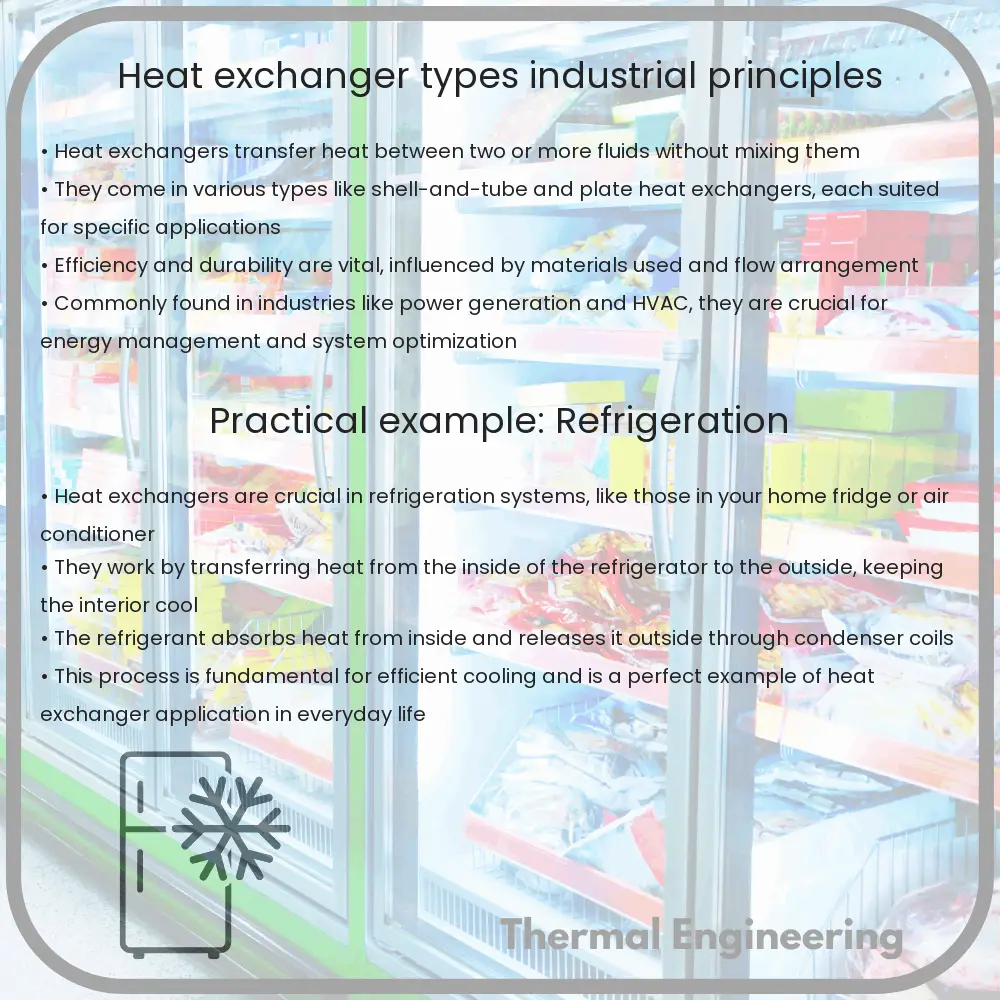
Understanding Heat Exchangers: Types and Industrial Applications
Heat exchangers are devices designed to transfer heat between two or more fluids—liquids, vapors, or gases—of different temperatures. Depending on the type of heat exchanger employed, the fluids may be separated by a solid wall to prevent mixing or may be in direct contact. They are widely used in various applications, including power plants, automotive engines, refrigeration, air conditioning systems, chemical plants, petrochemical plants, petroleum refineries, and natural gas processing.
Types of Heat Exchangers
- Shell and Tube Heat Exchangers: This is the most common type found in many industries. They are constructed of a series of tubes, one set carrying the hot fluid and the other the cold fluid. The tubes are enclosed in a shell, and heat transfer occurs as the fluids move through the tubes. The arrangement allows for high pressures and offers a flexible design to handle a wide range of temperatures.
- Plate Heat Exchangers: These exchangers use metal plates to transfer heat between two fluids. The major advantage of this type is that the fluids are exposed to a much larger surface area, making the heat transfer more efficient. Plate heat exchangers are typically more compact than shell and tube types.
- Fin Tube Heat Exchangers: These enhance heat transfer through fins on tubes. The fins increase the exterior surface area of the tube, improving the heat exchange efficiency. These are commonly used where one of the fluids is air or another gas.
- Condensers, Evaporators, and Boilers: While these are specific types of heat exchangers, each serves a particular purpose in refrigeration, HVAC systems, and power plants. Condensers cool gases into liquids; evaporators turn liquid into gases absorbing heat, and boilers transfer energy to water, turning it into steam.
Industrial Principles of Heat Exchangers
Heat exchangers operate on the principle of heat transfer by conduction or convection. In an industrial setting, these devices are vital in controlling fluid temperatures, thereby ensuring the efficiency and longevity of machines. The effectiveness of a heat exchanger is determined by several factors:
- Temperature Difference: The greater the temperature difference between the hot and cold fluids, the more effective the heat transfer process. This is quantified by the logarithmic mean temperature difference (LMTD).
- Heat Transfer Area: The amount of surface area available for heat transfer directly affects the rate at which heat is exchanged. More area can lead to more efficient heat transfer.
- Flow Arrangement: Fluids can flow in a parallel flow, counterflow, or cross-flow arrangement. Counterflow is typically the most efficient, as it allows the maximum temperature difference between fluids over the longest part of the exchanger.
- Properties of Fluids: The thermal conductivity, density, and viscosity of the fluids also affect the efficiency of the heat exchanger.
Heat exchangers are critical components in many industrial processes where temperature regulation is necessary. Understanding the different types and how they operate helps in selecting the right heat exchanger for a specific application, ensuring efficiency, safety, and cost-effectiveness in industrial operations.
In summary, heat exchangers are indispensable tools in the engineering industry, playing crucial roles in maintaining energy efficiency and process stability across various sectors. Their design and operational principles adapt to meet the demands of the specific functions they serve, making them a key element in the infrastructure of modern industry.