Explore the critical role of heat transfer in additive manufacturing, including its mechanisms and challenges, to optimize 3D printing processes.
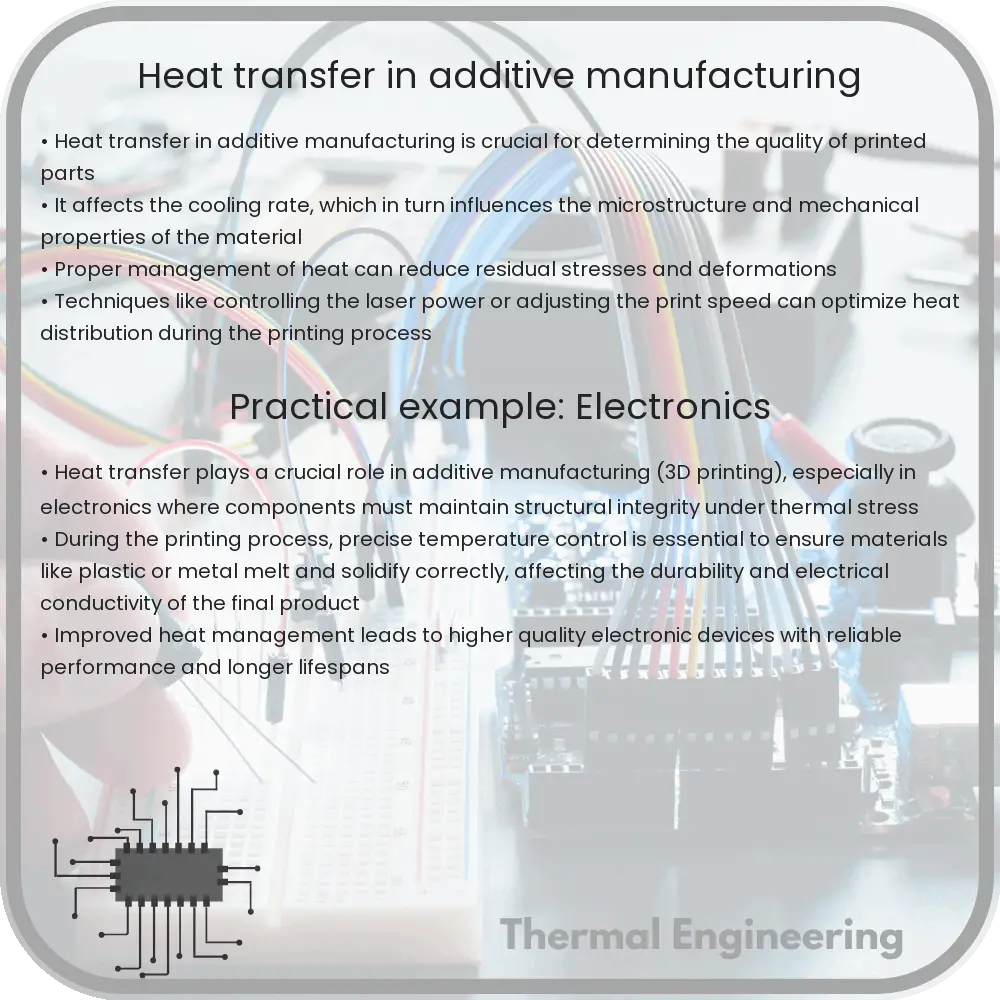
Understanding Heat Transfer in Additive Manufacturing
Additive manufacturing (AM), commonly known as 3D printing, is a revolutionary manufacturing process that builds parts layer by layer from digital models. While additive manufacturing offers substantial design flexibility and material efficiency, managing heat transfer during the printing process is critical for ensuring product quality and structural integrity. This article explores the basics of heat transfer in additive manufacturing and its implications on the process and final product.
Types of Heat Transfer in Additive Manufacturing
Heat transfer in additive manufacturing primarily involves three mechanisms:
- Conduction: This is the transfer of heat through materials. In AM, heat is conducted from the heat source (like a laser or electron beam) through the deposited material to the underlying layers and the build platform.
- Convection: Heat transfer occurs through the movement of fluids (air or inert gas in the build environment) over the surface of the part being printed. This can help in cooling the material as well as in removing by-product gases or particles.
- Radiation: Thermal radiation is the emission of heat in the form of infrared radiation from the surface. High temperatures typically used in AM make radiation a notable mechanism for heat transfer, particularly in processes involving metals.
Challenges Posed by Heat Transfer in Additive Manufacturing
Managing heat transfer in AM is crucial due to the following challenges:
- Thermal Stresses: Rapid heating and cooling rates can lead to significant temperature gradients within the material, generating thermal stresses. These stresses can cause warping, distortion, and even cracking of the material.
- Microstructural Changes: The thermal history of the material affects its microstructure, which in turn influences the mechanical properties such as strength, hardness, and ductility. Uneven cooling can lead to anisotropic properties, where the material behaves differently depending on the direction of the load.
- Residual Stresses: The accumulation of thermal stresses during the layer-by-layer construction can introduce residual stresses, which might lead to failures upon removal from the build plate or during post-processing stages.
Techniques for Managing Heat Transfer
To mitigate the issues associated with heat transfer in additive manufacturing, several techniques are applied:
- Optimized Process Parameters: Adjusting laser power, scanning speed, and hatch spacing are common ways to control the input heat and its distribution during the process.
- Preheating the Build Platform: Preheating can help in reducing thermal gradients between the build platform and the deposited layers, thereby decreasing the likelihood of part warping and delamination.
- Layer Time Control: By controlling the time interval between the deposition of successive layers, sufficient cooling can be ensured, allowing for the dissipation of excess heat and reducing thermal stresses.
- Use of Thermal Barriers: Incorporating thermal barrier coatings or materials can aid in managing heat conduction rates, particularly in parts with complex geometries or varying cross-sectional areas.
In summary, effective heat management in additive manufacturing is vital for achieving high-quality, dimensionally accurate parts with desirable material properties. Developers and engineers continue to innovate in process control and material science to better control and predict heat transfer dynamics in various AM technologies. This ongoing work expands the capabilities of additive manufacturing, pushing it towards broader industrial applications.