Learn how heat transfer impacts fire safety engineering through conduction, convection, and radiation, influencing building design and fire protection systems.
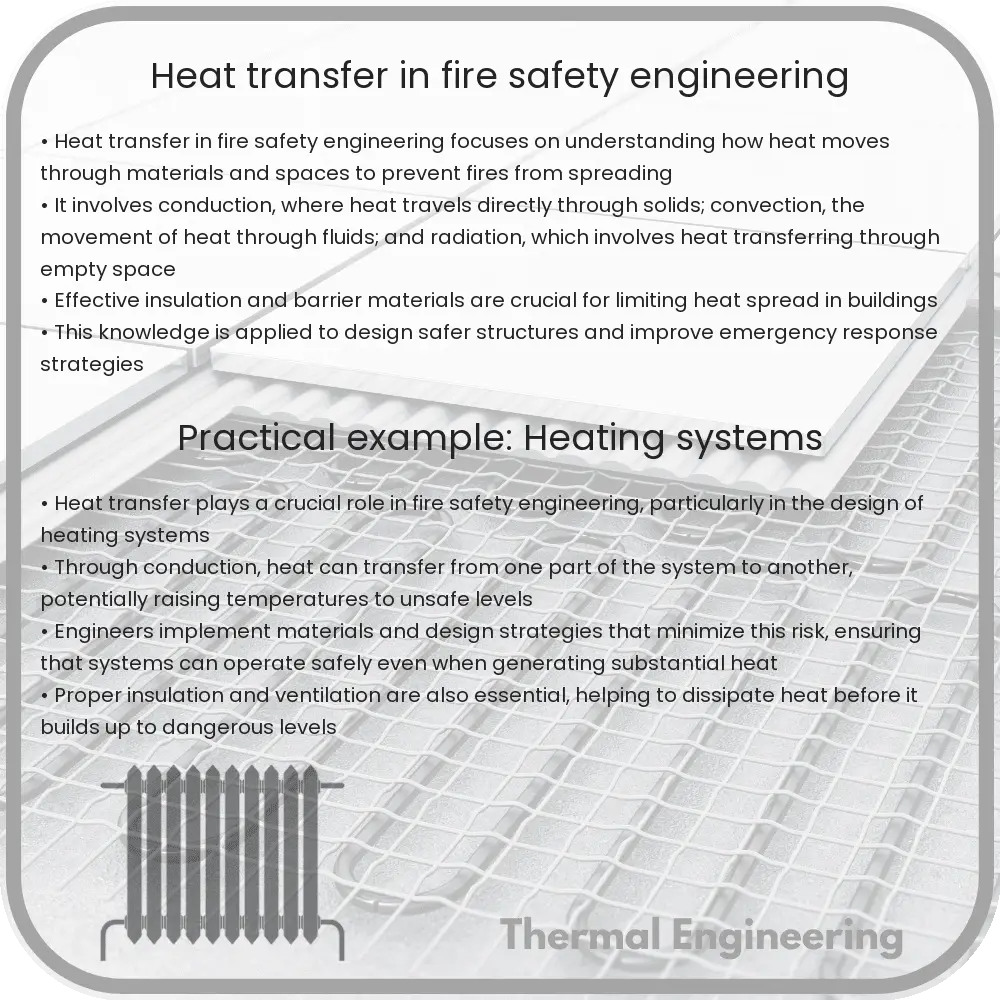
Understanding Heat Transfer in Fire Safety Engineering
Heat transfer plays a crucial role in the field of fire safety engineering. It involves the movement of heat from one area to another, which can greatly influence the spread of fire within structures and affect the safety measures in place. Understanding the principles of heat transfer helps engineers design safer buildings and develop better fire protection systems.
Types of Heat Transfer
There are three primary modes of heat transfer relevant to fire safety: conduction, convection, and radiation. Each of these plays a different role during a fire event.
- Conduction is the transfer of heat through materials. In buildings, heat can be conducted through walls, floors, and ceilings, spreading the fire to different parts of the structure. The rate of heat transfer by conduction can be described by Fourier’s law:
\( q = -k \frac{dT}{dx} \)
where \( q \) represents the heat flux, \( k \) is the thermal conductivity of the material, \( dT \) is the temperature difference, and \( dx \) is the thickness of the material.
- Convection involves heat transfer through fluids (liquids and gases), which is particularly important in the spread of fire as hot gases rise and cool gases descend. Convective heat transfer can enhance the spread of fire by moving hot smoke and flames to new areas.
The convective heat transfer rate can be estimated using Newton’s law of cooling:
\( q = hA(T_s – T_{\infty}) \)
where \( h \) is the convective heat transfer coefficient, \( A \) is the area through which heat is being transferred, \( T_s \) is the surface temperature, and \( T_{\infty} \) is the fluid temperature far from the surface.
- Radiation is the emission and transmission of energy in the form of rays or waves. Heat from a fire radiates in all directions and can ignite combustible materials even without direct contact.
The radiant heat flux can be calculated by the Stefan-Boltzmann law:
\( q = \epsilon \sigma A (T^4 – T_{\infty}^4) \)
where \( \epsilon \) is the emissivity of the material, \( \sigma \) is the Stefan-Boltzmann constant, and \( T \) and \( T_{\infty} \) are the temperatures of the surface and the surroundings respectively.
Applications in Fire Safety Engineering
The understanding of heat transfer mechanisms is applied in various ways in fire safety engineering:
- Fire Resistance Material Design: Engineers select materials with lower thermal conductivity and higher heat capacity to delay the spread of heat through conduction.
- Structural Fire Protection: Fire-resistant coatings and compounds are used to enhance the thermal resistance of structural elements, limiting the effects of heat and preventing structural collapse.
- Smoke Management Systems: Effective design of ventilation systems can manage the convective flow of hot gases and smoke, enhancing evacuation and firefighting efforts.
- Alarms and Detection: Radiation sensors, such as infrared detectors, can identify unusual heat fluxes indicative of a developing fire, triggering alarms and initiating response measures.
Comprehending these fundamental concepts of heat transfer allows fire safety engineers to create safer environments and protect both lives and properties from the devastating effects of fires. With advances in technology and continuous research, the application of this knowledge continually evolves, leading to more effective fire safety strategies.