Learn about heat transfer in geothermal systems, including conduction, convection, and radiation, and their role in sustainable energy.
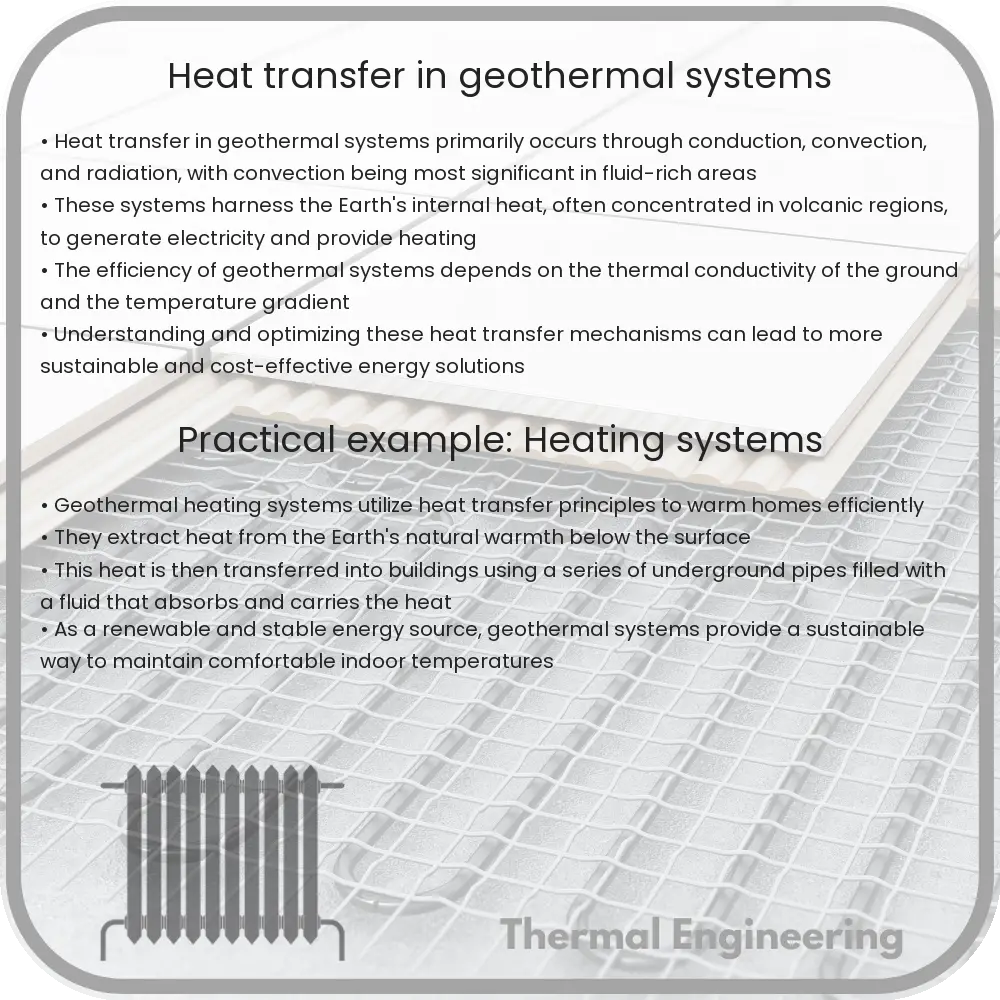
Understanding Heat Transfer in Geothermal Systems
Geothermal systems tap into the Earth’s internal heat as a reliable and eco-friendly energy source. This technology has gained attention for its contribution to sustainable energy solutions. The efficiency of geothermal systems largely depends on the principles of heat transfer, which involves the movement of heat from the Earth’s core to the surface and ultimately into our homes or power plants.
Key Types of Heat Transfer
There are three main mechanisms through which heat transfer occurs in geothermal systems:
- Conduction: This is the transfer of heat through materials without the movement of the material itself. In geothermal systems, heat conducts through the Earth’s crust, warming the rocks and water in geothermal reservoirs.
- Convection: Heat is also transferred by the movement of fluids. In a geothermal setup, this typically refers to the movement of water and steam within the Earth, circulating heat through natural or artificially created reservoirs.
- Radiation: Though less significant in geothermal systems, radiation is the transfer of energy through electromagnetic waves. In deep Earth, heat radiates from molten material to surrounding rock.
Heat Transfer Equation
The basic equation governing conductive heat transfer is Fourier’s law of heat conduction, which is expressed as:
q = -k * A * (dT/dx)
- q represents the heat transfer rate (in Watts),
- k is the thermal conductivity of the material (in W/mK),
- A is the area through which heat is being transferred (in square meters),
- dT/dx is the temperature gradient (in °C/m).
The negative sign indicates that heat flows from higher to lower temperatures.
Applications of Heat Transfer in Geothermal Systems
Efficient heat transfer is crucial in the design and operation of geothermal systems, which can be categorized primarily into three types:
- Direct Use Systems: These systems use geothermal hot water for heating buildings, greenhouses, pools, and industrial processes. The efficiency of these systems depends on the minimization of heat losses during transfer from the source to the end-use.
- Geothermal Heat Pumps: Also known as ground-source heat pumps, these systems utilize the stable ground temperature to provide heating, cooling, and hot water. They rely on conduction to transfer heat between the ground and a fluid that is circulated in a loop buried underground.
- Geothermal Power Plants: These plants convert geothermal heat into electricity. The plants exploit the heat from natural geothermal reservoirs, often transforming it from thermal to kinetic energy using steam turbines.
Improving Heat Transfer Efficiency
Enhancing heat transfer efficiency in geothermal systems can significantly affect their overall performance and environmental impact. Innovations may include improving materials used in heat exchangers, optimizing the geometry of the system, or enhancing the properties of the transfer fluid. Scientists and engineers continually study geological formations and fluid dynamics to develop more efficient geothermal systems.
Understanding the basics of heat transfer in geothermal systems not only aids in the appreciation of these green technologies but also highlights the intricate relationship between natural resources and human-engineered solutions.