Learn about thermal fluid systems, their key components, mechanisms of heat transfer, and applications in various industries.
Understanding How Thermal Fluid Systems Transfer Heat
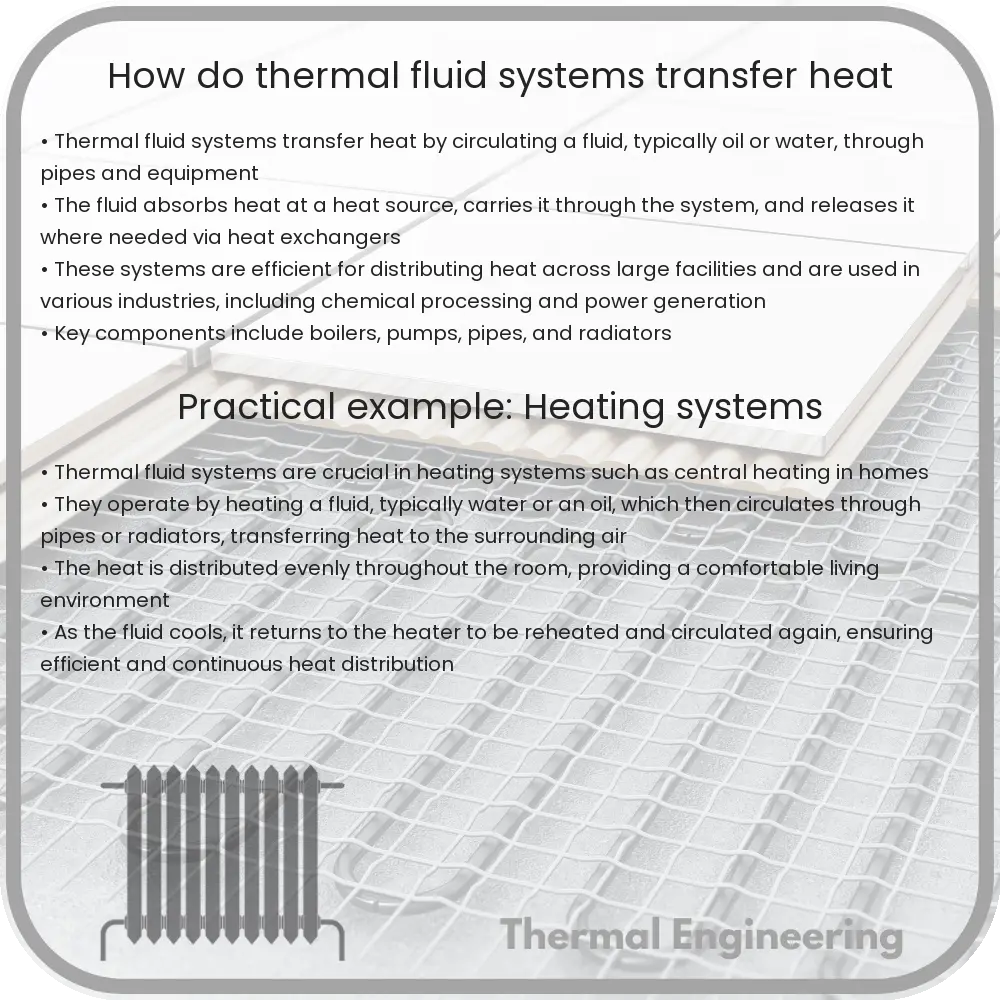
Thermal fluid systems, also known as heat transfer systems, play a crucial role in numerous industrial processes where heating and cooling are required. These systems are designed to transfer heat efficiently and safely across different temperatures and phases, often using a fluid as the medium of heat exchange. Here, we’ll delve into the fundamentals of how these systems function and the various mechanisms involved in the heat transfer process.
Key Components of Thermal Fluid Systems
Before diving into the mechanisms of heat transfer, let’s first identify the core components typically found in thermal fluid systems:
- Heat Source: This includes any equipment that generates heat, such as boilers or heaters.
- Heat Transfer Fluid (HTF): This fluid carries thermal energy from one part of the system to another. It is usually a liquid, such as oil or water, but can also be a gas.
- Heat User: The end point where the transferred heat is utilized, which could be a process stream or a heat exchanger.
- Piping and Pumps: These are used to transport the HTF throughout the system efficiently.
- Expansion Tank: This component accommodates the HTF’s expansion and contraction as it heats and cools.
- Control System: This ensures that the system operates within safe and efficient parameters.
Heat Transfer Mechanisms in Thermal Fluid Systems
Heat transfer in these systems generally occurs through three primary mechanisms:
- Conduction: Heat transfer through direct contact. The molecular agitation of heated particles transfers energy to adjacent particles in the fluid, increasing their thermal energy.
- Convection: Heat is carried away by the movement of the HTF. This can be either natural convection, resulting from density differences within the fluid due to temperature variations, or forced convection, where an external mechanism like a pump enhances the fluid motion.
- Radiation: Heat transfer through electromagnetic waves, which can occur even without a medium, such as in space. However, in thermal fluid systems, radiation is often less significant compared to conduction and convection.
The efficiency of each mechanism is influenced by factors such as the thermal conductivity of the fluid, the system’s temperature, the flow rate of the fluid, and the surface area over which the heat transfer occurs.
Equations Governing Heat Transfer
In any heat transfer process, several equations are fundamental. Among the most important is the heat transfer equation:
Q = m * Cp * ΔT
where:
- Q is the heat transferred (in joules or calories)
- m is the mass of the heat transfer fluid (in kilograms)
- Cp is the specific heat capacity of the fluid (in joules per kilogram per degree Celsius)
- ΔT is the change in temperature of the fluid (in degrees Celsius)
Another essential concept in heat transfer systems is the heat transfer coefficient (h), which quantifies the heat transfer rate per unit area per unit temperature difference:
Q = h * A * ΔT
where:
- A is the area through which heat is being transferred (in square meters)
Applications of Thermal Fluid Systems
Thermal fluid systems find applications in many industries, including:
- Chemical Processing: For controlling the temperature during chemical reactions.
- Plastics Manufacturing: For precise temperature control in plastic molding processes.
- Food and Beverage: In pasteurization and sterilization processes.
- Pharmaceuticals: For maintaining critical temperatures in drug manufacturing.
Understanding these principles helps in appreciating how essential thermal fluid systems are to modern industry, impacting productivity, safety, and efficiency. By mastering the basics of how these systems transfer heat, engineers can optimize processes and innovate new solutions across various fields.