Explore how heat transfer operates within microfluidic devices, impacting chemical reactions and biological processes.
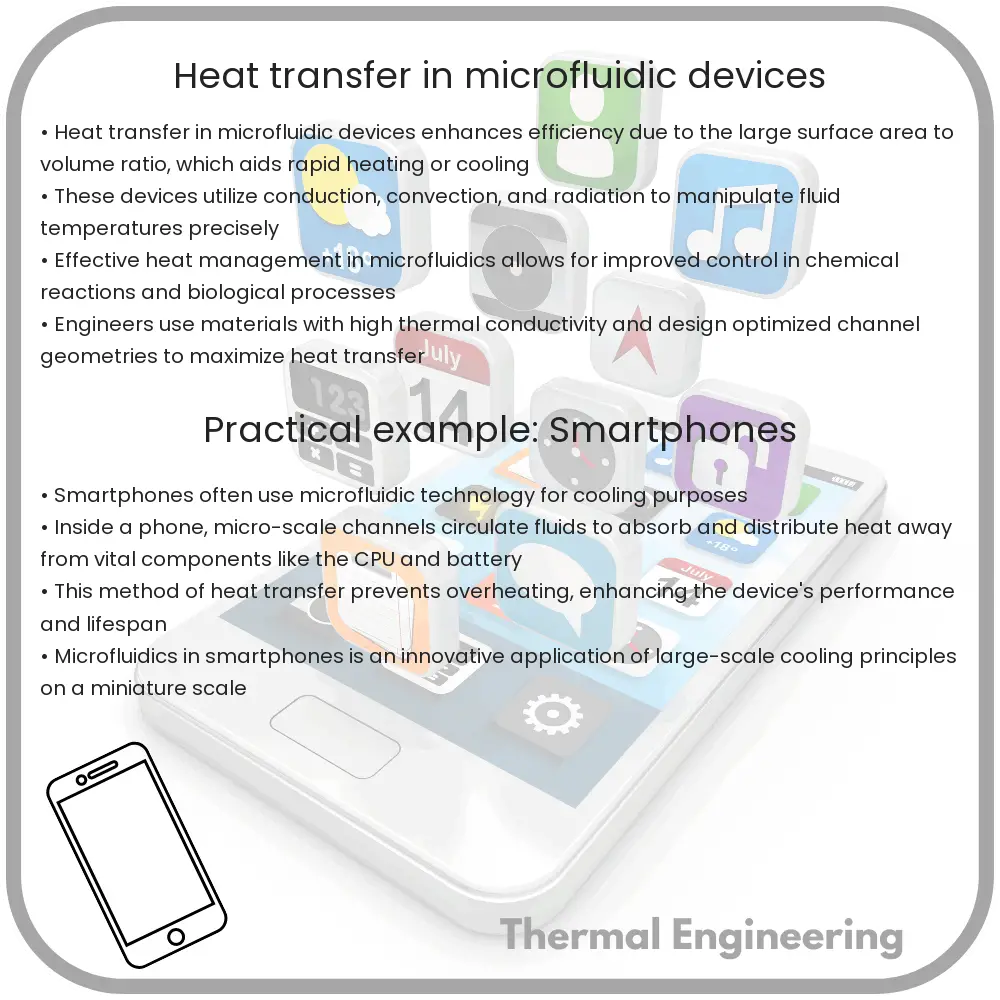
Understanding Heat Transfer in Microfluidic Devices
Microfluidic devices, often described as labs-on-a-chip, are increasingly vital in biochemical and medical fields for their ability to manipulate small volumes of fluids. One crucial aspect of their operation is understanding heat transfer, which affects everything from chemical reaction rates to biological cell viability. In this article, we will explore the types of heat transfer in microfluidic devices and consider some engineering solutions to manage heat effectively.
Types of Heat Transfer in Microfluidic Devices
Heat transfer in microfluidic devices can occur in three primary ways:
- Conduction: This is the transfer of heat through a solid material or between fluids in contact. In microfluidics, heat conduction is significant between different layers of the device materials and between the fluid and the device walls.
- Convection: Convection occurs when heat is carried along with the movement of fluids. In most microfluidic applications, fluid motion is laminar (i.e., flows in parallel layers with no disruption between them), which profoundly influences convection mechanisms.
- Radiation: Although less common in microfluidic devices due to their small scale and the types of materials used, radiation can transfer heat between surfaces that are separated by a transparent medium without needing direct contact.
Of these, conduction and convection are most relevant in microfluidic applications, with conduction often dominating due to the small dimensions and close contact between different components of the devices.
Fundamental Principles
The fundamental equation governing heat transfer in microfluidic devices is the heat equation, derived from the law of conservation of energy. For a homogeneous and isotropic material, it is given in its simplest form by:
\( \frac{\partial T}{\partial t} = \alpha \left(\frac{\partial^2 T}{\partial x^2} + \frac{\partial^2 T}{\partial y^2} + \frac{\partial^2 T}{\partial z^2}\right) \)
where \( T \) is the temperature, \( t \) is time, \( \alpha \) is the thermal diffusivity of the material, and \( x, y, z \) are the spatial coordinates.
Engineering Solutions for Managing Heat
Effective management of heat in microfluidic devices is critical for the accuracy and reliability of the processes they are intended to carry out. Engineers employ several strategies:
- Material Selection: Choosing materials with appropriate thermal conductivity can help manage heat transfer efficiently. For example, silicon, commonly used in microfabrication, has high thermal conductivity, assisting in the rapid spread of heat and preventing local hotspots.
- Device Design: The geometric design of the device can also influence heat transfer. Thin layers and high surface-area-to-volume ratios typical in microfluidics enhance heat dissipation.
- Active Cooling Systems: In devices where heat might affect the system’s function (e.g., in PCR amplification), integrating active cooling systems such as Peltier coolers can be effective.
- Flow Control: Adjusting the flow rate of fluids can influence convective heat transfer; faster flow rates generally enhance heat removal.
Conclusion
Heat transfer in microfluidic devices is a dynamic field that combines elements of physics, chemistry, biology, and engineering. Understanding and controlling thermal effects are crucial for the successful operation of these devices, especially when scaling down lab procedures to the microscale. As technology advances, the ongoing research and innovation in heat management within microfluidics promise to drive new applications and improvements.
This intriguing intersection of heat transfer and microscale fluid dynamics not only underscores the complexities of microfluidic device design but also highlights how pivotal thermal management is in the advancement of modern biochemical and medical technologies.