Explore how heat transfer operates differently in microgravity, impacting spacecraft systems and astronaut comfort.
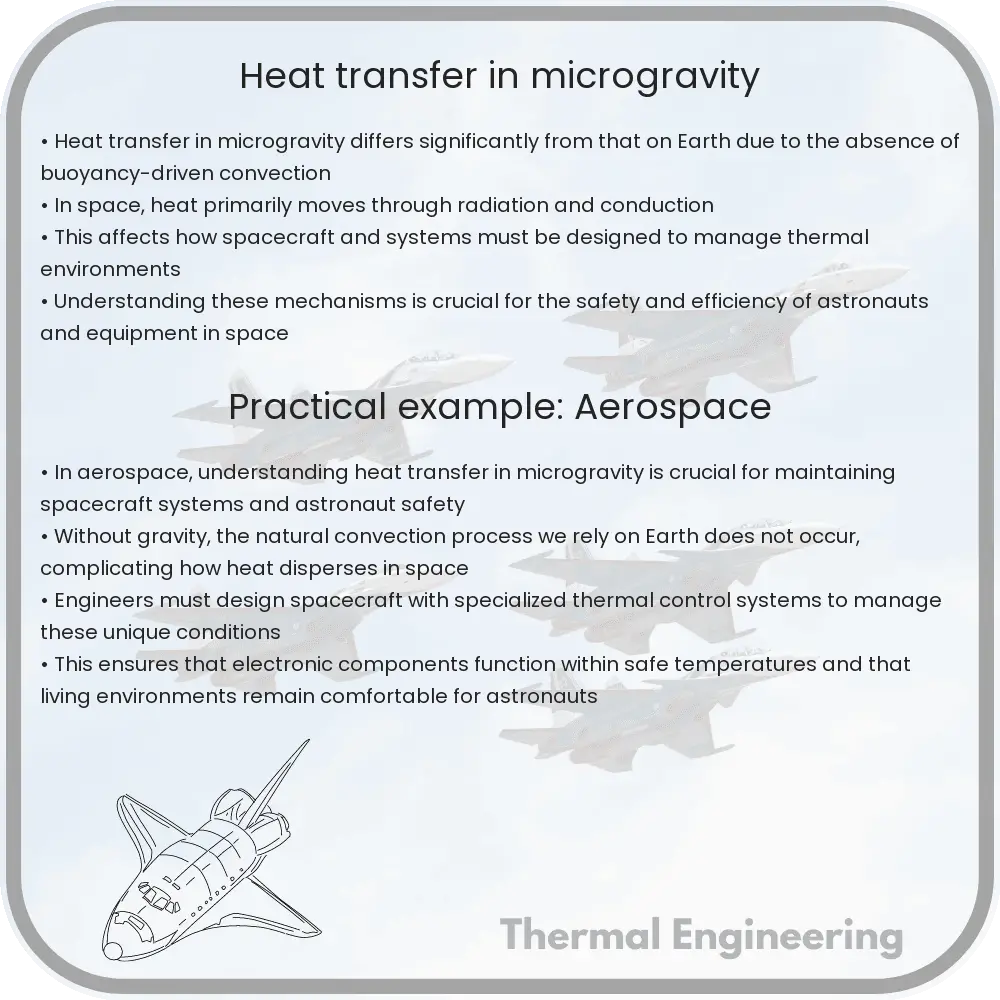
Understanding Heat Transfer in Microgravity
Heat transfer, a foundational concept in engineering, behaves differently in the microgravity environment of space compared to on Earth. This phenomenon affects everything from the life support systems on a spacecraft to the comfort of the astronauts. In this article, we’ll explore how heat transfer occurs in microgravity and some implications for space travel.
Basics of Heat Transfer
Heat transfer is the movement of thermal energy from one object or material to another. It can occur through three primary mechanisms: conduction, convection, and radiation.
- Conduction is the transfer of heat through direct contact between materials.
- Convection involves the movement of heat due to the motion of a fluid (which can be a gas or liquid) carrying heat with it.
- Radiation refers to heat transfer through electromagnetic waves such as infrared radiation.
In the context of Earth, convection plays a significant role in heat transfer, particularly in fluids. However, it relies on the effect of gravity on density variations within the fluid (hot fluid rises, cool fluid sinks), which is absent in microgravity environments.
Heat Transfer in Microgravity
Without the buoyancy-driven flow seen in gravity, convection as a mechanism is drastically reduced. This changes how engineers must approach cooling and heating systems in spacecraft. Instead, conduction and radiation become the primary modes of heat transfer.
- Conduction in Microgravity: Conduction remains largely unaffected by gravity. Thus, it continues to be a reliable method for managing heat within the direct contact between materials.
- Radiation in Microgravity: Radiation is also independent of gravity. Spacecraft often utilize radiation for both heat loss and gain, such as through the control of onboard systems and regulating temperature inside the spacecraft.
Without convection, spacecraft require alternative solutions to manage and distribute heat. For example, fans may be used in spacecraft to force air movement, simulating a convective heat transfer process.
Engineering Challenges
The unique behavior of heat transfer in microgravity poses several engineering challenges:
- Temperature Control: Engineers must design systems to avoid the accumulation of heat in certain areas, which can damage delicate electronics and create uncomfortable living conditions.
- Heat Dissipation: Devices that generate a lot of heat, such as computers and other electronic equipment, need special designs to ensure that the heat does not accumulate and negatively impact their operation or survival.
- Fluid Systems: Any fluid systems used in a spacecraft must be carefully designed to handle the lack of convective heat transfer, using pumps or fans to stimulate effective heat distribution.
Continued advancements in materials science and fluid dynamics in response to these challenges are essential for the future of human space exploration and the operation of unmanned spacecraft.
Conclusion
In microgravity, the typical behavior of heat transfer we observe on Earth does not apply, particularly with regards to convection. By focusing on conduction and radiation, and developing innovative solutions to stimulate forced convection, engineers can effectively manage thermal environments in space. The study and application of heat transfer in microgravity not only improve the safety and comfort of astronauts but also enhance the performance and lifespan of spacecraft systems.
This challenging yet fascinating aspect of space engineering continues to push the boundaries of what is technically feasible as humanity aims deeper into the cosmos.