Explore the dynamics of heat transfer in stratified flows, a key concept in thermofluid engineering affecting various industrial processes.
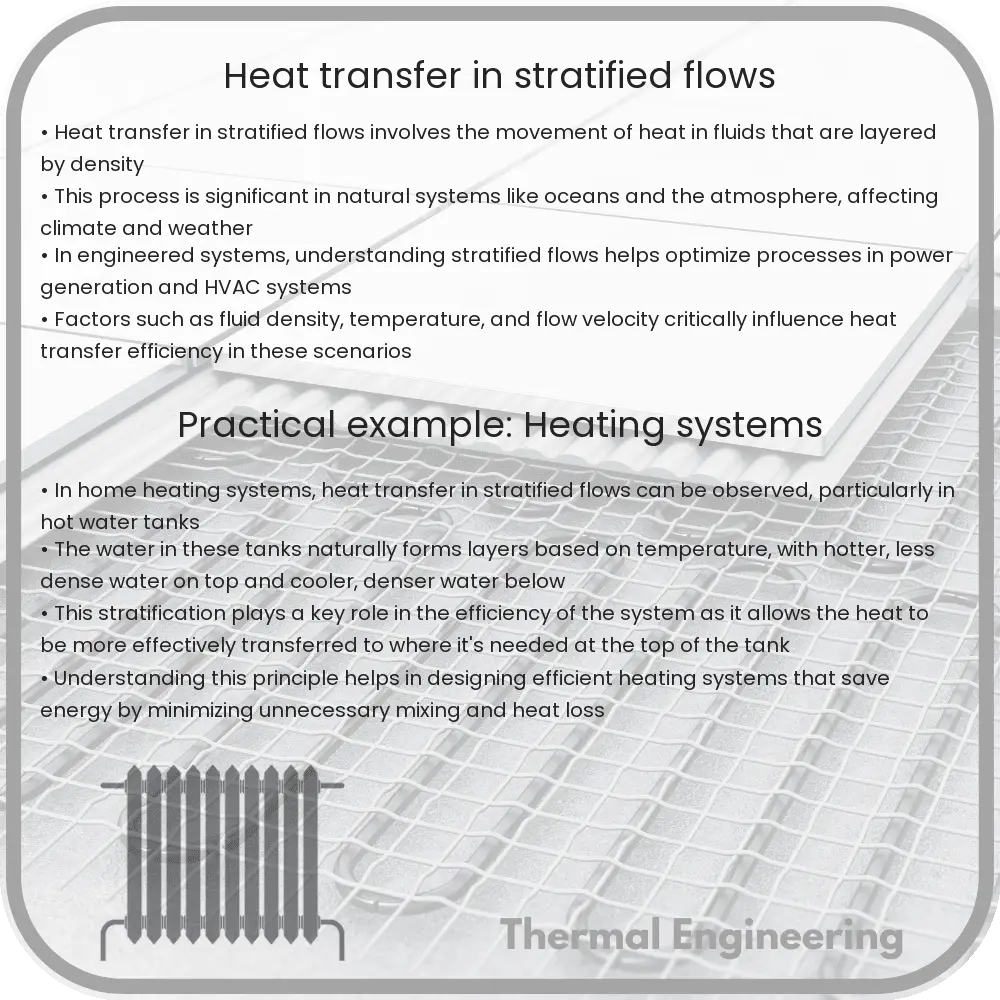
Understanding Heat Transfer in Stratified Flows
Heat transfer in stratified flows is a fascinating and complex topic within the field of thermofluid engineering. This process involves the movement of heat in a fluid that is not uniform in composition, often having layers of different densities due to temperature or concentration differences. These variations can significantly affect how heat is transported within the system. In this article, we will explore the basics of this phenomenon, its importance in various engineering applications, and the fundamental principles governing it.
What are Stratified Flows?
Stratified flows occur when a fluid develops layers that do not mix completely. These layers form due to differences in density, which can be induced by gradients in temperature or concentration of dissolved or suspended materials. In the context of heat transfer, stratification is critical because it influences how efficiently heat can move from one part of the fluid to another.
Key Principles of Heat Transfer in Stratified Flows
In any fluid flow situation, heat can be transferred through three primary mechanisms: conduction, convection, and radiation. In stratified flows, these processes interact in unique ways:
- Conduction: This is the heat transfer due to the thermal gradient within the material. It occurs across the temperature gradient from the hotter layer to the cooler layer.
- Convection: In stratified flows, convection is often suppressed due to the stable stratification that discourages fluid mixing. However, when it occurs, it can be either forced by external means (e.g., a pump or fan) or natural as a result of buoyancy effects triggered by the density differences.
- Radiation: Although less significant in fluids compared to solids, thermal radiation can also contribute to heat transfer, especially in semi-transparent fluids or at very high temperatures.
To quantify these mechanisms, engineers often rely on the heat transfer coefficient, a parameter that encapsulates the ability of the fluid layers to conduct heat. The overall effectiveness of heat transfer in stratified flows is also influenced by factors such as the thickness of the layers, the properties of the fluid, and the presence of any turbulence.
Mathematical Modelling of Heat Transfer in Stratified Flows
The mathematical description of heat transfer in stratified flows can be complex due to the nonlinear nature of the governing equations. However, the fundamental equation typically used is the heat diffusion equation, given as:
\[ \frac{\partial T}{\partial t} = \alpha \frac{\partial^2 T}{\partial x^2} \]
where:
- \( T \) is the temperature,
- \( t \) is time,
- \( x \) is the spatial coordinate, and
- \( \alpha \) is the thermal diffusivity of the fluid.
This equation may be modified or expanded based on the specific conditions, such as adding terms to account for convective effects or changes in fluid properties across the layers.
Applications of Heat Transfer in Stratified Flows
Understanding and controlling heat transfer in stratified flows is crucial in many industrial and environmental processes. Some key applications include:
- Environmental engineering, where stratified flows occur in bodies of water as a result of solar heating or pollutant dispersion.
- Energy systems, such as solar water heaters, where stratification can either enhance or impair the system’s efficiency.
- Chemical processing industries, where maintaining or disrupting stratification can affect reaction rates and product uniformity.
Each application demands specific strategies for managing heat transfer, tailored to the particular characteristics and requirements of the system.
Conclusion
Heat transfer in stratified flows presents both challenges and opportunities across various engineering fields. By understanding its fundamentals and how it affects system behavior, engineers can design more effective and efficient solutions tailored to the nuanced demands of applications involving stratified media. As such, the study of heat transfer in stratified flows remains a critical area of ongoing research and development.