Explore the critical role of hemodynamics in the design and function of artificial organs, focusing on blood flow dynamics and their engineering challenges.
Understanding Hemodynamics in Artificial Organs
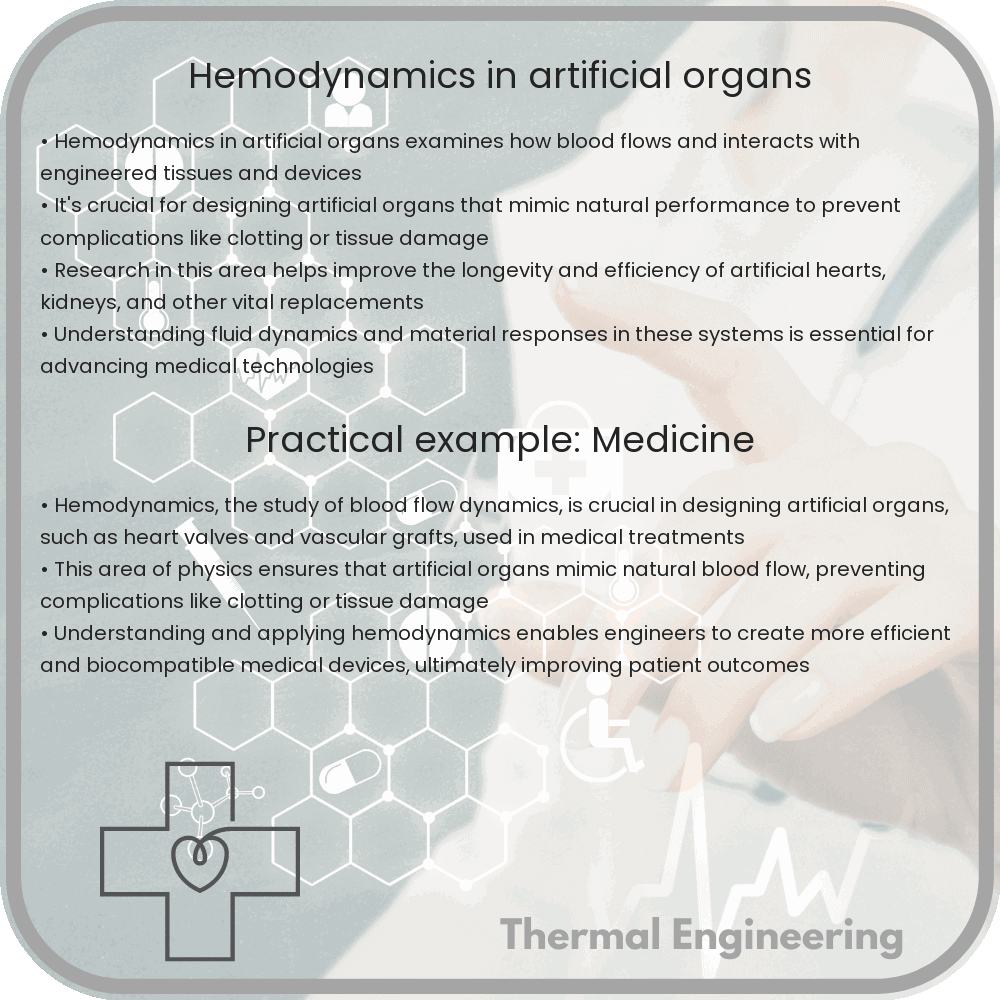
Hemodynamics, the study of blood flow and its principles, plays a critical role in the design and functioning of artificial organs. As the development of artificial organs such as hearts, kidneys, and lungs advances, understanding the intricacies of hemodynamics within these devices is essential for their success and integration into human physiology.
Principles of Hemodynamics
The basic principles of hemodynamics involve the dynamics of blood flow, pressure, and resistance. These factors are crucial in maintaining adequate and stable functioning in artificial organs. The equations governing hemodynamic principles, such as the continuity equation and Bernoulli’s equation, help engineers understand and predict the behavior of blood flow through artificial systems.
- Continuity Equation: A_{1} * v_{1} = A_{2} * v_{2}, where A is the cross-sectional area and v is the velocity of the blood flow. This equation asserts that blood flow (the product of area and velocity) is conserved along a streamline.
- Bernoulli’s Principle: P + 1/2 * ρ * v^2 + ρgh = constant, where P is the fluid pressure, ρ is the fluid density, v is the velocity of the fluid, g is the acceleration due to gravity, and h is the height above a reference point. This principle helps in understanding the pressure changes in flowing blood.
Challenges in Designing Artificial Organs
One of the major challenges in designing artificial organs is mimicking the natural conditions as closely as possible. Artificial organs must handle the mechanical and biological responses of blood, such as viscosity and flow rates, without causing damage to blood cells or inducing clotting.
- Material Compatibility: Materials used in artificial organs must be biocompatible and durable. They must not trigger immune reactions or cause thrombosis (clotting).
- Shear Stress: Artificial organs must minimize shear stress, which can damage blood cells and activate clotting pathways. Engineers need to optimize the geometry and surface conditions of these devices to reduce turbulent flows.
Role of Hemodynamics in Artificial Heart Design
The design of artificial hearts is one of the most complex applications of hemodynamics. These devices need to replicate the pumping action of the natural heart. Key considerations include:
- Rate of blood flow: The artificial heart must be able to pump blood at a rate comparable to that of the natural heart, typically about 5 liters per minute for an adult under resting conditions.
- Pressure gradients: Proper pressure gradients must be maintained to ensure that blood can be delivered to all parts of the body effectively.
- Energy efficiency: The device should consume minimal power, thus reducing the burden on battery life and improving patient mobility.
Future of Hemodynamics in Artificial Organ Research
Advances in computational fluid dynamics (CFD) and materials science are pushing the boundaries of what is possible in the field of artificial organs. By simulating blood flow, pressure, and interaction with various materials, researchers can iterate designs rapidly and with high precision. Innovations such as 3D printing and nanotechnology are set to play significant roles in creating more efficient and patient-friendly artificial organs.
In summary, understanding and applying the principles of hemodynamics is crucial for the development of successful artificial organs. Through careful consideration of fluid dynamics, material science, and biological interactions, engineers and researchers are making significant strides in creating devices that can one day seamlessly replace their biological counterparts.