Learn how airfoils, through unique shapes and airflow principles, create lift essential for aircraft flight and other aerodynamic applications.
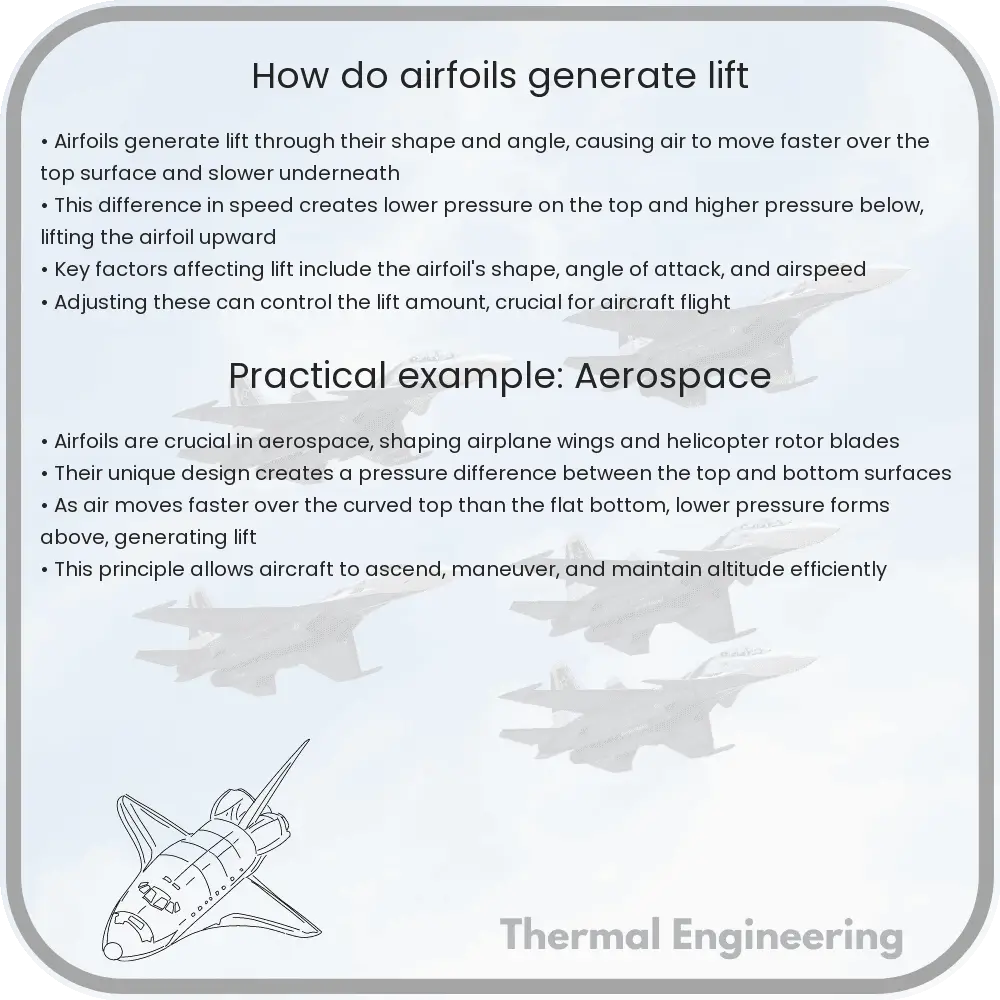
How Do Airfoils Generate Lift?
Lift is a fundamental concept in aerodynamics that allows an aircraft to rise and remain aloft. One of the key components responsible for generating lift is the airfoil, a specially shaped wing or blade. This article explores how airfoils generate lift, focusing on the principles of their design and the physics involved.
The Shape of Airfoils
Airfoils are designed with a particular shape that has a rounded leading edge, followed by a sharp trailing edge, and a characteristic asymmetry in the curved surfaces top and bottom. This shape is crucial because it affects how air moves over and under the wing, which in turn impacts the lift produced.
Principle of Airflow and Pressure Distribution
The key to understanding lift lies in the behavior of the airflow around the airfoil and the resultant pressure distribution. According to Bernoulli’s principle, an increase in the speed of a fluid (in this case, air) occurs simultaneously with a decrease in pressure. Here’s how this principle works in the context of an airfoil:
- Camber and Angle of Attack: Airfoils have a cambered or curved shape, and they are positioned with a certain angle of attack in relation to the incoming air. The angle of attack is the angle between the chord line (a straight line connecting the leading and trailing edges of the airfoil) and the oncoming air.
- Faster Airflow Over the Top Surface: As air splits at the leading edge of the airfoil, the flow that goes over the top experiences a longer, curved path. To meet up with the air flowing beneath the wing at the trailing edge, the air on top must travel faster.
- Lift from Pressure Differences: According to Bernoulli’s principle, the faster air on top of the wing creates a lower pressure than the slower air flowing beneath the wing. The higher pressure beneath the wing as compared to the pressure above the wing generates a net upward force — lift.
The Effect of Coefficient of Lift (CL)
The Coefficient of Lift (CL) is a dimensionless number that quantifies the lift produced by an airfoil at a given angle of attack. This coefficient is influenced by factors like airfoil shape, air density, and airspeed. The lift force (L) can be calculated with the equation:
\[ L = C_L \times \frac{1}{2} \rho v^2 S \]
where:
- \( \rho \) (rho) is the air density
- \( v \) is the velocity of the air
- \( S \) is the wing area
Stall and Angle of Attack
While increasing the angle of attack generally increases the lift up to a point, beyond a certain angle, the smooth airflow over the wing breaks down, and the wing stalls, rapidly losing lift. This phenomenon is crucial for understanding the limitations of airfoil performance in various flying conditions.
Real-World Applications
Airfoils not only enable airplanes to fly, but they are also used in other applications such as turbomachinery, where blades in a turbine or compressor function similarly to lift-generating wings. Their principles are also employed in designing efficient sails for boats and aerodynamic components for cars like spoilers, which manage airflow to reduce unwanted lift and increase traction.
Understanding how airfoils generate lift is essential not only for aerospace engineers but also for anyone interested in the principles of flight and aerodynamics. By exploring these concepts, innovations in design and functionality continue to evolve, enhancing the efficiency and capabilities of various flying and aerodynamic devices.