Learn how thermal imaging goggles use infrared radiation to allow vision in the dark and their applications across various fields.
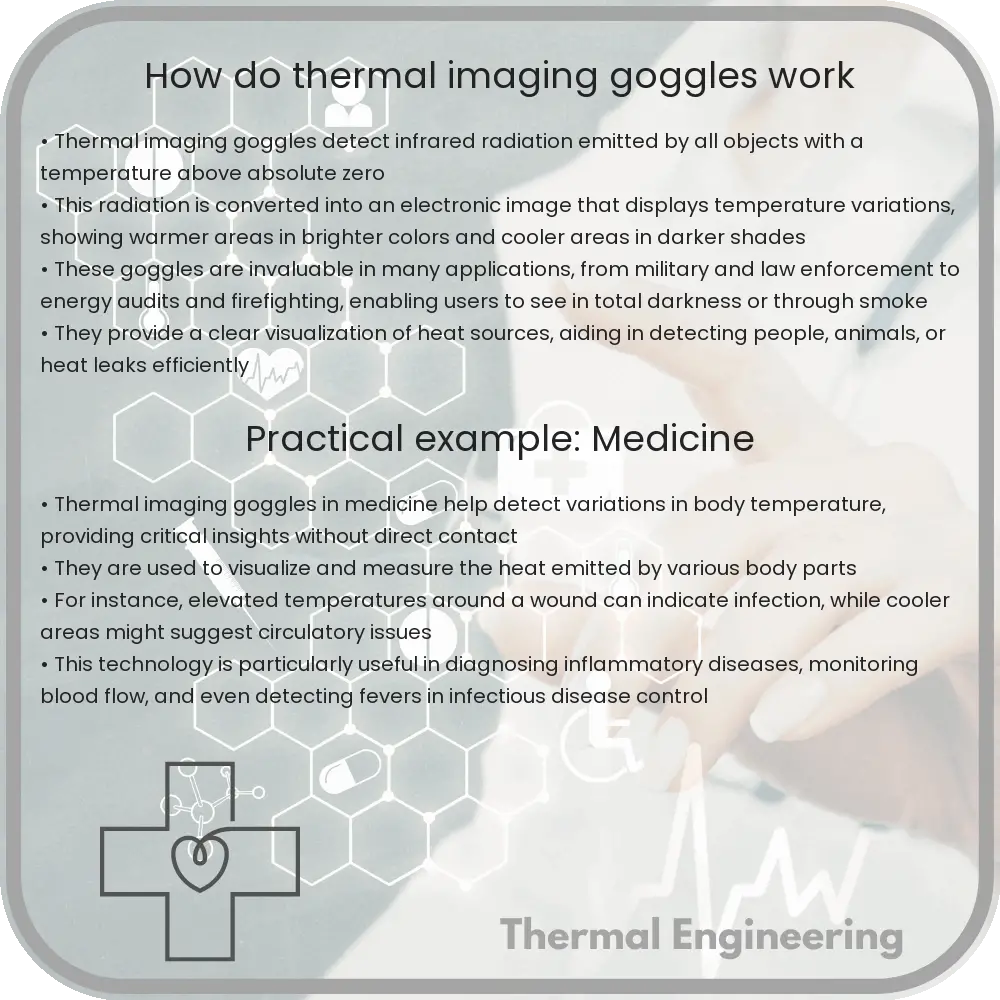
Understanding Thermal Imaging Goggles
Thermal imaging goggles are a fascinating piece of technology that allow users to see variations in temperature in their environment, effectively providing vision in the dark. These devices are particularly useful in various fields such as military operations, firefighting, and wildlife observation. To understand how thermal imaging goggles work, it’s important to grasp some basic concepts of infrared radiation and thermal detection.
Key Components
The functionality of thermal imaging goggles depends heavily on their core components, which include an infrared sensor, a signal processing unit, and a display system. Here is how they collaborate to create a thermal image:
- Infrared Sensor: At the heart of thermal imaging goggles is the infrared sensor. This sensor is designed to detect infrared energy (heat) emitting from objects in the vicinity. Different materials and temperatures emit different levels of infrared radiation.
- Signal Processing Unit: The infrared sensor captures raw thermal data, which consists of various levels of infrared radiation. This raw data is then processed by the signal processing unit, which translates it into a usable format, typically a digital image.
- Display System: Once the signal is processed, the thermal image is displayed to the user through an eyepiece or a screen. This image often appears in different colors representing various temperatures. Typically, warmer objects are depicted in reds and oranges, while cooler objects appear in blues and purples.
Principles of Operation
The core principle behind thermal imaging is the detection of infrared radiation. All objects emit some level of infrared radiation as a function of their temperature, according to the Stefan-Boltzmann law, which can be expressed as:
P = σ * A * T4
Where:
- P is the power radiated per unit area,
- σ (sigma) is the Stefan-Boltzmann constant (approximately 5.67 x 10⁻⁸ W/m2•K4),
- A is the surface area, and
- T is the absolute temperature in Kelvin.
As infrared radiation is generally invisible to the human eye, thermal imaging devices convert this radiation into a visible light spectrum image. This conversion is facilitated through the use of thermographic cameras within the goggles. These special cameras detect infrared radiation and create an image known as a “thermogram”. The thermogram is then transformed into electric impulses, interpreted by the goggles’ processor, and rendered as a visual image.
Applications of Thermal Imaging Goggles
Thermal imaging technology has a wide array of applications:
- Military and Law Enforcement: In covert operations and night-time surveillance, thermal imaging helps personnel detect hidden objects or individuals in complete darkness or through smoke-filled environments.
- Firefighting: Firefighters use thermal imaging goggles to see through smoke, allowing them to locate the bases of fires, find trapped individuals, and navigate burning structures safely.
- Wildlife Observation: Wildlife researchers utilize thermal imaging to study nocturnal animals, helping them observe these creatures without disturbing them or affecting their natural behavior.
- Building Inspection: Thermal imaging can be used to identify heat leaks in buildings, particularly around windows and doors, making it a useful tool for energy efficiency assessments.
In conclusion, thermal imaging goggles represent a powerful tool which leverages the physics of infrared radiation. By converting invisible heat energy into a visual display, these goggles provide invaluable assistance in a range of professional and recreational fields, enhancing both safety and efficiency.