Explore the efficient heat transfer capabilities of heat pipes, focusing on their structure, the mechanism of heat movement, and applications.
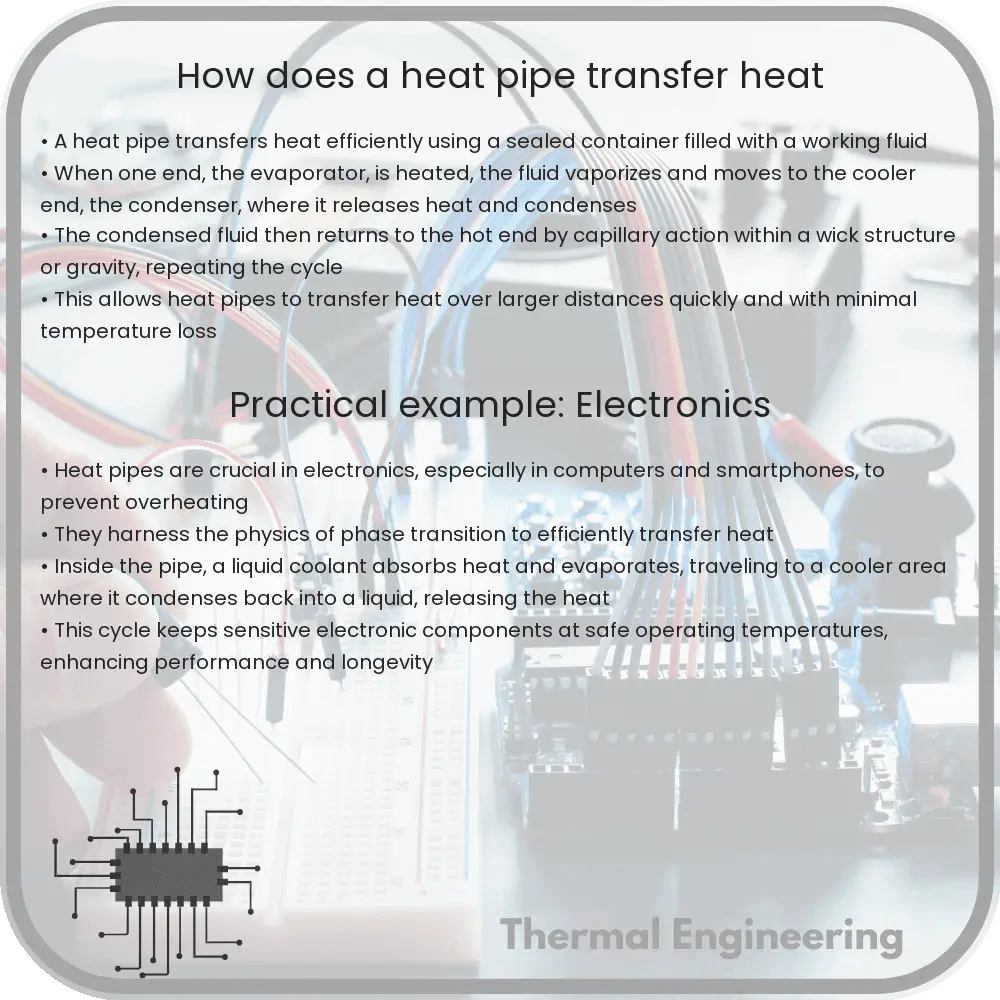
Understanding Heat Pipes and Their Heat Transfer Mechanism
Heat pipes are a highly efficient type of heat transfer equipment that are used to transport heat over relatively long distances with minimal temperature drop. They are commonly found in electronics cooling, air conditioning systems, and space applications. The operation of a heat pipe is based on the principles of thermodynamics and fluid mechanics.
Basic Structure of a Heat Pipe
A heat pipe typically consists of three main components:
- The Envelope: This is the outer shell of the heat pipe, usually made of materials with good thermal conductivity like copper or aluminum.
- The Wick Structure: Located inside the envelope, this structure acts like a capillary pumping mechanism, transporting liquid from colder areas (the condenser) back to warmer areas (the evaporator).
- The Working Fluid: Chosen based on the operational temperature range of the heat pipe, the fluid undergoes phase changes (evaporation and condensation) within the pipe to transfer heat.
How Heat Pipes Transfer Heat
Heat pipes operate on a simple yet effective principle involving two primary physical processes: evaporation and condensation. Here’s a step-by-step explanation:
- Heat Absorption: At the evaporator section, which is the heat input source, working fluid inside the wick absorbs heat. This causes the fluid to evaporate, transforming from a liquid to a vapor phase.
- Vapor Movement: The generated vapor, which now carries the absorbed heat energy, travels through the hollow center of the heat pipe towards the cooler end known as the condenser section.
- Heat Release: Upon reaching the condenser, the vapor condenses back into a liquid form, releasing the transported heat to the cooler environment outside the heat pipe.
- Liquid Return: The condensed liquid is then drawn back to the evaporator through the wick structure by capillary action, ready to absorb more heat and restart the cycle.
The efficiency of heat pipes lies in their ability to transfer large amounts of heat with very small temperature differences between the heat source and the sink. This is primarily due to the latent heat of vaporization, which is much greater than the sensible heat capacity of the working fluid. Theoretically, the amount of heat transferred, Q, can be described by the equation:
Q = mL
where:
- m is the mass flow rate of the vapor,
- L is the latent heat of vaporization of the working fluid.
Applications and Advantages
Heat pipes offer several advantages over traditional heat transfer methods, including:
- High thermal conductance,
- Ability to transfer heat over considerable distances without substantial energy loss,
- Uniform temperature distribution across the length of the pipe,
- Reliability and maintenance-free operation due to the lack of moving mechanical parts.
These properties make heat pipes a valuable component in modern engineering designs, particularly where efficient heat management is crucial, such as in high-performance electronic devices, satellite technology, and renewable energy systems.
In summary, heat pipes are fascinating devices that utilize the physics of phase change and capillary action to efficiently manage heat in a variety of applications. Their ability to operate under different orientations and across varying temperature ranges while maintaining high efficiency and reliability makes them integral to modern thermal management solutions.